Description
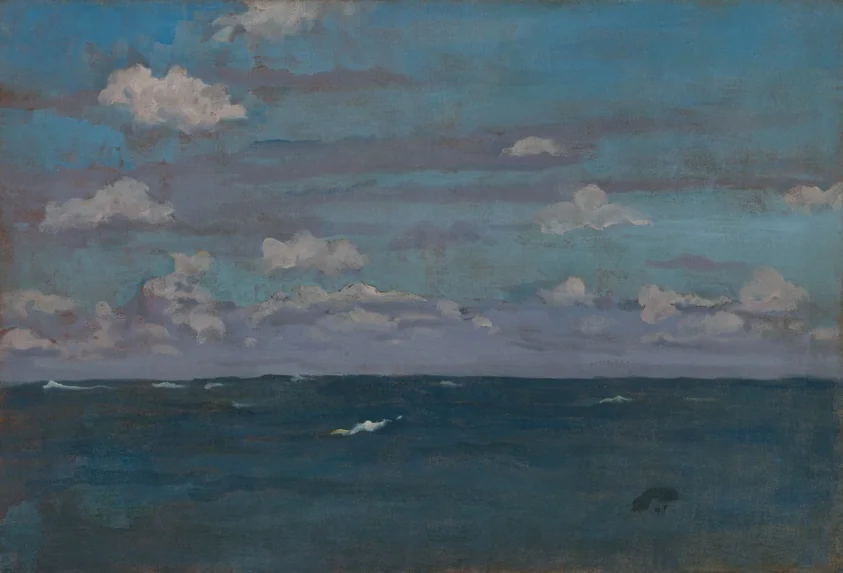
After years of painting seascapes on a significantly smaller scale, James McNeill Whistler returned briefly to a large-format canvas to capture a hot summer day on the water near Brittany, France. The artist likely painted this seascape while boating off the coast as a crewman steadied their vessel. This could account for the unusually broad handling of paint and thick touches of pigment apparent throughout the composition, particularly in the clouds and gently cresting waves. Here, Whistler demonstrated his enduring passion for the myriad relationships of color offered by the ever-changing sea.
Provenance
James McNeill Whistler, London and Paris, 1893; sold to John A. Lynch (1853–1938), Chicago, 1894 [inscribed on verso of painting: “Exhibited in salon of the / Champ de Mars. 1894 / & / bought in my Studio, Paris / in October of that year by / John A. Lynch, of Chicago. / J. McNeill Whistler.”]; bequeathed to his wife, Clara Margaret Lynch (1872–1954), Chicago, 1938; Estate of Clara Margaret Lynch, Chicago, 1954; given to the Art Institute of Chicago, 1955.
Accession Number
84088
Medium
Oil on canvas
Dimensions
50.2 × 73.3 cm (19 3/4 × 28 7/8 in.)
Classification
Painting
Credit Line
Gift of Clara Margaret Lynch in memory of John A. Lynch
Background & Context
Background Story
"Violet and Silver—The Deep Sea" is one of Whistler's most exquisite late Nocturnes, painted in 1893 when the artist was living in Paris and exploring the color possibilities of the sea with a freedom that his earlier, more restrained tonality had barely anticipated. The composition is extraordinarily simple: a horizontal band of violet-gray water beneath a pale silver sky, with the faintest suggestion of a distant horizon that separates the two tonal fields. The palette is restricted to cool violet, silver gray, and the palest suggestions of green, creating an atmosphere of twilight mystery that avoids every trace of narrative or topographical specificity. This abstraction of the sea into pure color was unprecedented in marine painting: Turner had dissolved ships into storms, but Whistler dissolves even the idea of the sea into optical sensation. The canvas size—barely 50 × 73 centimeters—makes the work intimate rather than monumental, a private meditation rather than a public declaration. The brushwork is thin and layered, with glazes of translucent color that allow earlier layers to shine through, creating a depth that contradicts the surface flatness. Art historians have linked this work to the Symbolist movement with which Whistler was increasingly associated in his Paris years, particularly the musically titled paintings of Odilon Redon and the Nocturnes of Debussy. The painting also reflects Whistler's deteriorating health: in 1893 he was suffering from the heart condition that would kill him three years later, and the late Nocturnes have been read as premonitions of the night that was closing around him. In the broader history of abstraction, the canvas stands as evidence that landscape could disappear entirely into color decades before Kandinsky's first improvisations.
Cultural Impact
This late Nocturne anticipated pure color abstraction by a decade, dissolving the sea into violet-silver optical sensation while reflecting Symbolist musical aesthetics and the artist's own mortality.
Why It Matters
It matters because Whistler painted the sea until it vanished—proving that a horizon could be just a rumor between violet and silver.