Accession Number
2848
Medium
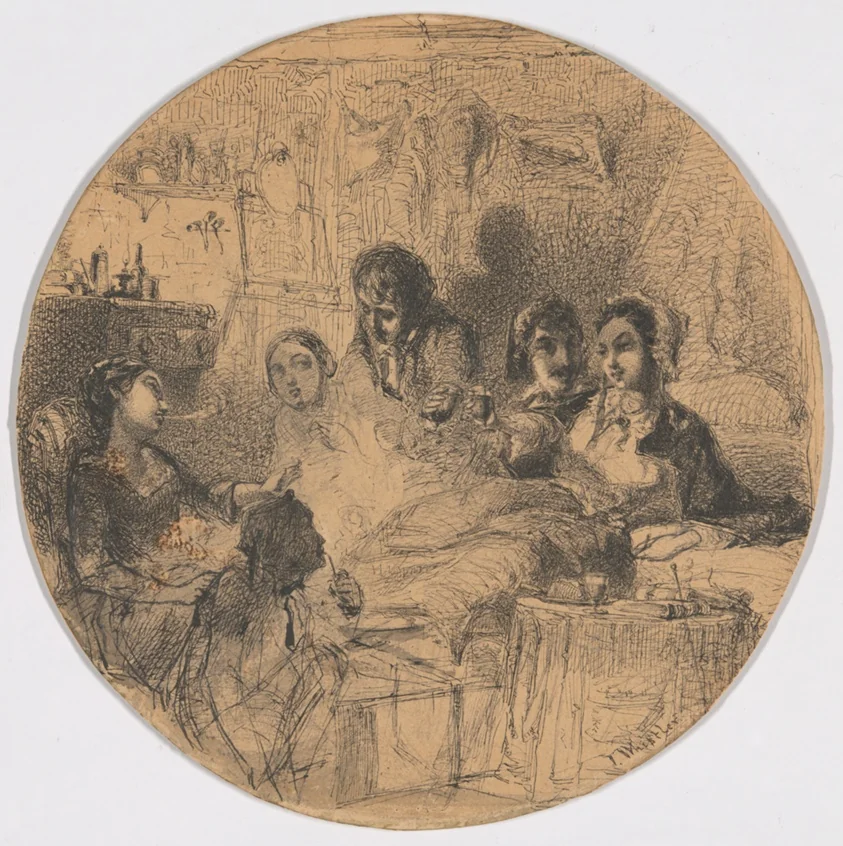
Pen and black ink and black watercolor over graphite, with touches of white opaque paint (discolored), on tan laid paper laid down on cream board
Dimensions
22.4 × 24 cm (8 7/8 × 9 1/2 in.)
Classification
pen and ink drawings
Credit Line
Gift of John F. O'Connell
Background & Context
Background Story
This early drawing, executed between 1855 and 1857, is one of the most revealing documents of Whistler's formative years in Paris, when the young American was immersing himself in the bohemian culture of the Left Bank and absorbing the influence of Courbet's realism and Japanese print design. The scene shows a group of figures in an interior—probably a café or artist's studio—rendered in pen and black ink with watercolor washes over graphite. The composition is informal and cropped, suggesting a fleeting moment observed from life rather than a staged tableau. Whistler's line is already confident, the pen strokes ranging from fine detail to broad, almost calligraphic gestures that describe clothing, furniture, and spatial depth with economical grace. The subject matter—bohemian life—was standard for aspiring artists in 1850s Paris, but Whistler's treatment avoids the romantic clichés of literary illustration in favor of direct observation. The touches of white opaque paint on tan paper create highlights that suggest light sources within the interior, a technique he learned from studying Dutch seventeenth-century drawings. This sheet also reveals Whistler's social ambitions: even as he lived in near-poverty, he was cultivating the persona of the elegant flâneur, documenting the lives of his fellow artists with the detachment of an anthropologist. The drawing belongs to the pre-history of Japonisme, the European fascination with Japanese art that would shape Whistler's mature style; the flattened space and decorative cropping already suggest the influence of Hiroshige's prints, which he was collecting at this period.
Cultural Impact
This early Paris drawing documented Whistler's Left Bank apprenticeship, combining Courbet's realism with Japanese-influenced cropping that foreshadowed his mature Japoniste style.
Why It Matters
It matters because a young American in Paris drew his poor friends like they were heroes—proving that bohemia was itself a subject worthy of art.