Provenance
Sold by Kennedy Gallery, New York, to Walter S. Brewster (1872-1954), Chicago, November, 1916 [Chicago 1917, Mr. Brewster's annotated copy of his exh. cat.] [stamp (Lugt 2651 a-b), verso, lower left, in blue]; given to the Art Institute, February 1933.
Accession Number
14523
Medium
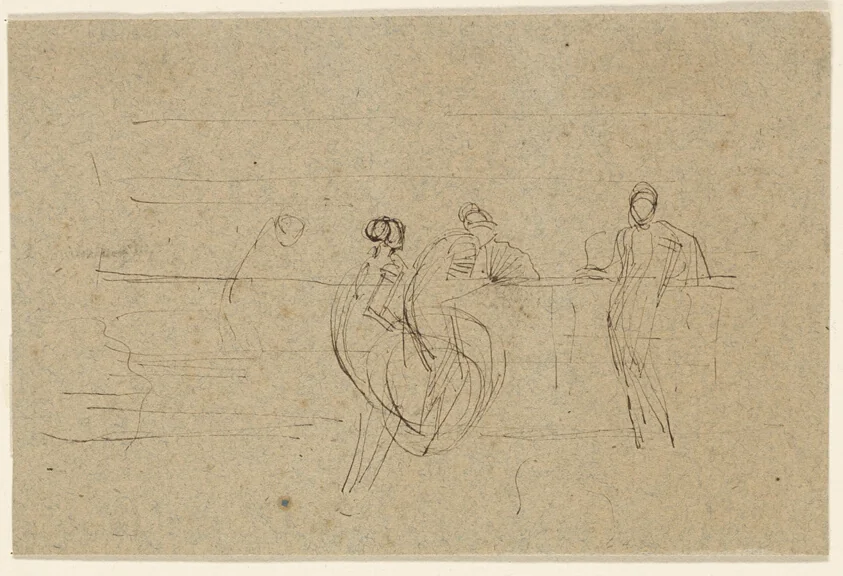
Pen and brown ink on blue laid paper (discolored)
Dimensions
8.6 × 12.9 cm (3 7/16 × 5 1/8 in.)
Classification
pen and ink drawings
Credit Line
Gift of Walter S. Brewster
Background & Context
Background Story
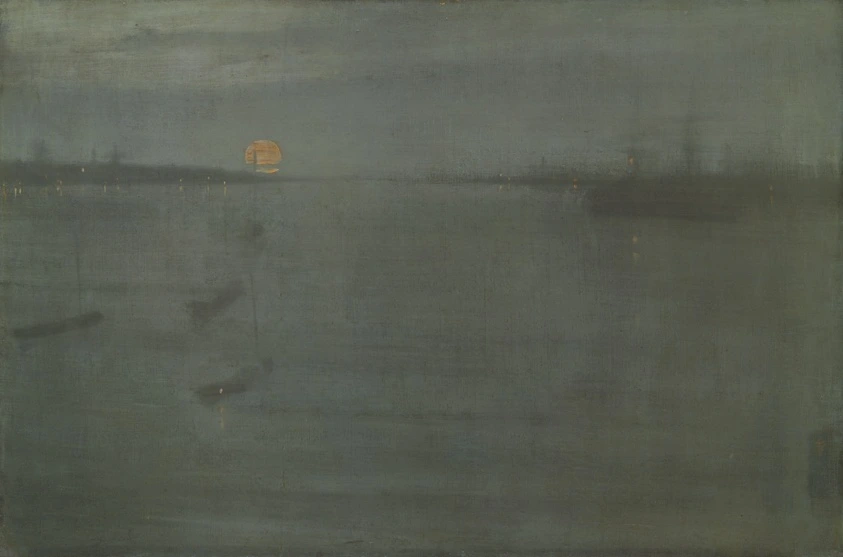
James McNeill Whistler's Figures by a Railing (1870/73) is a pen and brown ink drawing on blue laid paper, showing figures gathered by a railing, perhaps on a balcony, a bridge, or a waterfront. The blue paper gives the drawing a distinctive cool tonality that suits the outdoor setting. Whistler's pen and ink technique is fluid and economical, the figures suggested with rapid strokes that capture their poses and relationships without excessive detail. The brown ink on blue paper creates a harmonious, restrained effect. This drawing dates from the period when Whistler was at the height of his powers, producing the works that would establish him as one of the most innovative artists of the 19th century. The subject of figures by a railing, perhaps looking out over water, anticipates the atmospheric harbor scenes and nocturnes for which he is best known. The drawing's economy and its sensitivity to atmosphere mark it as a work of Whistler's artistic maturity.
Cultural Impact
Whistler's drawings of figures in urban settings document the social life of the 19th-century city, capturing moments of public leisure and observation.
Why It Matters
This ink drawing of figures by a railing captures a moment of urban leisure with Whistler's characteristic economy, the blue paper adding a distinctive atmospheric quality.