Description
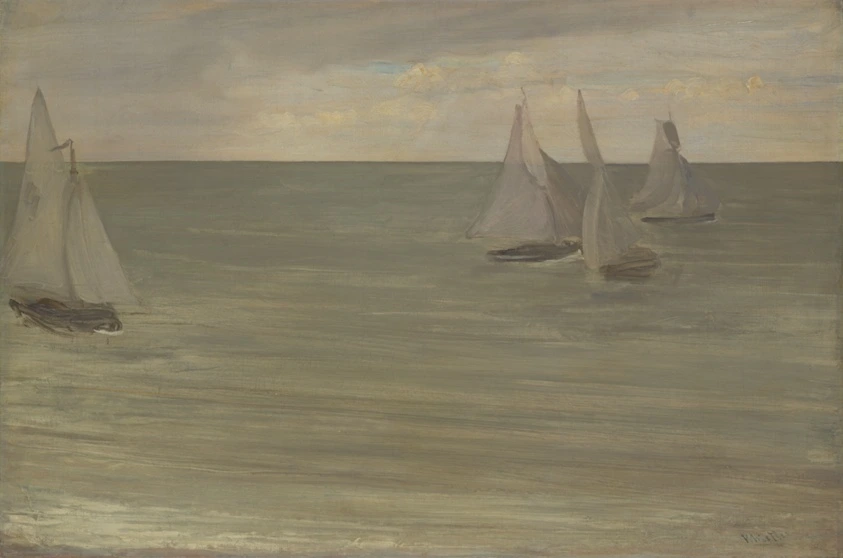
In the early 1860s, James McNeill Whistler began to develop an art-for-art’s-sake aesthetic, eschewing narrative or naturalistic details to focus more intently on formal concerns. In 1865 the artist traveled to Trouville, a French resort town, where he painted with Gustave Courbet and experimented with a series of increasingly simplified seascapes. The high horizon line and broad expanses of muted color in this spare composition reveal Whistler’s interest in Japanese woodblock prints. The sweeping, horizontal brushstrokes and restrained palette, limited to pale greens and soft grays, reinforce the painting’s innovative, flattened perspective.
Provenance
Mrs. Charles W. Deschamps (Christina Deschamps, born Dodds, 1845–1926), London, by November 1873 [lent to London 1873]; sold back to the artist, April 1891 [letter from Charles W. Deshamps to James McNeill Whistler, dated April 8, 1891, GUW 00803]; consigned to Boussod, Valadon & Cie/Goupil Gallery, Paris, by July 1892 [letter from David Croal Thomson to James McNeill Whistler, dated July 12, 1892, GUW 05753; letter from Whistler to Thomson, July 1892, GUW 08332; and letter from Thomson to Whistler, dated July 23, 1892, GUW 05754]; sold to Théodore Duret (1838–1927), Paris, 1892; consigned to Thomas Agnew & Sons, London, by July 1901; sold to Mrs. Potter Palmer (Bertha Palmer, born Honoré, 1849–1918), Chicago, July 1901 [according to Young, MacDonald, Spencer, and Miles 1980; lent to Boston 1904 and Paris 1905]; by descent to her sons, Honoré Palmer (1874–1964) and Potter Palmer II (1875–1943), 1918; given to the Art Institute of Chicago, 1922.
Accession Number
81572
Medium
Oil on canvas
Dimensions
51.5 × 77.2 cm (20 1/4 × 30 3/8 in.)
Classification
Painting
Credit Line
Gift of Honoré and Potter Palmer
Background & Context
Background Story
Painted in 1865 at Trouville, the fashionable Normandy resort where Courbet and Boudin had already established a tradition of seaside painting, this canvas represents Whistler's contribution to the marine genre during his brief French sojourn of the mid-1860s. The composition is extraordinarily simple: a horizon line dividing gray-green sea from pale sky, with a few sailboats visible in the middle distance and a darker foreground strip of beach or jetty. The palette—gray, green, silver—belongs to the same tonal family as the Battersea nocturnes, but here applied to daylight and open air rather than urban dusk. Whistler's brushwork is freer than in his studio portraits, with broad horizontal strokes that suggest water movement without describing it. The title's musical structure—"Grey and Green, the Silver Sea"—continues his program of replacing descriptive titles with color harmonies, asserting that the painting's subject is not Trouville but the optical experience of looking at sea and sky. This theoretical position influenced the development of landscape painting in both Europe and America, particularly the coastal scenes of Winslow Homer and the tonalist landscapes of the American Northeast. The painting also documents Whistler's artistic friendships in France: he was staying near Courbet's studio, and the broad handling and restricted palette show the influence of the French realist's seascapes. Yet Whistler's treatment is more atmospheric than Courbet's, less concerned with the physical weight of water and more interested in its capacity to reflect and dissolve light. The canvas thus stands as a bridge between French realism and the aestheticism that would dominate British art in the following decades.
Cultural Impact
This Normandy seascape bridged French Realism and British aestheticism, using musical titling and tonal restraint to transform marine landscape from topography into pure optical sensation.
Why It Matters
It matters because Whistler made the sea into a silver chord—gray and green and nothing else, yet somehow everything.