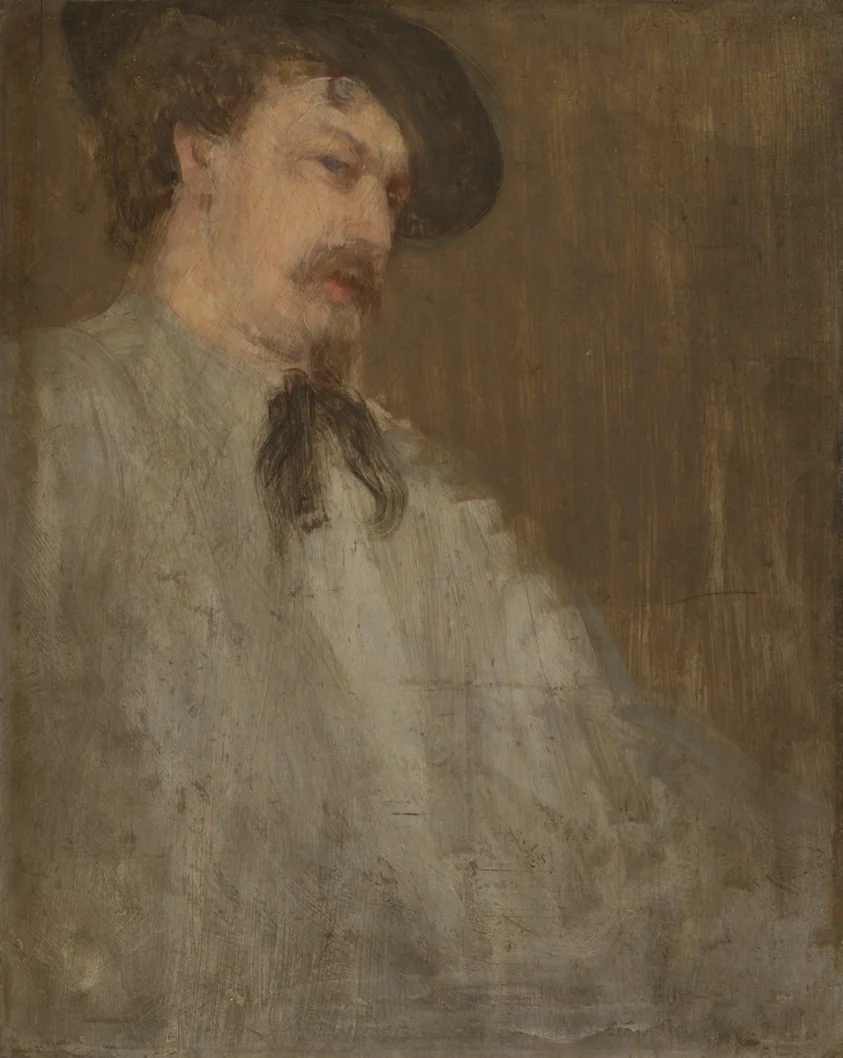
Portrait of Dr. William McNeill Whistler

Description

Born in Massachusetts, James McNeill Whistler lived all of his adult life in Europe, working in artistic centers such as Paris, London, and Venice. Whistler painted this portrait of his brother William in London, where both of them then lived; the artist had established a studio there in 1859. Having served as a medical officer for the Confederate Army, Dr. William McNeill Whistler moved to the city after the Civil War and was a respected physician. Whistler modeled his brother’s face with some degree of detail, yet also employed broad brushstrokes of thinly applied paint to merely suggest the sitter’s dress, which blends into a background of flat color.

Provenance

c. 1873-February 27, 1900, probably William McNeil Whistler, London (gift from the artist); February 27, 1900-unknown, Mrs. William McNeill Whistler, his widow, London. Unknown-October 19, 1918, Burton Mansfield, New Haven, Conneticut; October 19, 1918-January 28, 1919, Vose Galleries, Boston; January 28, 1919-unknown, William T. Cresmer, Chicago. Dates unknown, Anderson Art Galleries, Chicago. Unknown-December 22, 1935, Mrs. Moses J. Wentworth, Chicago; December 22, 1935-June 20, 1958, Mr. and Mrs. John Wentworth, Chicago; June 20, 1958-July 1977, Mrs. John Wentworth, Chicago and Paris; July 1977-November 1, 1977, estate of Mrs. John Wentworth; given to the Art Institute of Chicago.

Portrait of Dr. William McNeill Whistler

James McNeill Whistler

1871–73

Accession Number

111478

Medium

Oil on panel

Dimensions

43.7 × 34.8 cm (17 3/16 × 13 11/16 in.)

Classification

Painting

Museum

The Art Institute of Chicago

Chicago, United States

Credit Line

Gift of Mary T. Wentworth in memory of her husband, John
Background & Context

Background Story

"Portrait of Dr. William McNeill Whistler" is one of the most intimate family portraits by James McNeill Whistler, painted between 1871 and 1873 during the period when he was establishing the tonal aesthetic that would define his mature career. The sitter was his own father, a physician and devout Christian whose moral seriousness and aesthetic conservatism stood in sharp contrast to his son's bohemian lifestyle and avant-garde ambitions. The composition is a small panel—barely 44 × 35 centimeters—showing the elderly doctor in three-quarter view against a dark, neutral background, his face emerging from the surrounding gloom with the same tonal subtlety that Whistler was simultaneously applying to his more famous portraits of celebrities and collectors. The palette is restricted to blacks, warm grays, and the pale flesh tones of old age, creating a luminosity that makes the small image feel like a devotional object rather than a mere likeness. Whistler's brushwork is extraordinarily refined on the panel support: the smooth surface allows seamless blending that makes the transitions between light and shadow almost imperceptible, the technique he called "arrangement" rather than painting. The portrait also documents the complex relationship between father and son: Dr. Whistler had never fully approved of his son's artistic career, yet he sat for this portrait with the patient dignity that Whistler demanded from all his sitters. Art historians have compared this work to the famous "Arrangement in Grey and Black No. 1" (Whistler's Mother), noting that both portraits explore the theme of filial piety through tonal restraint and compositional simplicity. The painting also reflects Whistler's social ambitions: even as he scandalized London with his unconventional behavior, he was painting his family with the same gravity he brought to duchesses and industrialists, asserting that his own origins were worthy of artistic immortality.

Cultural Impact

This 1871–73 panel portrait translated filial complexity into tonal devotional object, using seamless panel blending to make family gravity equal to aristocratic commission in Whistler's emerging aesthetic.

Why It Matters

It matters because Whistler painted his father like he was a saint in shadow—proving that even disapproval could become art if the greys were patient enough.