Provenance
The artist to John Ross Key [Chicago Times Herald 1896]. Charles Deering (1852–1927), Chicago [stamp (Lugt 516) verso, lower right, in blue]; by descent to his daughters, Mrs. Chauncey McCormick (née Marion Deering; 1886–1965), Chicago and Mrs. Richard Ely Danielson (née Barbara Deering; 1885–1957), Chicago; given to the Art Institute of Chicago, 1927.
Accession Number
50743
Medium
Pen and black ink over graphite on cream wove paper
Dimensions
8.2 × 5.6 cm (3 1/4 × 2 1/4 in.)
Classification
pen and ink drawings
Credit Line
The Charles Deering Collection
Background & Context
Background Story
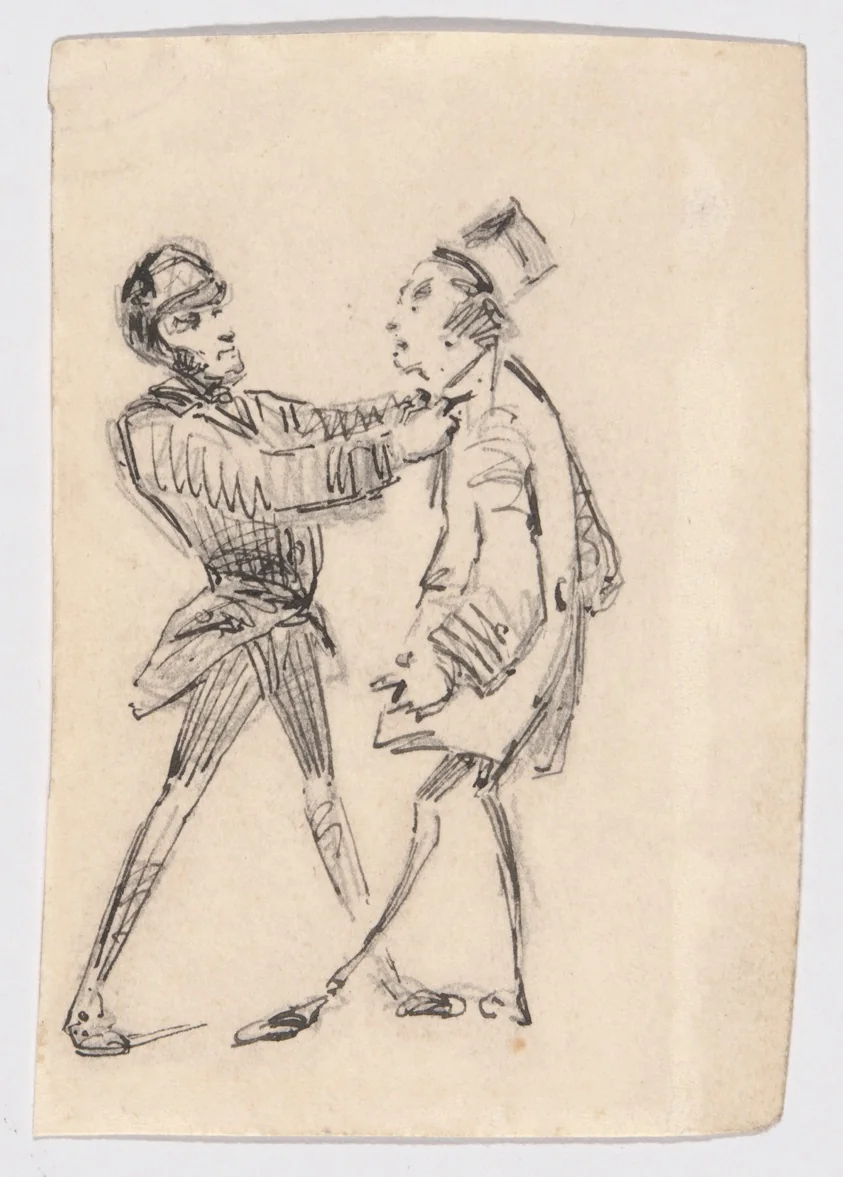
James McNeill Whistler's Policeman and Citizen (1854/55) is a pen and black ink drawing over graphite on cream wove paper, showing an interaction between a policeman and a civilian. This drawing introduces a narrative element into Whistler's series of street studies: the two figures are engaged in some kind of exchange, perhaps a request for directions, a warning, or a moment of everyday social interaction. Whistler's treatment captures the relationship between the two figures, their postures and gestures suggesting the nature of their encounter. The pen and ink technique is rapid and expressive, the lines capturing the essential character of each figure. The cream wove paper provides a warm ground. This drawing, like the others in the series, demonstrates Whistler's early interest in the life of the streets and his ability to capture the drama of everyday social interaction with remarkable economy. These early studies anticipate the more sophisticated observations of Parisian life that would characterize his mature work.
Cultural Impact
Whistler's street scenes document the everyday social interactions of mid-19th-century urban life, capturing moments of human encounter with wit and observation.
Why It Matters
This drawing of a policeman and a citizen captures a moment of everyday urban interaction, Whistler's economical line conveying both the character of the figures and the nature of their encounter.