Summer (recto)

Description

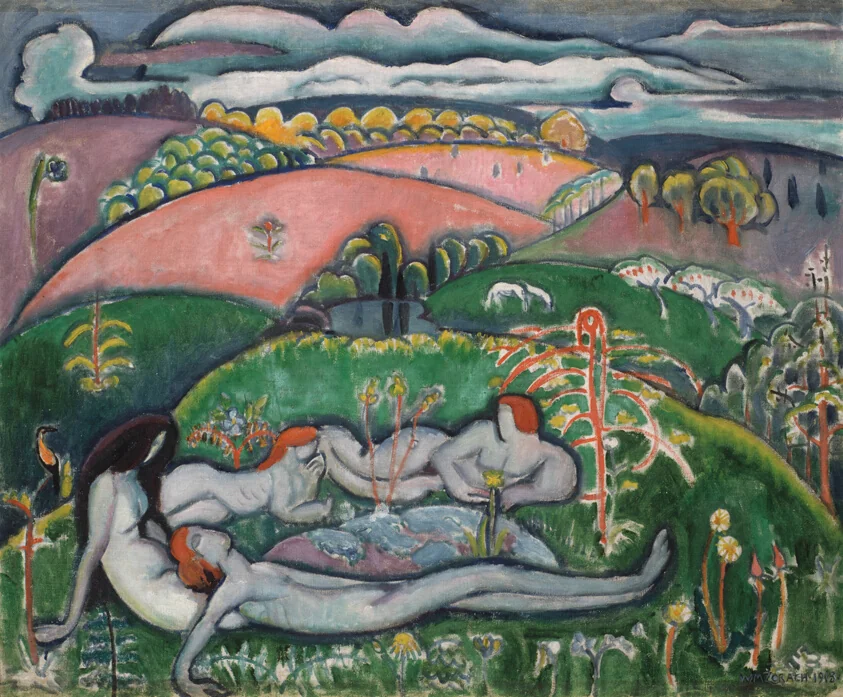
William Zorach was better known for his wood and stone sculptures, but he began his career as a painter. He initially worked in a more traditional style, but while studying in Paris in 1911, he met his future wife Marguerite Thompson, who pushed him toward a more avant-garde aesthetic. In 1913 the couple rented a house in Chappaqua, New York, where Zorach painted Summer. This rare, early canvas shows Zorach’s love for the organic forms of nature and his exuberant use of color. The image of four languid nudes in a pastoral setting creates a splendid vision of the artistic life, while the often nonnaturalistic hues draw attention to the abstracted, patterned surface. Both in subject matter and style, Summer reveals the artist’s admiration for the work of Henri Matisse, which he would have seen in Paris and at the 1913 Armory Show.

Provenance

Mrs. Thomas Shanahan, Brooklyn, New York, by 1968 [Brooklyn Museum, William Zorach exhibition, 1968]. Mr. and Mrs. Marshall Field, Lake Forest, Ill., by 1994; given to the Art Institute of Chicago in 2005.

Summer (recto)

William Zorach

1913

Accession Number

130520

Medium

Oil on canvas

Dimensions

73.7 × 88.9 cm (29 × 35 in.)

Classification

oil on canvas

Museum

The Art Institute of Chicago

Chicago, United States

Credit Line

Gift of Jamee J. and Marshall Field

Background & Context

Background Story

"Summer (recto)" is a 1913 oil on canvas by William Zorach that captures the Lithuanian-American artist in his most vibrant and coloristically daring early period, the image showing a landscape or figure study rendered with the same bold, Fauvist-inspired colors and simplified forms that made Zorach a pivotal figure in the development of American modernism. The composition is a medium-sized canvas—73.7 × 88.9 centimeters—showing a summer scene with the thick, expressive brushwork and the saturated palette of oranges, yellows, and greens that suggest both the physical heat of the season and the emotional exuberance of the artist's response. The oil on canvas creates a surface of extraordinary richness and tactile energy, the paint suggesting both the observed reality of the American landscape and the transformed vision of the modernist imagination. The 1913 date places this work in the period of Zorach's residence in Paris and his close association with the avant-garde circles of the early twentieth century, when he was producing the paintings that established his reputation as the leading American colorist. Art historians have connected this painting to the broader tradition of the summer landscape in modern art, from the haystacks of Monet to the bathers of Cézanne, noting that Zorach's treatment is more focused on the coloristic intensity and the emotional expression, the transformation of observed reality into chromatic poetry, than the atmospheric effect or the structural analysis of these other traditions.

Cultural Impact

This 1913 oil canvas made summer vibrantly Fauvist through medium 73cm saturated orange-yellow-green thick brushwork and tactile energy, using Paris avant-garde early period to transform American landscape into chromatic emotional poetry beyond Monet atmospheric haystack series.

Why It Matters

It matters because Zorach painted summer and made the canvas feel like it was sweating with joy—proving that even a season could shout if the colors were bold enough.