Waterloo Bridge, Sunlight Effect

Description

If not for the fog, Claude Monet once remarked, “London wouldn’t be a beautiful city. It’s the fog that gives it its magnificent breadth.” While working on his London Series, he rose early every day to paint Waterloo Bridge in the morning, moving on to Charing Cross Bridge at midday and in the afternoon. He observed both motifs from his fifth-floor window at the Savoy Hotel. The Art Institute’s two Waterloo Bridge paintings are dated 1900 and 1903, but both were likely begun in 1900 and dated only when Monet felt that they were finished. He worked on all of his London paintings in his studio in Giverny, refusing to send any of them to his dealer until he was satisfied with them as an ensemble.

Provenance

The artist (d. 1926); sold to Durand-Ruel, Paris, May 11, 1904, for 9,000 francs [this and the following per Durand-Ruel, Paris, stock book for 1901–13 (no. 7641, as La Tamise à Londres, Waterloo Bridge, effet de soleil, 1903), as confirmed by Paul-Louis Durand-Ruel and Flavie Durand-Ruel, Durand-Ruel Archives, to the Art Institute of Chicago, Feb. 21, 2013, curatorial object file]; sold to Durand-Ruel, New York, Dec. 14, 1904 or Jan. 6, 1905 [see previous; also per Durand-Ruel, New York stock book for 1904–1924 (no. 2965, as La Tamise à Londres, Waterloo Bridge, effet de soleil, 1903), as confirmed by Paul-Louis Durand-Ruel and Flavie Durand-Ruel, Durand-Ruel Archives, to the Art Institute of Chicago, Feb. 21, 2013, curatorial object file]; sold to W. A. Putnam, Jan. 10, 1905, for $4,000 [per Durand-Ruel, New York, stock book for 1904–24 (no. 2965, as La Tamise à Londres, Waterloo Bridge, effet de soleil, 1903), as confirmed by Paul-Louis Durand-Ruel and Flavie Durand-Ruel, Durand-Ruel Archives, to the Art Institute of Chicago, Feb. 21, 2013, curatorial object file; according to Wildenstein 1996, this sale was to A. M. Putnam]; sold back to Durand-Ruel, New York, May 22, 1913, for 25,000 francs [this and the following per Durand-Ruel, New York, stock book for 1904–24 (no. 3646, as La Tamise à Londres, Waterloo Bridge, effet de soleil, 1903), as confirmed by Paul-Louis Durand-Ruel and Flavie Durand-Ruel, Durand-Ruel Archives, to the Art Institute of Chicago, Feb. 21, 2013, curatorial object file; according to Wildenstein 1996, the painting was owned by Lawrence J. Abbott and William Lowell Putnam, c. 1913]; sold to Martin A. Ryerson (d. 1932), Chicago, Feb. 10, 1914, for $7,500 [see previous; also a purchase receipt on Durand-Ruel letterhead, dated February 10, 1914, which details that this painting (no. 3646, Monet, Waterloo Bridge, London, 1903) was acquired by M. A. Ryerson, in addition to two other paintings (no. 3668, Monet, La cabane de douaniers, 1897; and no. 3768, Monet, Les nymphéas, paysage d’eau, 1906 [cat. 44]) for $20,000, photocopy in curatorial object file]; bequeathed to the Art Institute of Chicago, 1933.
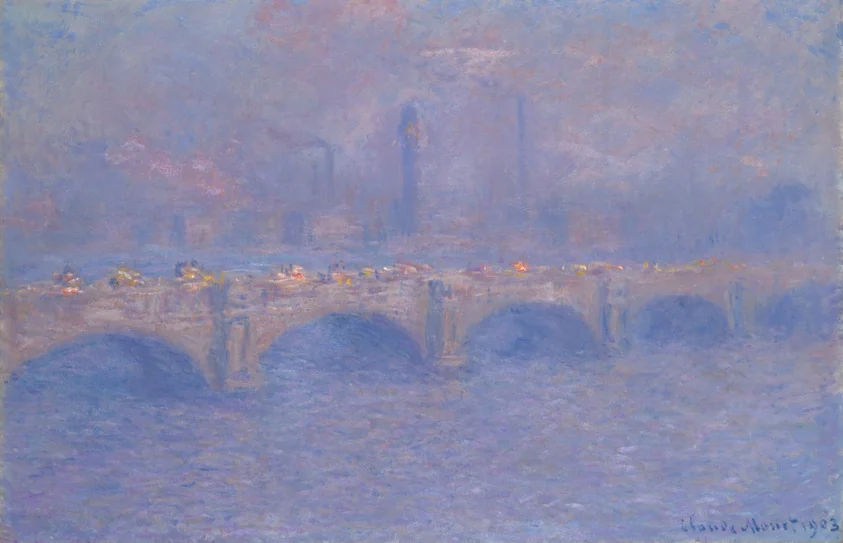
Waterloo Bridge, Sunlight Effect

Claude Monet

1903

Accession Number

20701

Medium

Oil on canvas

Dimensions

65.7 × 101 cm (25 7/8 × 39 3/4 in.); Framed: 88.9 × 123.2 × 10.8 cm (35 × 48 1/2 × 4 1/4 in.)

Classification

Painting

Museum

The Art Institute of Chicago

Chicago, United States

Credit Line

Mr. and Mrs. Martin A. Ryerson Collection

Background & Context

Background Story

"Waterloo Bridge, Sunlight Effect" captures the same Thames subject under radically different atmospheric conditions than its gray-weather companions, showing the bridge bathed in rare London sunshine. Painted in 1903 during Monet's final London visit, the canvas is suffused with warm rose, gold, and violet tones that make the stone architecture appear almost incandescent. The sunlight version was technically more demanding than the fog paintings because strong light creates sharper contrasts and more saturated colors, risking the decorative sweetness that Monet always avoided. The artist solved the problem by introducing unexpected complementary notes—violet shadows beneath the arches, green reflections in the water—that prevent the warmth from becoming cloying. This painting also documents a meteorological reality: London sunshine was sufficiently rare that Monet treated it as an event worthy of urgent recording, sometimes working on a single canvas for only twenty minutes before the clouds returned. The result is a work that feels provisional and permanent simultaneously, a moment snatched from time yet built to endure. In the broader history of art, the sunlight Waterloo Bridge canvases influenced the American Luminists and Tonalists who were seeking to capture atmospheric effects in the Hudson River valley and New England coast. They also anticipate Color Field painting by demonstrating that a recognizable subject could serve merely as a pretext for exploring the emotional resonance of pure color.

Cultural Impact

This rare London sunshine painting influenced American Luminism and anticipated Color Field abstraction by making pure color warmth the true subject beneath the bridge.

Why It Matters

It matters as Monet's celebration of improbable light—proof that even London could glow when the clouds parted for twenty minutes.