The Customs House at Varengeville

Description

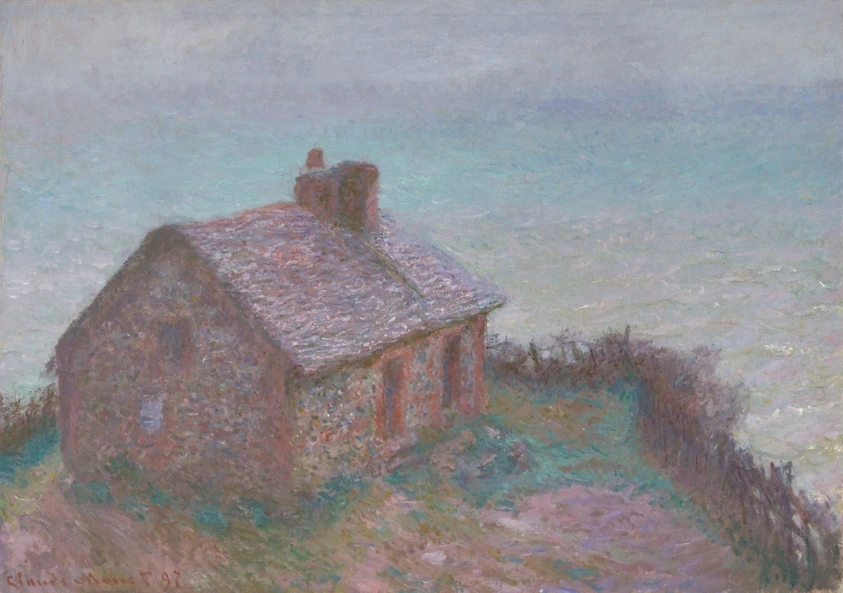
Claude Monet painted the customs house at Varengeville, on the Normandy coast of France, four times in 1882 and four more times in 1897. On each occasion he chose a similar vantage looking down on the small structure, which appears to grow out of the cliffside. The dimensions of this version are nearly identical to those of the other three canvases from the second visit. Here, Monet increased the amount of white in his paints to capture more nuanced atmospheric effects. He also experimented with techniques to animate the surface, at times scraping down or wiping away the still-soft paint to expose underlying colors. In the water, for example, breaks in the pale-gray paint reveal a bright green beneath, which the artist accentuated with additional touches of a similar green on top.

Provenance

The artist (d. 1926); sold to Galerie Allard et Noel, Feb. 1899, for 6,000 francs [per Monet’s livre de comptes, ventes janvier–juillet 1899, photocopy of this page in curatorial object file]. Maurice Masson, Paris, by Feb. 27, 1911 [per Bernheim-Jeune, exh. cat., 1911]; sold at the Maurice Masson, Paris, sale, Hôtel Drouot, Paris, June 22, 1911, lot 23, to Durand-Ruel, Paris, for 9,020 francs [per Hôtel Drouot, sale cat., June 22, 1911; see also Durand-Ruel, Paris, stock book for 1901–13 (no. 9648, as La cabane du douanier), as confirmed by Paul-Louis Durand-Ruel and Flavie Durand-Ruel, Durand-Ruel Archives, to the Art Institute of Chicago, Feb. 5, 2013, curatorial object file]; sold to Durand-Ruel, New York, July 21, 1913 or Aug. 6, 1913 [The Paris and New York Durand-Ruel stock books record different dates for the sale: The Paris stock book for 1901–13 (no. 9648, as La cabane du douanier) states: “Sold to DR New York on 21 July 1913.” The New York stock book for 1904–24 (no. 3668, as La cabane de douaniers) states: “Purchased by DR New York on 6 August 1913 as La cabane de douaniers.” As confirmed by Paul-Louis Durand-Ruel and Flavie Durand-Ruel, Durand-Ruel Archives, to the Art Institute of Chicago, Feb. 5, 2013, curatorial object file]; sold to Martin A. Ryerson (d. 1932), Chicago, Feb. 10, 1914 for $7,500 [per Durand-Ruel, New York, stock book for 1904–24 (no. 3668, as La cabane de douaniers), as confirmed by Paul-Louis Durand-Ruel and Flavie Durand-Ruel, Durand-Ruel Archives, to the Art Institute of Chicago, Feb. 5, 2013; see also purchase receipt on Durand-Ruel letterhead, dated February 10, 1914, detailing that this painting (no. 3668, Monet, La cabane de douaniers, 1897) was acquired by M. A. Ryerson, in addition to two other paintings (no. 3646, Monet, Waterloo Bridge, London, 1903) (cat. 39 [W1586]); and no. 3768, Monet, Les nymphéas, paysage d’eau, 1906 (cat. 44 [W1683]) for $20,000, photocopy in curatorial object file]; bequeathed to the Art Institute of Chicago, 1933.

The Customs House at Varengeville

Claude Monet

1897

Accession Number

16542

Medium

Oil on canvas

Dimensions

65.6 × 92.8 cm (25 13/16 × 36 1/2 in.); Framed: 83.5 × 110.2 × 5.7 cm (32 7/8 × 43 3/8 × 2 1/4 in.)

Classification

Painting

Museum

The Art Institute of Chicago

Chicago, United States

Credit Line

Mr. and Mrs. Martin A. Ryerson Collection
Background & Context

Background Story

"The Customs House at Varengeville" depicts a modest coastal building on the Normandy cliffs near Dieppe, painted by Monet during a stay in 1897. The customs house stands at the edge of the cliff, its simple geometry contrasting with the wild, eroded coastline and the turbulent sea below. Monet had visited Varengeville repeatedly since the 1880s, attracted by the dramatic chalk cliffs and the shifting weather of the Channel coast. This canvas is notable for its architectural focus: rather than dissolving the building into atmosphere, Monet uses it as a stable vertical element around which the sea and sky perform their chromatic variations. The palette combines the cool maritime blues and greens with the warm ochre and russet of the building's weathered stone, demonstrating his mature ability to balance complementary colors without harmonic discord. The painting also documents a vanishing world—the small customs posts that dotted the French coast were being centralized and modernized in the late nineteenth century, making Monet's image an unintentional historical record. Art historians have connected this work to the broader tradition of French marine painting that stretches from Vernet to Boudin, though Monet's treatment is distinguished by its near-total absorption in optical sensation rather than narrative or topographical accuracy.

Cultural Impact

This coastal scene preserves a vanishing architectural type while demonstrating Monet's mature color balancing between warm masonry and cool maritime elements.

Why It Matters

It matters as Monet's rare architectural focus—proof that he could make a building stand firm while everything around it dissolved into color.