Charing Cross Bridge, London

Description

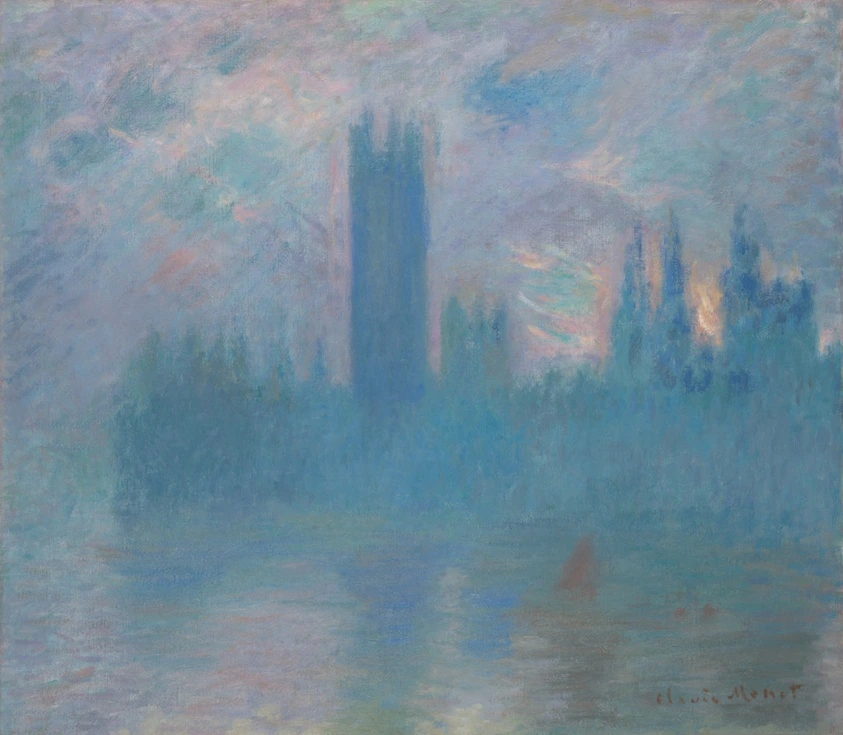
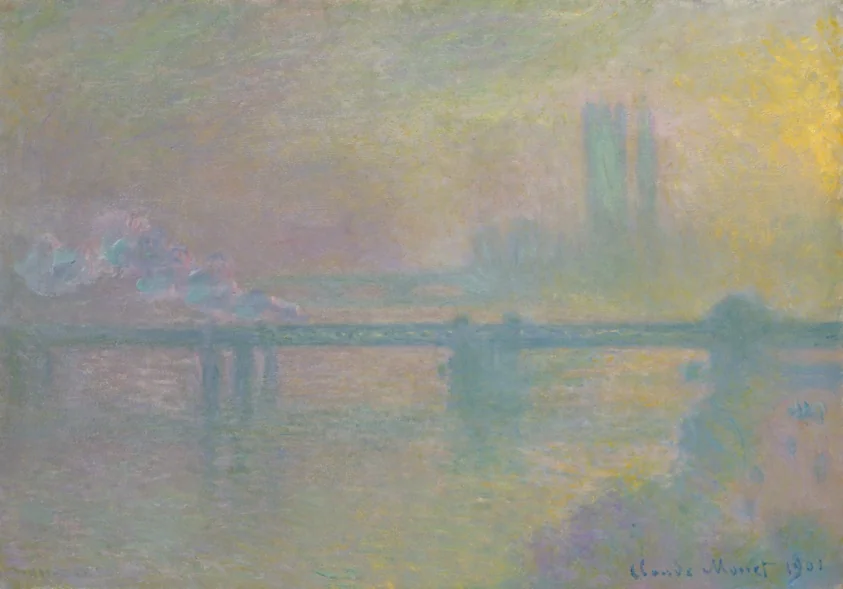
Beginning in September 1899, Claude Monet made almost one hundred paintings of the river Thames in London. These works show only three different views—Charing Cross Bridge and Waterloo Bridge, both painted from the Savoy Hotel; and the Houses of Parliament, painted from Saint Thomas’s Hospital. In the smoggy, industrial city, Monet challenged himself to capture effects of light seen through a dense atmospheric screen. Beyond the rectilinear skeleton of Charing Cross Bridge—reminiscent of bridges in Japanese prints, which the artist collected—rises the ghostlike silhouette of the Houses of Parliament.

Provenance

The artist (d. 1926); sold to Durand-Ruel, Paris, Oct. 30, 1905, for 8,000 francs [this and the following per Durand-Ruel, Paris, stock book for 1901–13 (no. 8018, as Londres, Charing Cross Bridge, soleil couchant, 1901), as confirmed by Paul-Louis Durand-Ruel and Flavie Durand-Ruel, Durand-Ruel Archives, to the Art Institute of Chicago, Feb. 21, 2013, curatorial object file]; sold to Adrien Hébrard, as agent for the Prince de Wagram (Alexandre Berthier, 4th Prince de Wagram), Paris, Dec. 20, 1905, for 15,000 francs; sold back to Durand-Ruel, Paris, Apr. 4, 1914, for 15,000 francs [this and the following per Durand-Ruel, Paris, stock book for 1913–21 (no. 10528, as Londres, Charing Cross Bridge, soleil couchant, 1901), as confirmed by Paul-Louis Durand-Ruel and Flavie Durand-Ruel, Durand-Ruel Archives, to the Art Institute of Chicago, Feb. 21, 2013, curatorial object file]; sold to Durand-Ruel, New York, Nov. 11 or Dec. 9, 1915; sold to Martin A. Ryerson (d. 1932), Chicago, Feb. 23, 1916, for a painting by Pierre-Auguste Renoir [Pivoines, no. 3094], plus $1,000 [per purchase receipt on Durand-Ruel letterhead, dated February 23, 1916, details that this painting (no. 3898, Claude Monet, Charing Cross Bridge, 1901, Soleil couchant) was acquired by M. A. Ryerson, in exchange for a painting by Renoir (no. 3094, Pierre-Auguste Renoir, Pivoines) in addition to a cash payment of $1,000, photocopy in curatorial object file; see also Durand-Ruel, New York, stock book for 1904–24 (no. 3898, as Londres, Charing Cross Bridge, soleil couchant, 1901), as confirmed by Paul-Louis Durand-Ruel and Flavie Durand-Ruel, Durand-Ruel Archives, to the Art Institute of Chicago, Feb. 21, 2013, curatorial object file]; bequeathed to the Art Institute of Chicago, 1933.
Charing Cross Bridge, London

Claude Monet

1901

Accession Number

16544

Medium

Oil on canvas

Dimensions

65 × 92.2 cm (25 5/8 × 36 5/16 in.); Framed: 87 × 113.1 × 11.2 cm (34 1/4 × 44 1/2 × 4 3/8 in.)

Classification

Painting

Museum

The Art Institute of Chicago

Chicago, United States

Credit Line

Mr. and Mrs. Martin A. Ryerson Collection

Background & Context

Background Story

"Charing Cross Bridge, London" continues Monet's systematic investigation of Thames bridges during his London campaigns of 1899–1901. The painting shows the railway bridge with its iron lattice structure silhouetted against the river and sky, steam from passing locomotives softening its industrial geometry into atmospheric poetry. Unlike Waterloo Bridge's classical masonry, Charing Cross Bridge represented modern engineering—iron, rivets, and steam—and Monet's decision to paint it signals his acceptance of modernity as a legitimate aesthetic subject. The canvas is distinguished by its pink and gold tonality, suggesting early morning or late afternoon light penetrating the London haze and transforming iron into something almost luminous. Critics at the time noted that Monet had made the bridge appear to float, dissolving its physical weight into color and air. This treatment anticipates the futurist and vorticist fascination with industrial structures, though Monet's aim was never to celebrate mechanical power but to record its optical effects. The painting also belongs to a significant moment in urban iconography: London's bridges were becoming internationally recognizable symbols of modern city life, reproduced in photographs, postcards, and popular prints. Monet's painted versions competed with these mass-media images by offering something no photograph could capture—the unstable, subjective experience of looking at a bridge through fog, sun, and steam simultaneously.

Cultural Impact

This canvas made industrial infrastructure into atmospheric poetry, helping establish the modern cityscape as a subject for fine art and prefiguring Futurist enthusiasm for engineering aesthetics.

Why It Matters

It matters because Monet looked at an iron railway bridge and saw light, not industry—proving that modernity could be beautiful without being propaganda.