Description
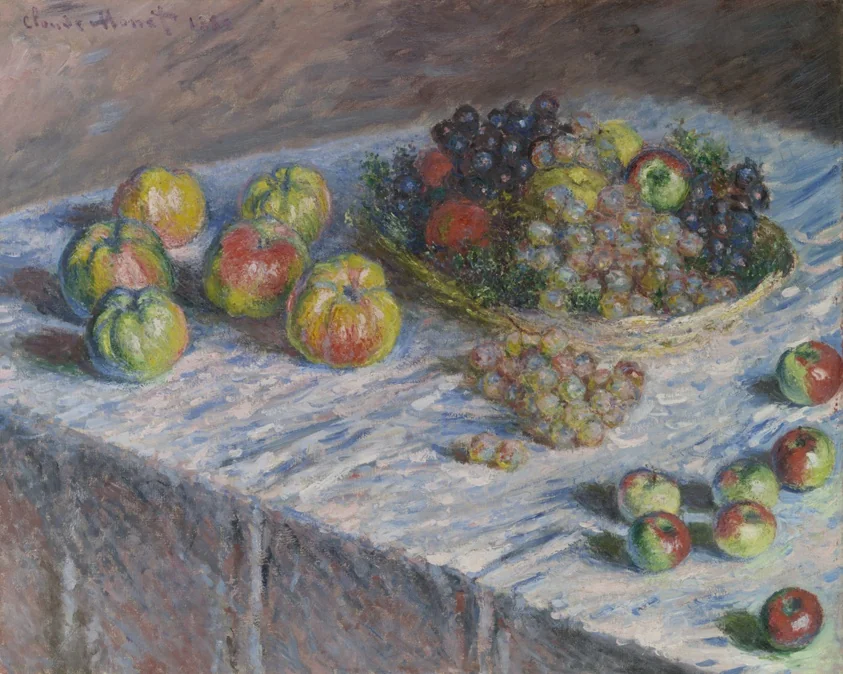
Claude Monet probably painted this and other still lifes in 1879–80, knowing that they would be more readily marketable than his landscapes. In Apples and Grapes, however, he employed the complexity of color, light, and texture found in his most Impressionist landscapes. This is particularly evident in the extensive cloth surface—the play of light on the horizontal brushstrokes (indicating the folds in the tablecloth) recalls earlier canvases in which Monet used similar short horizontals of variegated colors to suggest water rippling in the sunlight.
Provenance
The artist (d. 1926); possibly sold to Cahuzac, Paris, Nov. 1880, in addition to two other paintings (Fleurs, pommes; and Les Saules), for 1,000 francs [ per Monet’s livre de comptes, ventes octobre–décembre 1880, as “M. Cahuzac / Vendre trois toiles / fleurs pommes – fruits / Les Saules – ensemble 1000.” The livre de comptes is located at the Musée Marmottan Monet, Paris; photocopy of this page in curatorial object file]; possibly Durand-Ruel, Paris, c. 1883 [per Wildenstein 1996. The Durand-Ruel Archives could not verify this information, as confirmed by Paul-Louis Durand-Ruel and Flavie Durand-Ruel, Durand-Ruel Archives, to the Art Institute of Chicago, Oct. 5, 2010, curatorial object file]. Catholina Lambert, Paterson, N.J., by May 16, 1895 [per Durand-Ruel Archives, “Acheté par Durand-Ruel NY (stock 1421, as Fruits) à Catholina Lambert le 16 mai 1895,” as confirmed by Paul-Louis Durand-Ruel and Flavie Durand-Ruel, Durand-Ruel Archives, to the Art Institute of Chicago, Oct. 5, 2010, curatorial object file]; sold to Durand-Ruel, New York, May 16, 1895 [this and the following per Durand-Ruel, New York, stock book for 1904–24 (no. 1421, as Fruits), as confirmed by Paul-Louis Durand-Ruel and Flavie Durand-Ruel, Durand-Ruel Archives, to the Art Institute of Chicago, Oct. 5, 2010, curatorial object file]; sold to Martin A. Ryerson (d. 1932), Chicago, Dec. 18, 1915, for $8,100 [see previous; also a purchase receipt on Durand-Ruel letterhead, dated Dec. 21, 1915, includes this painting as one of a number sold by Durand-Ruel, New York, to M. A. Ryerson, photocopy in curatorial object file]; bequeathed to the Art Institute of Chicago, 1933.
Accession Number
16549
Medium
Oil on canvas
Dimensions
66.5 × 82.5 cm (26 3/16 × 32 1/2 in.); Framed: 88 × 103.9 × 10.2 cm (34 5/8 × 40 7/8 × 4 in.)
Classification
Painting
Credit Line
Mr. and Mrs. Martin A. Ryerson Collection
Background & Context
Background Story
Painted in 1880, "Apples and Grapes" represents a rare excursion into still life during a decade when Monet was overwhelmingly devoted to landscape and plein-air series. The canvas shows a modest arrangement of fruit against a loosely indicated background, rendered with the broken color and flickering brushwork that had already become his signature. Rather than the formal tabletop compositions of the Dutch Golden Age or Chardin's moralizing simplicity, Monet treats the fruit as a pretext for studying color relationships—how the red of an apple answers the purple of a grape, how warm flesh tones emerge from cool shadow. The painting dates from a period of domestic stability: Monet had settled at Vétheuil with Alice Hoschedé and their children, and the still life format may reflect the rhythms of family life interrupting his wanderings along the Seine. Art historians have noted that Monet's still lifes are often undervalued because they lack the spectacle of his series paintings, yet they demonstrate his analytical rigor in miniature. The canvas also anticipates the still-life experiments of Cézanne, who was transforming the same genre into structural geometry during these same years. Monet's approach remained atmospheric rather than architectonic, privileging the sensation of seeing over the architecture of form.
Cultural Impact
This still life reveals Monet's analytical color studies in domestic format, showing how Impressionist technique translated to intimate subjects and influenced later modernist still-life practice.
Why It Matters
It demonstrates that Monet's Impressionist method was not limited to landscapes—his color science could make even a bowl of fruit shimmer with light.