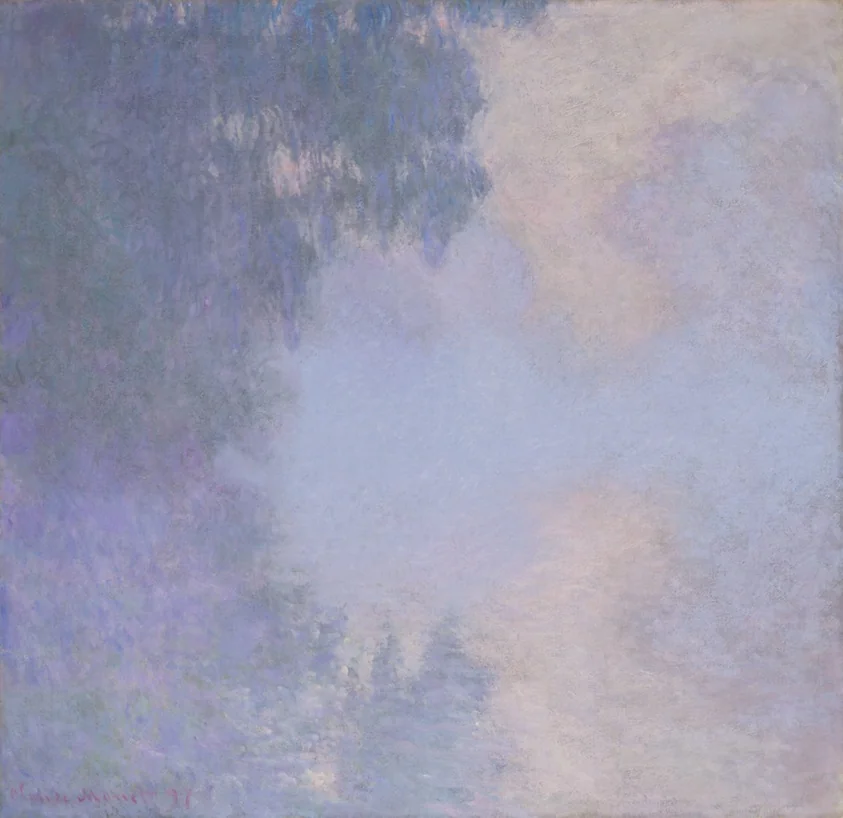
Description
Claude Monet painted the 18 works in his Mornings on the Seine series from a flat-bottomed boat anchored to the riverbank where the Epte River flows into the Seine. There, as the light changed from dawn to day, he worked on one canvas after another. To keep them in order, he numbered them, placed them in grooves built into the boat, and had the gardener whom he enlisted as his assistant hand them to him.
Provenance
Jos Hessel, Paris, by Oct. 26, 1916 [this and the following per Durand-Ruel, Paris, stock book for 1913–21 (no. 10908, as Matinée sur la Seine, 1897), as confirmed by Paul-Louis Durand-Ruel and Flavie Durand-Ruel, Durand-Ruel Archives, to the Art Institute of Chicago, Feb. 5, 2013, curatorial object file; Wildenstein 1996 states this painting was sold by the artist to Durand-Ruel in 1913, which is not mentioned in the Durand-Ruel Archives]; sold to Durand-Ruel, Paris, Oct. 26, 1916, for 20,000 francs; sold to Durand-Ruel, New York, Nov. 6 or Dec. 4, 1916 [per Durand-Ruel, Paris, stock book for 1913–21 (no. 10908, as Matinée sur la Seine, 1897) states: “Sold to DR New York on 6 November 1916.” The New York stock book for 1904–24 (no. 4023, as Matinée sur la Seine, 1897) states: “Purchased by DR New York on 4 December 1916.” Both confirmed by Paul-Louis Durand-Ruel and Flavie Durand-Ruel to the Art Institute of Chicago, Feb. 5, 2013, curatorial object file]; sold to Martin A. Ryerson, Chicago, Dec. 8, 1916, for $10,000 [per Durand-Ruel, New York, stock book for 1904–24 (no. 4023, as Matinée sur la Seine, 1897), as confirmed by Paul-Louis Durand-Ruel and Flavie Durand-Ruel, Durand-Ruel Archives, to the Art Institute of Chicago, Feb. 5, 2013, curatorial object file; also a purchase receipt on Durand-Ruel letterhead, dated December 26, 1916, includes this painting as one of several sold by Durand-Ruel, New York, to M. A. Ryerson, photocopy in curatorial object file]; bequeathed to the Art Institute of Chicago, 1933.
Accession Number
16564
Medium
Oil on canvas
Dimensions
89.9 × 92.7 cm (35 3/8 × 36 1/2 in.); Framed: 112.4 × 115.6 × 11.5 cm (44 1/4 × 45 1/2 × 4 1/2 in.)
Classification
Painting
Credit Line
Mr. and Mrs. Martin A. Ryerson Collection
Background & Context
Background Story
Painted in 1897, "Branch of the Seine near Giverny (Mist)" belongs to a transitional moment in Monet's career, between the monumental series of the early 1890s and the Water Lilies that would dominate his final decades. The canvas shows a quiet backwater of the Seine near his Giverny property, shrouded in morning mist so thick that the riverbank trees appear as ghostly verticals emerging from a silver-gray void. The palette is extraordinarily restrained—almost entirely cool blues, greens, and grays with occasional warm accents where light penetrates the fog. This painting exemplifies what critics have called Monet's "atmospheric abstraction," a tendency to let the subject matter nearly disappear behind the envelope of weather. The work also reflects his growing investment in his own garden and its water features; the branch of the Seine depicted here is the same water source that fed his famous lily pond. Technical analysis reveals that Monet used unusually thin paint layers for this canvas, building the mist effect through successive transparent glazes rather than the thick impasto of his sunny landscapes. The result is a painting that seems to breathe, its surface as vaporous as the scene it depicts. In the context of French art, the canvas can be read as Monet's response to the Symbolist movement—an attempt to make paint itself evoke mood rather than merely describe appearance.
Cultural Impact
This misty Seine landscape represents Monet's shift toward atmospheric abstraction, bridging the series paintings of the 1890s and the later Water Lilies while engaging with Symbolist aesthetics.
Why It Matters
It matters as the moment Monet let the world almost disappear into fog—a preview of the dissolved forms in his late Giverny gardens.