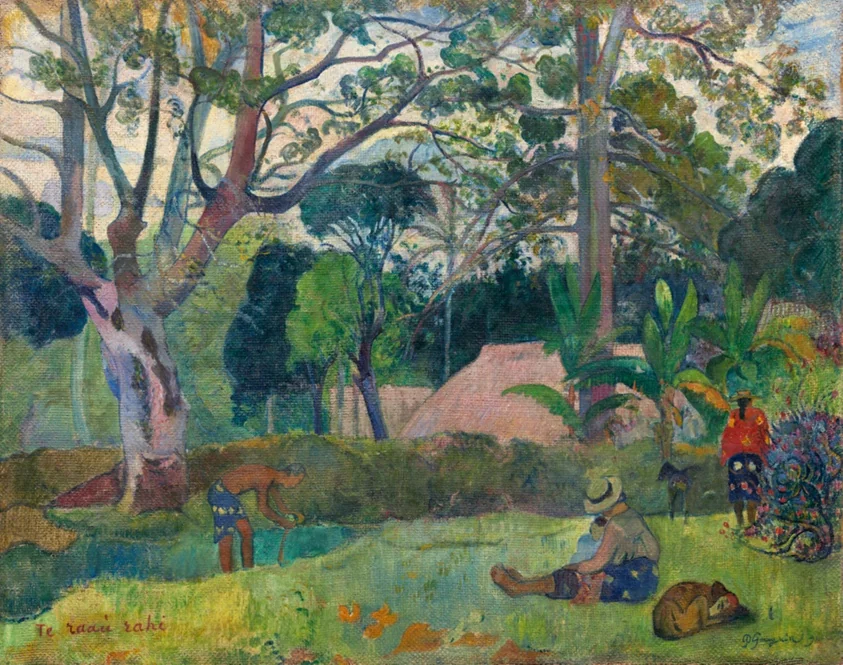
Te raau rahi (The Big Tree)

Description

“Everything in the landscape blinded and dazzled me,” wrote Paul Gauguin of his first months in Tahiti. Here, he showcased the island’s variety of bountiful fruit trees, including a thick-trunked, violet hotu at left; spindly mango and coconut trees; and three short banana plants with lush, splayed leaves. In the foreground, a man uses a stick to crack a coconut and a family rests in the grass with a sleeping dog beside them. The painting’s coarsely woven canvas, made of a fibrous plant matter (jute), is visible through the paint layer. Cheaper and more readily available than traditional canvas, this support material lends the work a rugged, organic texture.

Te raau rahi (The Big Tree)

Paul Gauguin

1891

Accession Number

111062

Medium

Oil on jute canvas

Dimensions

72.5 × 91.5 cm (28 9/16 × 36 in.); Framed: 96.6 × 115.6 × 11.5 cm (38 × 45 1/2 × 4 1/2 in.)

Classification

oil on canvas

Museum

The Art Institute of Chicago

Chicago, United States

Credit Line

Gift of Kate L. Brewster
Background & Context

Background Story

Paul Gauguin's Te raau rahi (The Big Tree) (1891) is an oil on jute canvas from Gauguin's first trip to Tahiti. Gauguin (1848-1903) was a Post-Impressionist painter who abandoned European civilization for the South Pacific, seeking a simpler, more authentic life. This painting shows a large tree in the Tahitian landscape, the forms simplified and the colors intensified in the distinctive style Gauguin developed in the tropics. The jute canvas has a coarse texture that adds to the primitive effect.

Cultural Impact

Gauguin's Tahitian paintings were revolutionary in their use of color and their rejection of European artistic conventions.

Why It Matters

This painting of a big tree in Tahiti shows Gauguin's distinctive style, the simplified forms and intensified colors capturing the tropical landscape.