Vétheuil

Description

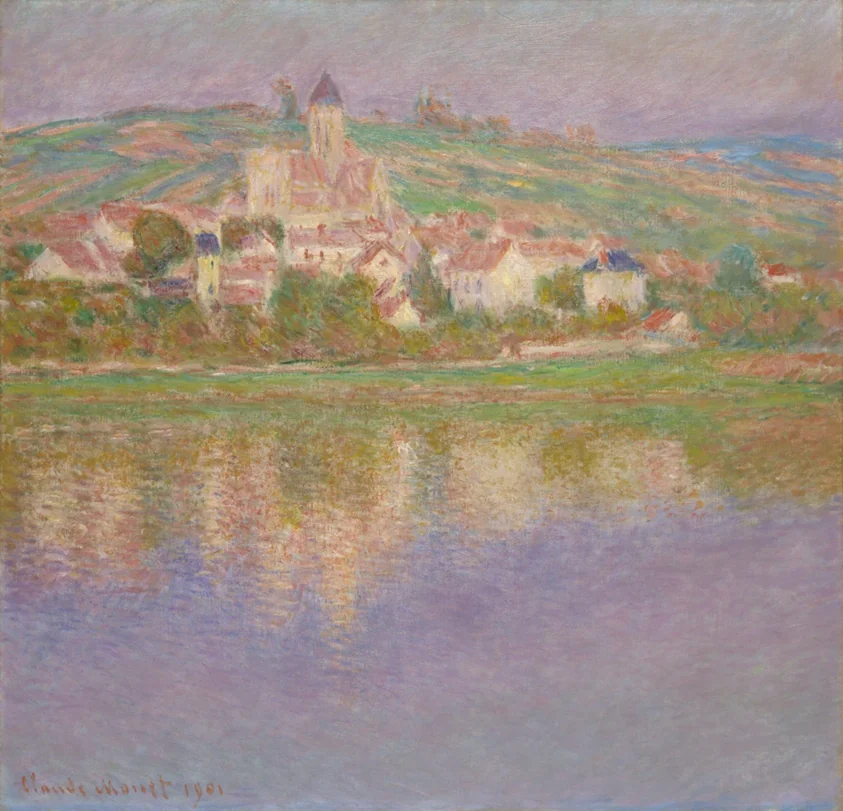
In summer 1901 Claude Monet rented a modest house in Lavacourt, a small hamlet across the Seine from Vétheuil and not far from his property at Giverny, which he was in the process of expanding. He began 15 paintings of Vétheuil from the balcony of this rented home, all of which feature the same restricted view of the riverbank and town—punctuated by the church—and document the changes in light throughout the day. The Art Institute holds two paintings from the series, one from midday and another from sunset. Painted on nearly square canvases, Monet divided each composition in half, separating the town from its reflection. Rather than replicating the area’s topography or creating a convincing illusion of space, Monet emphasized the decorative over the descriptive qualities of this riverscape. His loose brushwork and subtle color transitions blur the distinctions between the scene’s various forms, dissolving the borders, for example, between the water and the land and the land and the sky. The shapes of the different buildings along the shoreline emerge through changes in the direction of brushstrokes and slight shifts in hue.

Provenance

The artist (d. 1926); sold to Boussod, Valadon & Cie., Paris, Feb. 15, 1902, for 8,000 francs [per Wildenstein 1996; see also Boussod, Valadon & Cie, Paris, stock book 15, 1901–18 (as Vétheuil, effet rose), which includes a price code “INXZ,” decoded by the Getty Research Institute’s online database as 8000 francs]; sold to Rosenberg, Paris, May 26, 1903, for 10,000 francs [per Wildenstein 1996; see also Boussod, Valadon & Cie, Paris, stock book 15, 1901–18 (as Vétheuil, effet rose) and includes a price code “PNNXZ,” decoded by the Getty Research Institute’s online database as 10000 francs]. Alfred Savoir, Paris, by Mar. 22, 1922 [per Hôtel Drouot, sale cat., Mar. 22, 1922]; sold at the Alfred Savoir, Paris, sale, Hôtel Drouot, Paris, Mar. 22, 1922, lot 16 (ill.), to Durand-Ruel, Paris, for 5,000 francs [Hôtel Drouot, sale cat., Mar. 22, 1922; see also Durand-Ruel, New York, deposit book for 1908–25 (no. 12664, as Vétheuil, 1901), as confirmed by Paul-Louis Durand-Ruel and Flavie Durand-Ruel, Durand-Ruel Archives, to the Art Institute of Chicago, Feb. 5, 2013, curatorial object file]; on deposit with Durand-Ruel, New York, by Apr. 22, 1922 [per Durand-Ruel, New York, stock book for 1908–25 (no. 4742, as Vétheuil, 1901), as confirmed by Paul-Louis Durand-Ruel and Flavie Durand-Ruel, Durand-Ruel Archives, to the Art Institute of Chicago, Feb. 5, 2013, curatorial object file; see also Durand-Ruel, New York, deposit book for 1908–25 (no. 12664, as Vétheuil, 1901)]; sold to Durand-Ruel, New York, Apr. 22, 1922 [this and the following per Durand-Ruel, New York, stock book for 1908–25 (no. 4742, as Vétheuil, 1901), as confirmed by Paul-Louis Durand-Ruel and Flavie Durand-Ruel, Durand-Ruel Archives, to the Art Institute of Chicago, Feb. 5, 2013, curatorial object file]; sold to Annie Swan Coburn, Chicago, Sept. 29, 1926, for $10,000; bequeathed to the Art Institute of Chicago, 1933.

Vétheuil

Claude Monet

1901

Accession Number

14634

Medium

Oil on canvas

Dimensions

90.2 × 93.4 cm (35 1/2 × 36 3/4 in.); Framed: 101 × 104.2 × 6.4 cm (39 3/4 × 41 × 2 1/2 in.)

Classification

Painting

Museum

The Art Institute of Chicago

Chicago, United States

Credit Line

Mr. and Mrs. Lewis Larned Coburn Memorial Collection
Background & Context

Background Story

Painted in 1901, this canvas represents a return to Vétheuil, the village on the Seine where Monet had lived from 1878 to 1881 with his first wife Camille and the Hoschedé family. The painting shows the village church and houses nestled into the river valley, rendered with the high-keyed palette and broad, confident brushwork of his mature style. The return to Vétheuil after twenty years was emotionally charged: Camille had died there in 1879, and the village represented both personal tragedy and artistic origin. Yet the canvas avoids elegiac melancholy, treating the familiar landscape with the same analytical optimism that characterized his entire output. The composition is notable for its elevated viewpoint, probably from the hillside above the village, which allows Monet to integrate river, architecture, and sky into a single panoramic rhythm. The church spire functions as a vertical accent amid the horizontal flow of the valley, a compositional device that Monet had learned from the Dutch tradition and made his own. Art historians have debated whether this late return to Vétheuil represents nostalgia or simply the practical decision to paint a familiar subject under new light conditions. Either interpretation supports the broader understanding of Monet as an artist whose personal history and professional methodology were inseparable—every landscape he painted twice was also a landscape he had lived twice.

Cultural Impact

This return to Vétheuil connects Monet's mature technique to the site of his early personal tragedy, showing how memory and place intertwined in his lifelong visual autobiography.

Why It Matters

It matters as a homecoming—Monet returning to the village where he became a widower and finding not grief, but color.