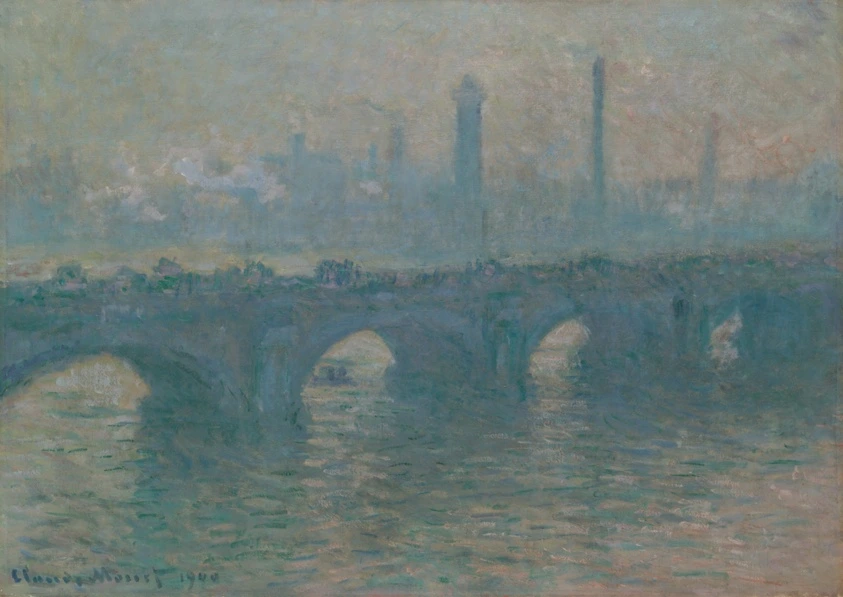
Waterloo Bridge, Gray Weather

Description

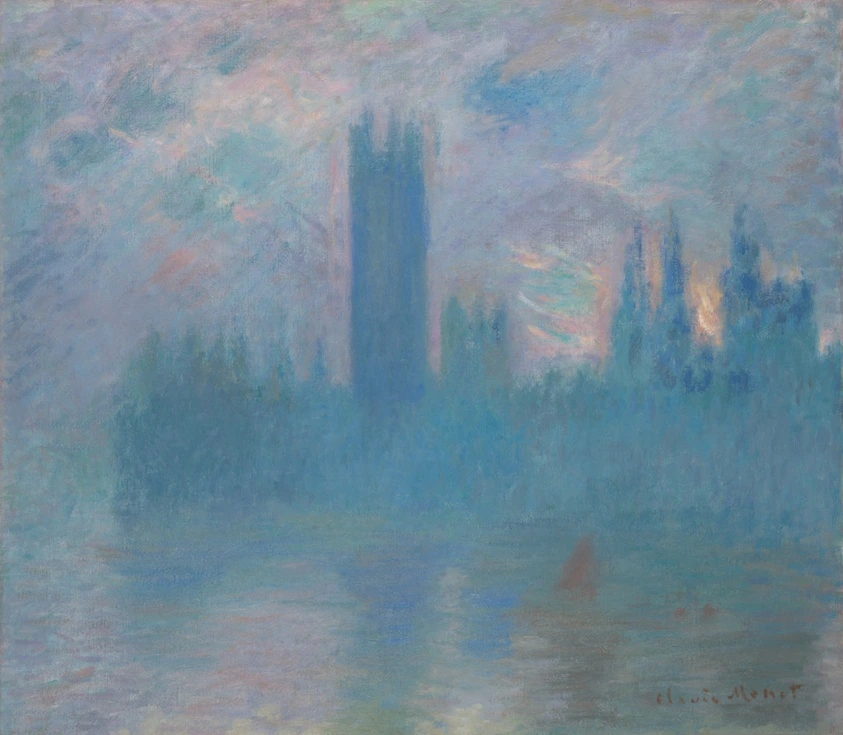
If not for the fog, Claude Monet once remarked, “London wouldn’t be a beautiful city. It’s the fog that gives it its magnificent breadth.” While working on his London series, he rose early every day to paint Waterloo Bridge in the morning, moving on to Charing Cross Bridge at midday and in the afternoon. He observed both motifs from his fifth-floor window at the Savoy Hotel. The Art Institute’s two Waterloo Bridge paintings are dated 1900 and 1903, but both were likely begun in 1900 and dated only when Monet felt that they were finished. He worked on all of his London paintings in his studio in Giverny, refusing to send any of them to his dealer until he was satisfied with them as an ensemble.

Provenance

The artist (d. 1926); sold to Durand-Ruel, Paris, May 11, 1904, for 9,000 francs [this and the following per Durand-Ruel, Paris, stock book for 1901–13 (no. 7643, as La Tamise, Waterloo Bridge, temps couvert, 1901, as confirmed by Paul-Louis Durand-Ruel and Flavie Durand-Ruel, Durand-Ruel Archives, to the Art Institute of Chicago, Feb. 21, 2013, curatorial object file]; sold to Paul Cassirer, Berlin, Nov. 28, 1904, for 11,500 francs. Albrecht Guttmann, Berlin, by May 18, 1917 [this and the following per Cassirer and Helbing 1917]; sold at the Albrecht Guttmann, Berlin, sale, Paul Cassirer (Berlin) and Hugo Helbing (Munich), Berlin, May 18, 1917, lot 69. Howard Young, New York [this and the two following per Art Dealers Association of America, report, Mar. 8, 1995, curatorial object file]. Berthe Honoré Palmer, Chicago. Anderson Gallery, Chicago, c. 1927 [see previous and further corroborated by a telephone conversation between Courtney Donnell, Art Institute of Chicago, and Jeanne Hansell (daughter of Mrs. Mortimer B. Harris), March 1999, see provenance worksheet, dated June 17, 1999, curatorial object file]; sold to William Redfield, Chicago, c. 1927 [this and the following per Jeanne Hansell (daughter of Mrs. Mortimer B. Harris), relayed to Courtney Donnell, Art Institute of Chicago, March 1999 telephone conversation; see conversation summary in provenance worksheet, June 17, 1999, curatorial object file]; given to his sister, Ethel R. Harris, Chicago, c. 1930; given to the Art Institute of Chicago, beginning in 1984 [The painting was given to the Art Institute of Chicago in undivided fractional interests beginning in 1984. The Art Institute received the final fractional interest for one hundred percent ownership in 2000].

Waterloo Bridge, Gray Weather

Claude Monet

1900

Accession Number

103139

Medium

Oil on canvas

Dimensions

65.4 × 92.6 cm (25 3/4 × 36 3/8 in.); Framed: 86.4 × 110.5 × 10.2 cm (34 × 43 1/2 × 4 in.)

Classification

Painting

Museum

The Art Institute of Chicago

Chicago, United States

Credit Line

Gift of Mrs. Mortimer B. Harris
Background & Context

Background Story

"Waterloo Bridge, Gray Weather" is one of approximately forty-one canvases Monet devoted to the Thames bridges during three London sojourns between 1899 and 1901. Painted from a room at the Savoy Hotel, the canvas shows Waterloo Bridge spanning the river under a typically English gray sky, its masonry arches dissolving into atmospheric haze. The painting belongs to the most systematically serial phase of Monet's London work, in which he attempted to capture the same urban motif under every conceivable weather condition. The gray-weather versions are among the most subtle, relying on near-imperceptible shifts between slate blue, pearl gray, and pale green to suggest moisture-laden air. Contemporary Londoners complained that Monet had made their city too beautiful, sanitizing the industrial smog that was actually poisoning the river; but Monet insisted that what he painted was not the objective city but his visual experience of it. The canvas also demonstrates his growing willingness to tackle modern subjects—steam trains, factory chimneys, and iron bridges—that the Impressionists had largely avoided in favor of rural and suburban leisure. Technical analysis shows that Monet scraped and repainted the bridge arches multiple times, searching for the exact tone that would make the stone appear simultaneously solid and enveloped in mist. The Waterloo Bridge series as a whole established urban atmospheric painting as a major genre and influenced twentieth-century cityscape painters from Derain to Whaam-era Lichtenstein.

Cultural Impact

This London canvas established urban atmospheric painting as a modern genre, transforming industrial smog into a subject for high art and influencing twentieth-century cityscape.

Why It Matters

It matters because Monet proved that fog could be as beautiful as sunlight—and that London's gray was actually a thousand colors.