Accession Number
93808
Medium
Oil on canvas
Dimensions
68.6 × 106.7 cm (27 × 42 in.)
Classification
Painting
Credit Line
Gift of Ivan Albright
Background & Context
Background Story
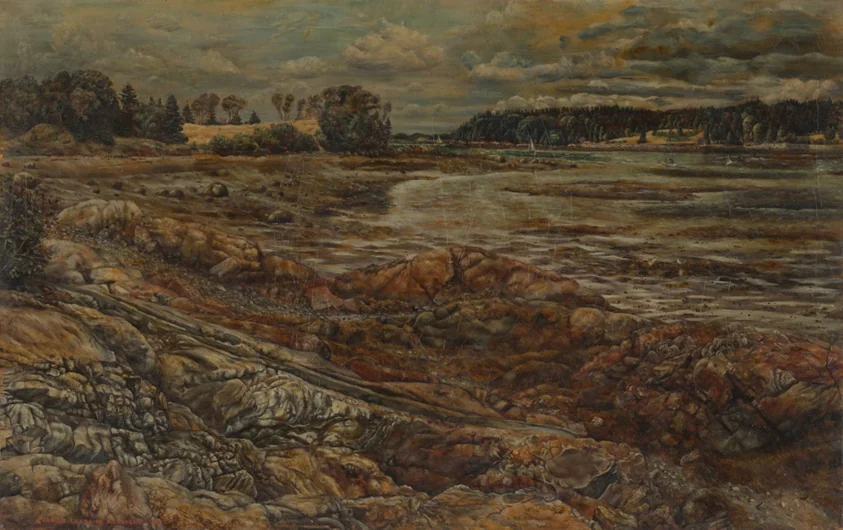
Ivan Albrights Divided and Divided from 1941 is an oil painting that exemplifies the artists obsession with physical decay, psychological fragmentation, and the grotesque transformation of the human body under the pressure of time and mortality. Albright, who spent his career in Chicago producing paintings of such meticulous detail and disturbing intensity that he was dubbed the master of the macabre, developed a technique of building up paint in layers of stippling and cross-hatching that gives his surfaces a textural richness unprecedented in American painting. The title Divided and Divided suggests a process of multiplication by division, a cell-like splitting that transforms organic unity into fragmented multiplicity, and the painting depicts a figure or object in a state of decomposition that mirrors the artists own anxiety about the disintegration of the physical body. The year 1941 places this work in the period before Albrights service as a war artist in World War II, an experience that would reinforce his preoccupation with physical destruction and psychological disintegration. The painting technique, with its obsessive accumulation of tiny marks that build up to create an image of horrifying specificity, represents the opposite of the broad, gestural painting that was becoming dominant in American art through the Abstract Expressionists, and Albrights insistence on representational detail and narrative content in a period of increasing abstraction made him a deliberately contrarian figure in the history of American painting.
Cultural Impact
Albrights paintings are among the most technically accomplished and psychologically disturbing works in American art, and their influence extends from the horror film tradition to the work of contemporary artists who explore the grotesque and the abject. Divided and Divided exemplifies the obsessive technique and macabre subject matter that made Albright a unique figure in 20th-century American painting.
Why It Matters
An oil painting by Albright exemplifying his master-of-the-macabre technique of meticulous stippling and cross-hatching, depicting physical decay and psychological fragmentation with an obsessive accumulation of detail that positioned him as a deliberate contrarian against the rise of Abstract Expressionism.


