Provenance
(Doll and Richards Gallery, Boston); purchased September 1874 by George Baty Blake, Boston; by descent 1884 to his son, George Baty Blake, Jr., Boston, until about 1905; (Walter Rowlands Gallery, Boston); sold 1912 to Daniel Merriman, Worcester; his wife, Mrs. Daniel Merriman [née Helen Bigelow], by 1914; her son, Roger Bigelow Merriman, by 1936; his widow, Mrs. Roger Merriman; (Victor Spark and Macbeth Gallery, New York), 1947; purchased 1949 by Corcoran Gallery of Art, Washington; acquired 2014 by the National Gallery of Art.
Accession Number
2014.79.25
Medium
oil on canvas
Dimensions
overall: 61.4 × 51 cm (24 3/16 × 20 1/16 in.) | framed: 76.2 × 66 × 7.6 cm (30 × 26 × 3 in.)
Classification
Painting
Credit Line
Corcoran Collection (Museum Purchase, Anna E. Clark Fund)
Tags
Painting Impressionist & Modern (1851–1900) Oil Painting Canvas American
Background & Context
Background Story
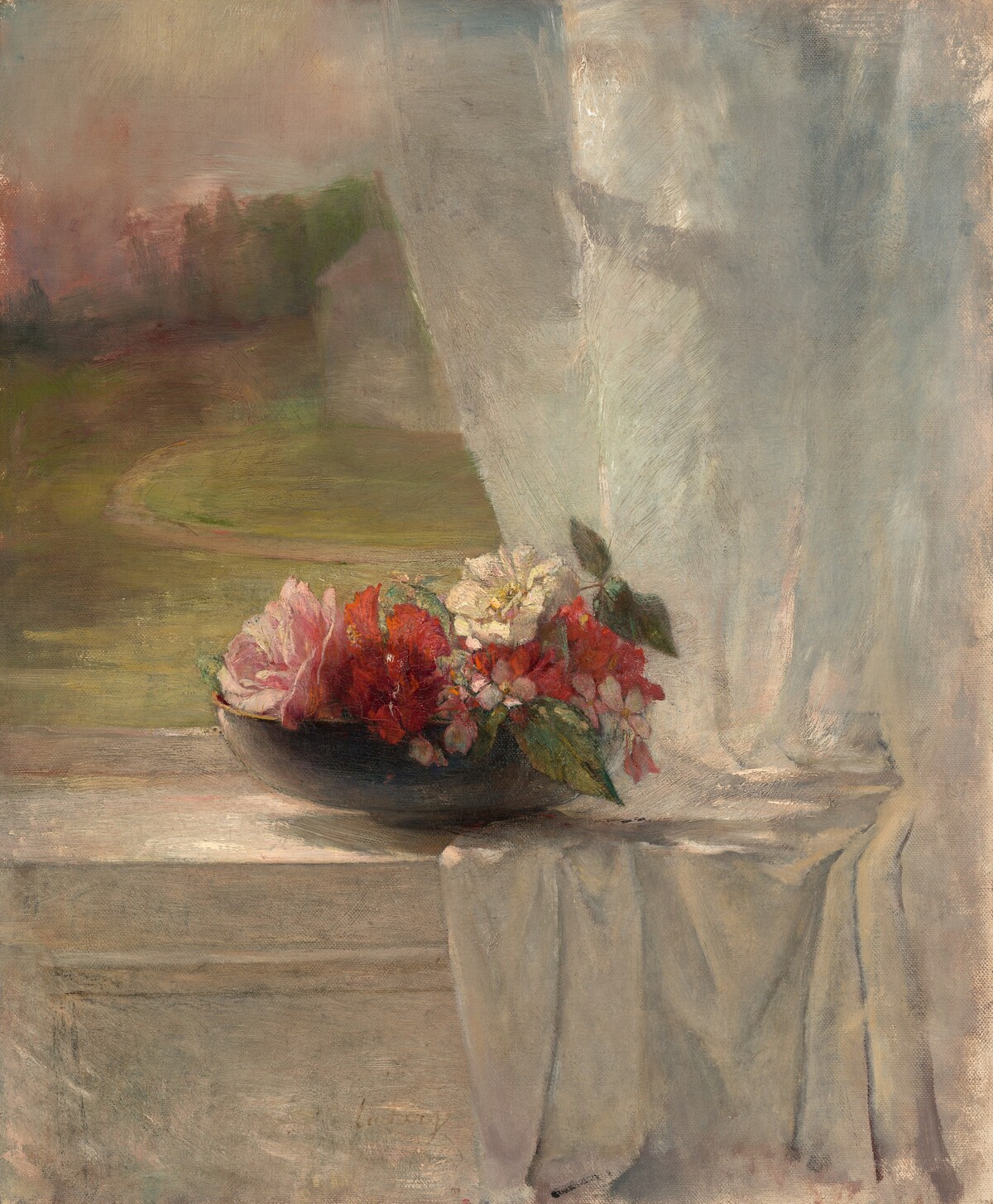
John La Farge (1835-1910) was one of America's most versatile artists — painter, muralist, stained glass designer, and writer — and this early oil painting from around 1861 shows him working in the still-life tradition that would inform his later, more ambitious work. Flowers on a Window Ledge combines the intimate scale of a domestic still life with the color sensibility that would make La Farge's stained glass rooms among the most beautiful in American art. The window ledge format — flowers displayed against a view through a window — was a standard still-life device, but La Farge's handling of the light, which passes through the petals and filters through the glass, anticipates his later obsession with translucent color.
Cultural Impact
La Farge's early still-life paintings were created during the same period when he was studying Japanese art and developing the theories of color harmony that would inform his stained glass. Flowers on a Window Ledge shows these interests in embryo: the composition is influenced by Japanese asymmetry, and the treatment of color anticipates the opalescent glass techniques he would patent in the 1880s. The painting is a small work with large implications.
Why It Matters
Flowers on a Window Ledge is La Farge's stained glass sensibility in oil: flowers and window glass creating the same translucent color effects that he would later achieve in glass. The painting is a modest still life that points toward the revolutionary opalescent glass rooms still to come.