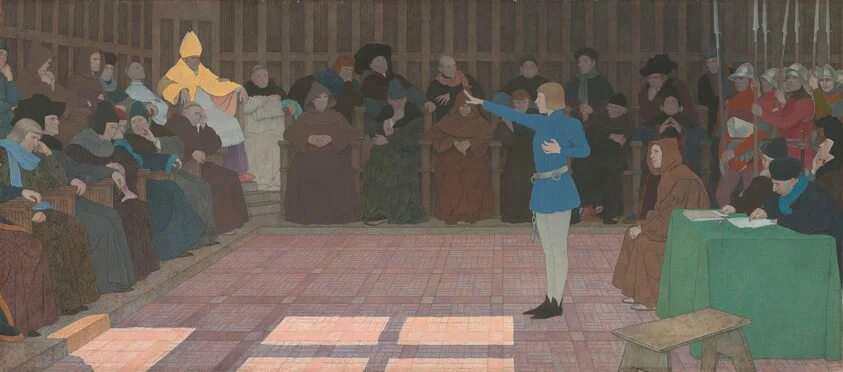
Provenance
Commissioned by William A. Clark [1839-1925], New York; bequest April 1926 to the Corcoran Gallery of Art, Washington; acquired 2015 by the National Gallery of Art.
The Trial of Joan of Arc (Joan of Arc series: VI)
c. late 1909-early 1910
Accession Number
2015.19.39
Medium
oil and gold leaf on canvas
Dimensions
overall: 75.57 × 171.45 cm (29 3/4 × 67 1/2 in.) | framed: 97.79 × 193.04 × 9.53 cm (38 1/2 × 76 × 3 3/4 in.)
Classification
Painting
Credit Line
Corcoran Collection (William A. Clark Collection)
Tags
Painting Early Modern (1901–1950) Oil Painting Gold Leaf Canvas French
Background & Context
Background Story
The Trial of Joan of Arc is the sixth and final panel in Boutet de Monvel's series, depicting the moment of Joan's condemnation by the English-backed church court at Rouen. The composition shows Joan standing alone before her judges, while the gold leaf background transforms the courtroom into a sacred space—the martyr facing her persecutors with the same divine authority that animated her military campaigns. The stylized rendering of the judges (uniformly hostile) and Joan (resolute in her faith) creates a clear moral dichotomy that was central to the Joan of Arc mythology in early 20th-century France.
Cultural Impact
The Trial of Joan of Arc was the most charged panel in the series because it touched on the question of Joan's sainthood at a time when her canonization was being debated. Boutet de Monvel's treatment unambiguously presents Joan as a martyr rather than a heretic, aligning the painting with the nationalist and Catholic cause that was pushing for her canonization. The gold leaf background, which throughout the series transforms historical events into sacred iconography, here transforms a judicial murder into a martyrdom.
Why It Matters
The Trial of Joan of Arc is the series' climax: Joan alone before her judges, the gold leaf transforming the courtroom into a sacred space where martyrdom and sainthood are revealed. The painting is not just a historical scene but a devotional image—the visual argument for Joan's canonization, rendered in the language of medieval hagiography.
Related Artworks

Jeanne d'Arc (Joan of Arc)
Boutet de Monvel, Louis Maurice

The Crowning at Rheims of the Dauphin (Joan of Arc series: V)
Boutet de Monvel, Louis Maurice
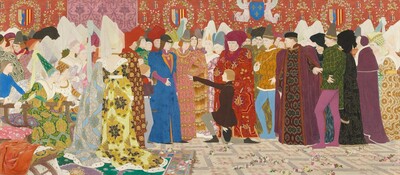
Her Appeal to the Dauphin (Joan of Arc series: II)
Boutet de Monvel, Louis Maurice
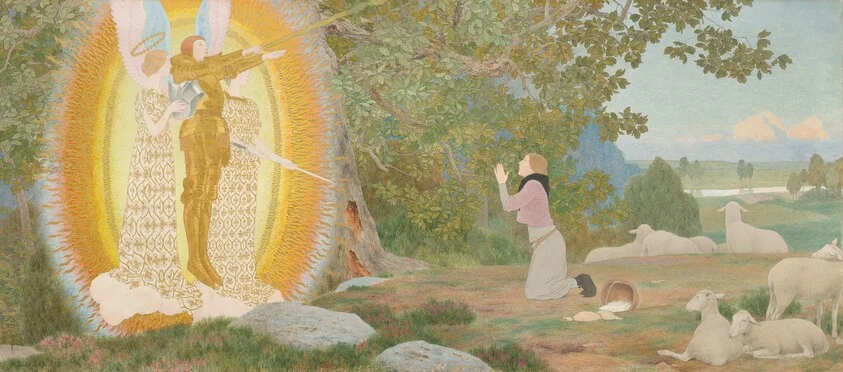
The Vision and Inspiration (Joan of Arc series: I)
Boutet de Monvel, Louis Maurice