Provenance
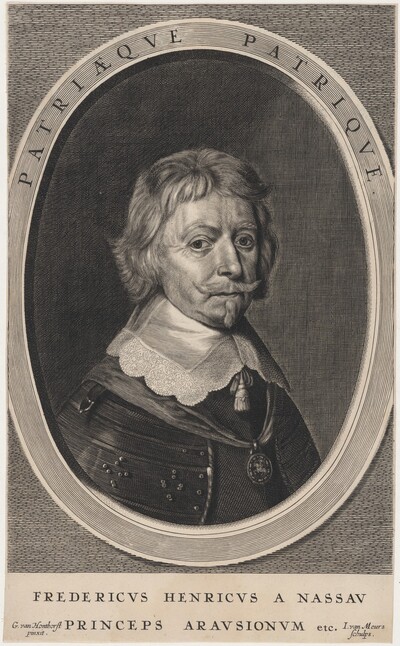
Probably Prince Frederick Hendrick of Orange [1584-1647], The Hague, by 1632; by descent to Prince Willem V of Orange [1748-1806], The Hague;[1] requisitioned as a ‘spoil of war’ by the Revolutionary Government of France, and taken to Paris, May 1795.[2] private collection, Paris and Senan, France, since 1840;[3] purchased jointly 2009 by (Anthony Speelman, London) and (Adam Williams Fine Art, Ltd., New York);[4] purchased 31 July 2013 by NGA.
[1] According to the inventory of the Stadhouderlijk Kwartier (the Stadholder’s official residence) made in August 1632: "In the Great Hall: (no. 611) A painting for the fireplace mantle made by Honthorst, being a Music." The inventory covers the collections of both the Prince of Orange and of his wife, Amalia van Solms. The painting was not inherited by (female) heirs of Amalia van Solms, which indicates that in 1632 it was owned by the Prince of Orange and later inherited in the male line. The _Catalogus Kabinet van Schilderijen van Willem V op het Buitenhof_ (_Catalog of the Gallery of Paintings of Prince Willem V of Orange_), undated, but no later than 1793, includes: "(No. 65) A company making music, on canvas in [black frame with gilded inside edge] by Honthorst."
[2] _Catalogus van de schooner verzameling Schilderijen die zig in den Haag bevonden in de Galerij van den voormaligen Stad-houder Willem den vijfden Prins van Orange etc. etc. en die in Frankrijk getransporteerd zijn voor en door de Fransche Natie als gereekend zijnde te behooren onder de geconquesteerde goederen van dien Prins in Mey 1795_. Likely No. 69: "Een Consert, van verscheide speelders en speelsters Leevens groote halverlijf op doek door G. Honthorst, 4 voet 5 duim 6 voet 5 duim" (A concert of several male and female musicians, life size, half length on canvas by Honthorst, 4 feet 5 thumbs). (1814 copy of 1795 original, Rijksarchief, Den Haag, ARA, Archief Binnenlandse Zaken, Onderwijs, Kunsten en Wetenschappen 1815-1848, dossier nr. 4029.)
[3] A set of four interior scenes of the owner’s country residence, circa 1900, by French artist Etienne Azambre (1859 -1935) includes a _View of the ‘grand salon’ as seen from the ‘petit salon’_ in which the right 2/3 portion of the NGA’s painting is visible on the far wall. (Photos of the four paintings are in the NGA curatorial files.) See also Speelman's account of the ownership in this period in his book _A Tale of Two Monkeys: Adventures in the Art World_, London, 2022: 159-161.
[4] Permanent French export license no. 111555, issued on 23 July 2009; copy in NGA curatorial files.
Accession Number
2013.38.1
Medium
oil on canvas
Dimensions
overall: 123.5 × 205 cm (48 5/8 × 80 11/16 in.)
Classification
Painting
Credit Line
Patrons' Permanent Fund and Florian Carr Fund
Tags
Painting Baroque (1600–1750) Oil Painting Canvas Dutch
Background & Context
Background Story
Gerrit van Honthorst (1592-1656) was a Dutch Golden Age painter known for his dramatically lit nocturnal scenes in the manner of Caravaggio, whose work he studied during his years in Rome (c. 1610-20). The Concert from 1623 depicts a musical gathering in the dramatically lit, nocturnal manner that earned Honthorst the nickname 'Gherardo delle Notti' (Gerrit of the Nights) in Rome. The 1623 date places this just after Honthorst's return from Rome to Utrecht, when he was producing the dramatically lit genre scenes that made him the most accomplished Dutch follower of Caravaggio.
Cultural Impact
The Concert is important in the history of Dutch Golden Age painting because it demonstrates the Caravaggist manner that Honthorst brought back from Rome to Utrecht in the early 1620s. The dramatically lit, nocturnal manner that earned Honthorst his nickname 'Gherardo delle Notti' would influence the development of Dutch genre painting throughout the 1620s and 1630s, and The Concert shows the Caravaggist manner at its most dramatically effective in Dutch hands.
Why It Matters
The Concert is Honthorst's 'Gherardo delle Notti' manner: a musical gathering rendered in the dramatically lit, nocturnal style that earned him the nickname 'Gerrit of the Nights' in Rome. The 1623 painting shows the Caravaggist manner that Honthorst brought back from Rome, which would influence Dutch genre painting throughout the 1620s.