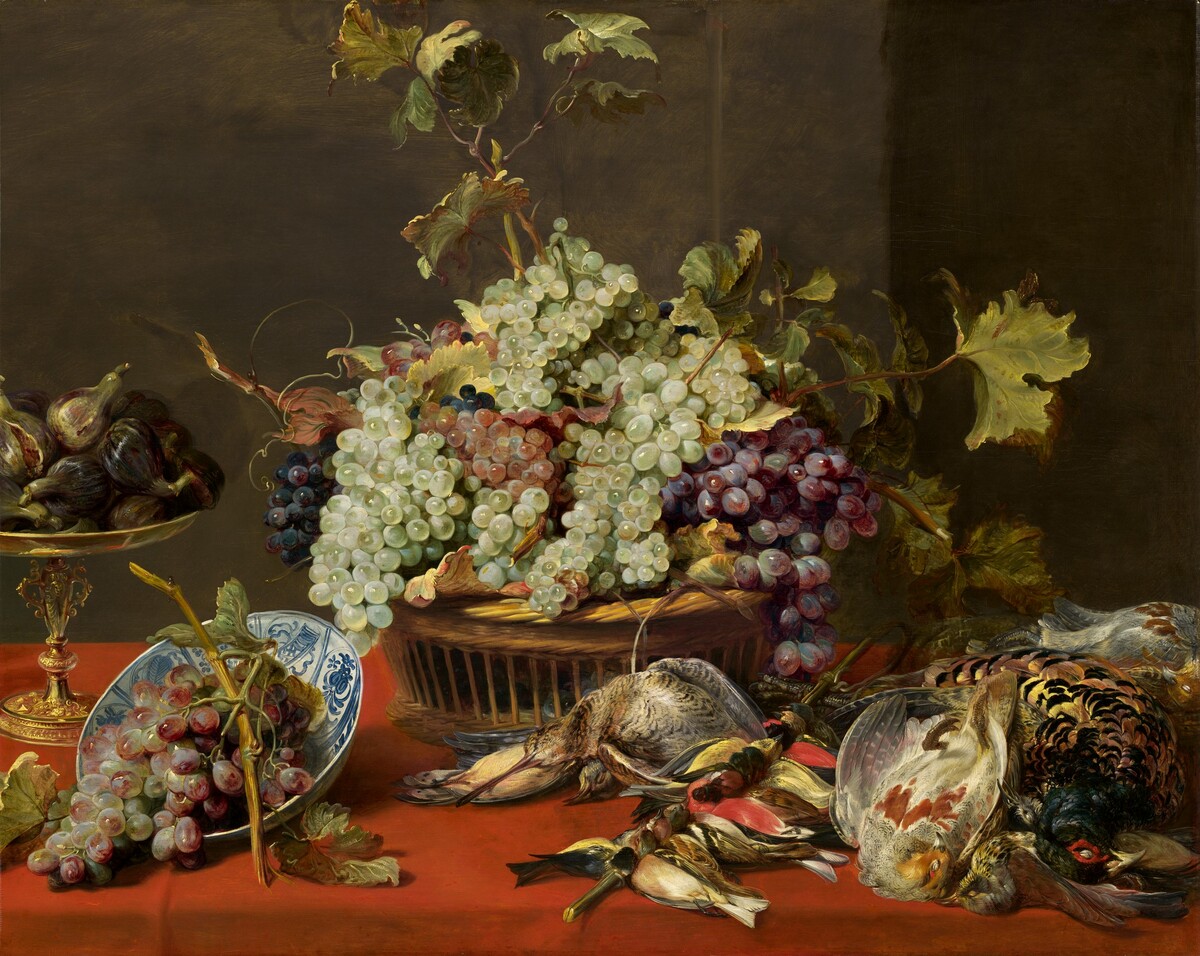
Provenance
Oscar Winterbottom [b. 1891], Horton Hall, Northampshire; by descent in his family;[1] (sale, Christie, Manson & Woods, London, 8 July 2005, no. 50); (Johnny van Haeften Ltd., London, and Colnaghi, London); purchased 15 February 2006 by NGA.
[1] This provenance is given in the catalogue of Christie's (London) 8 July 2005 sale. The Horton Hall mansion, sold c. 1899 to George Winterbottom [1861-1934], was demolished in 1936.
Accession Number
2006.22.1
Medium
oil on panel
Dimensions
overall: 90.2 x 112.1 cm (35 1/2 x 44 1/8 in.) | framed: 111.8 x 133.4 x 7 cm (44 x 52 1/2 x 2 3/4 in.)
Classification
Painting
Credit Line
Gift of The Lee and Juliet Folger Fund in Honor of the Twentieth Anniversary of the Circle of the National Gallery of Art
Tags
Painting Baroque (1600–1750) Oil Painting Panel Painting Flemish
Background & Context
Background Story
Frans Snyders (1579-1657) was a Flemish painter known as the most important still life and animal painter of the Flemish Baroque, whose large-scale still lifes of game, fruit, and dead animals make him one of the most accomplished painters of the 17th-century Flemish tradition. Still Life with Grapes and Game from c. 1630 depicts grapes and game in the dynamic, colorful manner that distinguishes Snyders's best work from the more restrained still life painting of his contemporaries. The c. 1630 date places this in Snyders's most productive period, when he was producing the large-scale still lifes that are his most accomplished works, and the grapes and game subject shows his talent for depicting the abundance of nature with dynamic energy.
Cultural Impact
Still Life with Grapes and Game is important in the history of Flemish painting because it demonstrates the dynamic, colorful manner that Snyders brought to still life as the most important still life and animal painter of the Flemish Baroque. Snyders's large-scale still lifes—combining the abundance of game and fruit with the dynamic energy of the Baroque—represent one of the most important traditions in Flemish painting, and the c. 1630 painting shows this tradition at its most dynamic.
Why It Matters
Still Life with Grapes and Game is Snyders's dynamic Flemish still life: grapes and game rendered in the energetic manner of the most important still life and animal painter of the Flemish Baroque. The c. 1630 painting shows the combination of abundance and dynamic energy that makes Snyders one of the most accomplished still life painters of the 17th century.
![Saint Bernard and Saint Catherine of Alexandria with the Virgin of the Annunciation [right panel]](https://api.nga.gov/iiif/e6890364-4d99-4684-a62b-5060ee3c3446/full/400,/0/default.jpg)