Provenance
Purchased from the artist by Alvin Adams [1804-1877], Watertown, Massachusetts, by 14 December 1858;[1] his estate; (his estate sale, Leonard & Co., Boston, 16-17 March 1882, 2nd day, no. 109); Hezekiah Conant [1827-1902], Pawtucket, Rhode Island;[2] William Leroy Sunderland [d. 1938], Exeter, Rhode Island, circa 1890;[3] his wife, Pearl Joslin Tarbox Sunderland Rose [d. 1989], Exeter, Rhode Island; (her estate sale, Northern Appraisers, Warwick, Rhode Island, 13 October 1990, no. 43).[4] purchased 1990 by NGA.
[1] On 14 December 1858 the _New Bedford Daily Mercury_ reported "Mr. Bierstadt has disposed of his oil painting of 'Lake Lucerne' to a gentleman in Boston [Alvin Adams], for the sum of $925." Orphaned as a young boy, Adams [1804-1877] later rose to prominence and acquired a substantial fortune as founder and president of the Adams Express Company. In 1860 he built Fairhaven, a lavish home in Watertown, Massachusetts, where he displayed his art collection in a gallery open to the public one day a week.
[2] Alvin Adams died 1877 but his art collection was not sold until 1882. On 18 March 1882 the _Boston Globe_ reported that _Lake Lucerne_ had been purchased at the Adams sale by Mr. H[ezekiah] Conant of Pawtucket, Rhode Island, for $3375. Conant [1827-1902], an inventor and manufacturer, had established the Conant Thread Company in Pawtucket in 1868. For many years the largest employer in the state, he succeeded in forging profitable alliances with European thread manufacturers including J. & P. Coats Company, Ltd., of Paisley, Scotland, which began operating the Conant Thread Company as one of its branches in 1893.
[3] _The New York Times_ (11 June 1990) reported that John D. Lynch, executor of the Rose estate, said he was told by Mrs. Rose that William L. Sunderland, her first husband, had acquired the painting in the 1890s.
[4] _Lake Lucerne_ was purchased at auction by Richard York of Richard York Gallery, New York, acting on behalf of the National Gallery of Art with funds provided by Richard M. Scaife and Margaret R. Battle.
Accession Number
1990.50.1
Medium
oil on canvas
Dimensions
overall: 182.9 x 304.8 cm (72 x 120 in.) | framed: 235.3 x 359.4 x 17.2 cm (92 5/8 x 141 1/2 x 6 3/4 in.)
Classification
Painting
Credit Line
Gift of Richard M. Scaife and Margaret R. Battle, in Honor of the 50th Anniversary of the National Gallery of Art
Tags
Painting Impressionist & Modern (1851–1900) Oil Painting Canvas American
Background & Context
Background Story
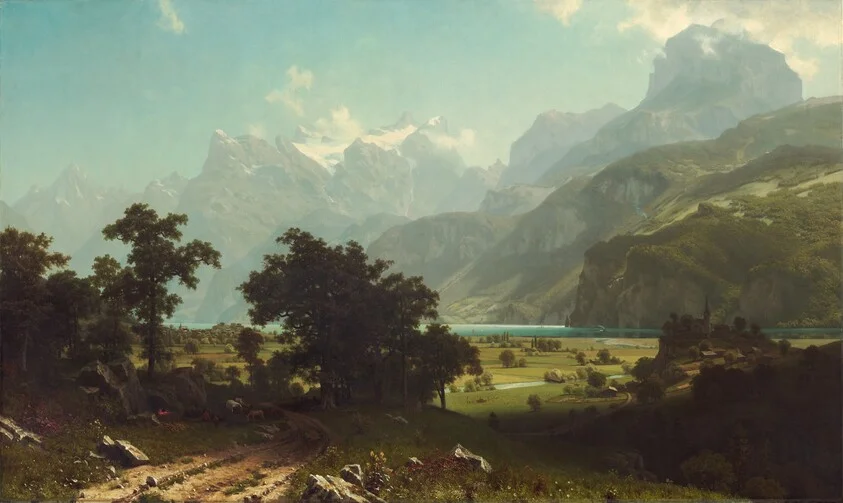
Lake Lucerne from 1858 is one of Bierstadt's early European landscapes, painted during his study period in Düsseldorf and Switzerland before he made his first trip to the American West. The lake, surrounded by Swiss mountains and rendered with the detailed topographic accuracy that characterized the Düsseldorf School, demonstrates the European training that Bierstadt would later apply to American scenery. The composition is characteristically grand—the lake fills the foreground, the mountains rise in the middle distance, and the sky provides atmospheric drama—but the scale is more intimate than the vast western panoramas that would make his reputation.
Cultural Impact
Lake Lucerne is important as a document of Bierstadt's artistic formation. The detailed rendering of the Swiss landscape, the panoramic composition, and the dramatic atmospheric effects are all techniques that Bierstadt learned in Europe and later applied to the American West. The painting demonstrates that the 'Bierstadt style' was not invented for the West but developed in Europe and then adapted to the even more dramatic scenery of the American frontier.
Why It Matters
Lake Lucerne is Bierstadt's European training on display: the techniques he would later apply to the Rocky Mountains and the Sierra Nevada are all present in this Swiss lake—the panoramic composition, the detailed topography, and the atmospheric drama. The West would give him more spectacular scenery, but the approach was already formed.