Provenance
Arthur George, 3rd earl of Onslow [1777-1870], Richmond, and Clandon Park, near Guilford, Surrey;[1] his heirs; (his estate sale, Christie, Manson & Woods, London, 22 July 1893, no. 24); (J.W. Vokins).[2] Siméon del Monte, Brussels, by 1928;[3] sold by his heirs at (sale, Sotheby's, London, 24 June 1959, no. 22); purchased by (P. & D. Colnaghi & Co., London); (sale, Christie, Manson & Woods, London, 19 April 1985, no. 111); purchased by NGA.
[1] The Arthur George ownership comes from labels that were formerly affixed to the stretcher (now in NGA curatorial files).
[2] The buyer is noted in an annotated copy of the sales catalogue; copy in NGA curatorial files.
[3] Published in Gustav Glück, _La Collection del Monte_, Vienna, 1928: 22, pl. 41. An old label from the back of the painting (now in NGA curatorial files) also refers to the del Monte collection.
Accession Number
1985.29.1
Medium
oil on canvas
Dimensions
overall: 114.3 x 167.3 cm (45 x 65 7/8 in.) | framed: 147.3 x 146.1 x 6.4 cm (58 x 57 1/2 x 2 1/2 in.)
Classification
Painting
Credit Line
Ailsa Mellon Bruce Fund
Tags
Painting Baroque (1600–1750) Oil Painting Canvas Dutch
Background & Context
Background Story
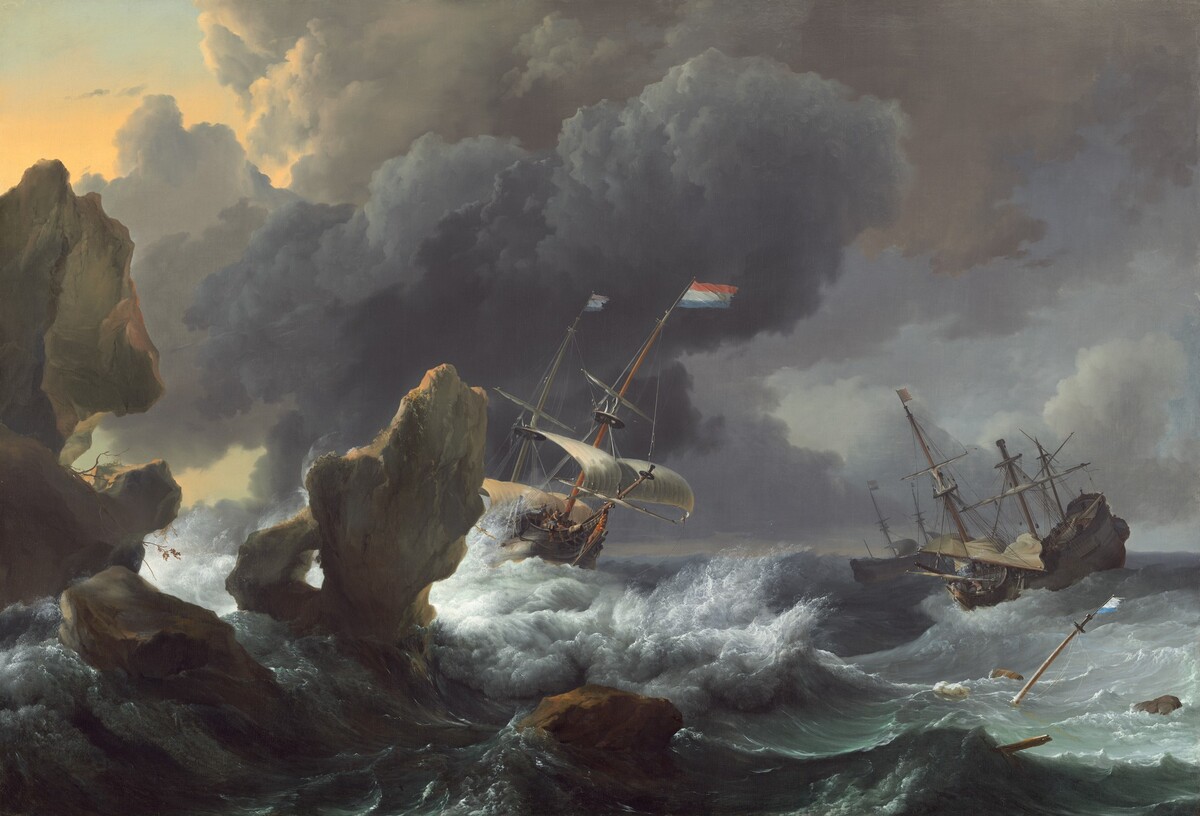
Ludolf Backhuysen (1630-1708) was the leading marine painter of the Dutch Golden Age after Willem van de Velde, known for his dramatic depictions of ships in stormy seas that combined topographical accuracy with theatrical grandeur. Ships in Distress off a Rocky Coast from 1667 is a characteristic Backhuysen subject: ships struggling against wind and waves near a threatening coastline, with the composition organized by the diagonal lines of masts and waves that give his best seascapes their dramatic energy. The 1667 date places this in Backhuysen's most productive period, when he was the preferred marine painter of the Amsterdam elite.
Cultural Impact
Backhuysen's maritime paintings are among the most important works in the history of marine painting because they combine the topographical accuracy of the Dutch marine tradition with the dramatic grandeur of the Baroque. Ships in Distress off a Rocky Coast demonstrates Backhuysen's ability to make topographical accuracy serve dramatic purposes: the ships are rendered with the precision of a marine painter who understood rigging and navigation, but the composition and the lighting transform the topographical record into a scene of Baroque drama.
Why It Matters
Ships in Distress off a Rocky Coast is Backhuysen's marine painting at its most dramatic: topographically accurate ships struggling against wind and waves, organized by the diagonal lines of masts and waves that give the composition Baroque energy. The 1667 painting demonstrates that Dutch marine accuracy and Baroque drama are not incompatible—the same ships that carry Dutch trade and naval power can be actors in scenes of maritime theater.