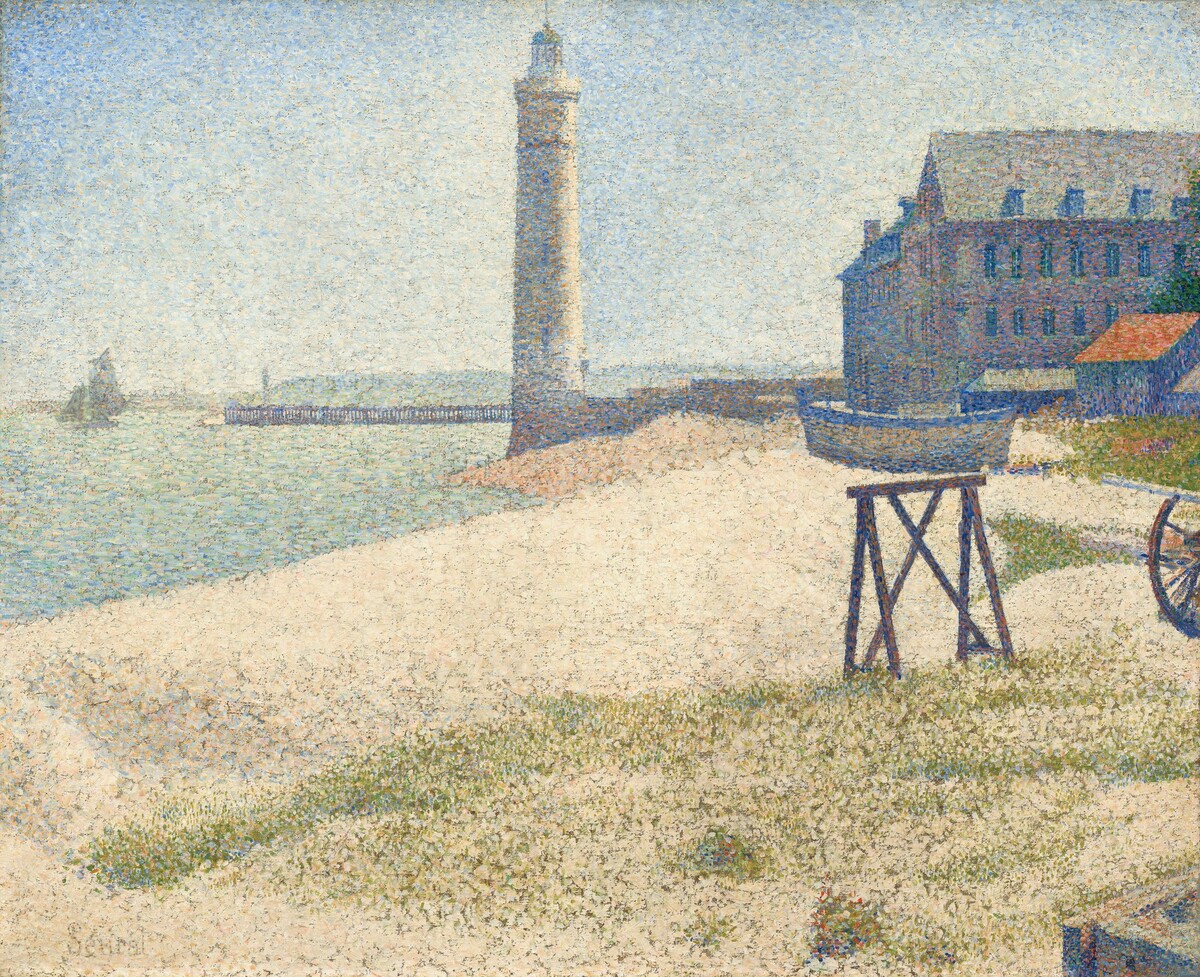
Provenance
From the artist 1887 to Emile Verhaeren, Paris. Curt von Mützenbecher, Wiesbaden, by 1907. (Bernheim-Jeune, Paris) from 1909 until 1913.[1] Richard Goetz, Paris, from 1913; (sale of his sequestered property, Hôtel Drouot, Paris, 23 February 1922, no. 181);[2] acquired from Goetz in June 1929 through (Dr. Alfred Gold [1874-1958]) by (César de Hauke, New York);[3] on joint account from 1929 with (Alex Reid & Lefèvre, London) and (Jacques Seligmann et Cie., New York and Paris); sold 1934 via (Alex Reid & Lefevre, London) to Mrs. Alfred Chester Beatty [née Edith Dunn Stone, d. 1952], London;[4] by inheritance to Sir Alfred Chester Beatty, London [d. 1968]. (Arthur Tooth and Sons, London); sold 1965 to Mr. Paul Mellon, Upperville, VA; gift 1983 to NGA.
[1] Lent by Bernheim-Jeune to 1910-1911 exhibition at Grafton Galleries, London.
[2] Goetz was a German national whose property was sequestered by the French government during the First World War and sold at this 1922 auction. The purchaser, according to the annotated copy of the sales catalogue in the Knoedler library [Knoedler microfiche, French no. 0896], was "Grunewald." This likely refers to Isaac Grünewald, a Swedish artist who had gone to Paris in 1908 to study with Matisse and was part of a group of German and German-speaking artists in Paris, including Goetz, who gathered at the Café du Dôme before WWI (see _Pariser Begegnungen 1904-1914_, exh. cat. Duisburg, 1965, and Annette Gautherie-Kampka, _Les Allemands du Dôme_, Bern, 1995.) Grünewald, who took over Goetz's Paris studio in 1921, quite possibly purchased the painting for Goetz, as it was the latter who then later sold it through Dr. Alfred Gold in 1929. Goetz returned to France after WWI and rebuilt his collection before moving to New York in 1939. According to Henri Dorra and John Rewald's catalogue raisonné of Seurat's paintings, no. 168, Goetz had tried to donate this picture to the Louvre at the outbreak of hostilities in 1914, but it was refused.
[3] See de Hauke records in the Seligmann papers at the Archives of American Art, box 406 (copies in NGA curatorial files). See also correspondence between de Hauke and Dr. Alfred Gold regarding Gold's commission, and Gold's correspondence with Goetz, in Seligmann papers, box 394 (copies in NGA curatorial files).
[4] The painting was still on de Hauke's books when his gallery closed, and its association with Seligmann dissolved, in 1931. It was then on joint account with Seligmann and Alex Reid & Lefèvre until its sale in 1934. Reid & Lefèvre Paintings Sold, sheet no. 248, #116/29 B1572 gives acquisition source as Wilhelm Lowenstein. However, Gold's correspondence with Richard Goetz (see n. 3 above) makes it clear that Goetz still owned the painting in 1929; perhaps Lowenstein acted as an intermediary. (Lefèvre archives, Hyman Kreitman Research Centre, Tate Britain, London, TGA 2002/11, Box 283). See also the Seligmann papers at the Archives of American Art, Washington, D.C., boxes 7, 177, 406-407 (copies in NGA curatorial files), and Germain Seligman, _Merchants of Art, 1880-1960: Eighty Years of Professional Collecting_, New York, 1961: 206, pl. 64b.
Accession Number
1983.1.33
Medium
oil on canvas
Dimensions
overall: 66.7 × 81.9 cm (26 1/4 × 32 1/4 in.) | framed: 86.36 × 101.6 × 7.62 cm (34 × 40 × 3 in.)
Classification
Painting
Credit Line
Collection of Mr. and Mrs. Paul Mellon