Provenance
(Galerie Nebehay, Vienna); sold 1919 to Otto [d. 1926] and Eugenia Primavesi, Vienna;[1] acquired 1928 with other paintings from Eugenia Primavesi by Hugo or Otto Bernatzig (or Bernatzik), Vienna. Brought to the United States by Josef Urban [1872-1933], New York.[2] (Galérie St. Etienne, New York), possibly by 1959;[3] Otto [1894-1978] and Franziska [1899-1992] Kallir, New York; acquired 1978 through gift and purchase by NGA.
[1] According to Tobias G. Natter, cited in _Klimt, Schiele, Moser, Kokoschka. Vienne 1900_, Exh. cat., Galeries nationales du Grand Palais, Paris, 2005-2006: unnumbered catalogue. The name Sigmund Primavesi that is listed in the painting's provenance in the 1965 Guggenheim exhibition catalogue is probably an error.
[2] According to Jane Kallir, _Saved from Europe: Otto Kallir and the History of the Galerie St. Etienne_, Exh. cat., Galerie St. Etienne, New York, 1999: pl. 16.
[3] The Galerie St. Etienne, whose owners were Otto and Franziska Kallir, included the painting in its 1959 Klimt exhibition. Mrs. Josef Urban was listed in the catalogue as a lender, but which painting(s) she lent is not specified, so it is possible she had inherited the painting from her husband and still owned it in 1959.
Accession Number
1978.41.1
Medium
oil on canvas
Dimensions
overall: 110.9 x 110.4 cm (43 11/16 x 43 7/16 in.) | framed: 116.21 x 115.89 x 6.67 cm (45 3/4 x 45 5/8 x 2 5/8 in.)
Classification
Painting
Credit Line
Gift of Otto and Franziska Kallir with the help of the Carol and Edwin Gaines Fullinwider Fund
Background & Context
Background Story
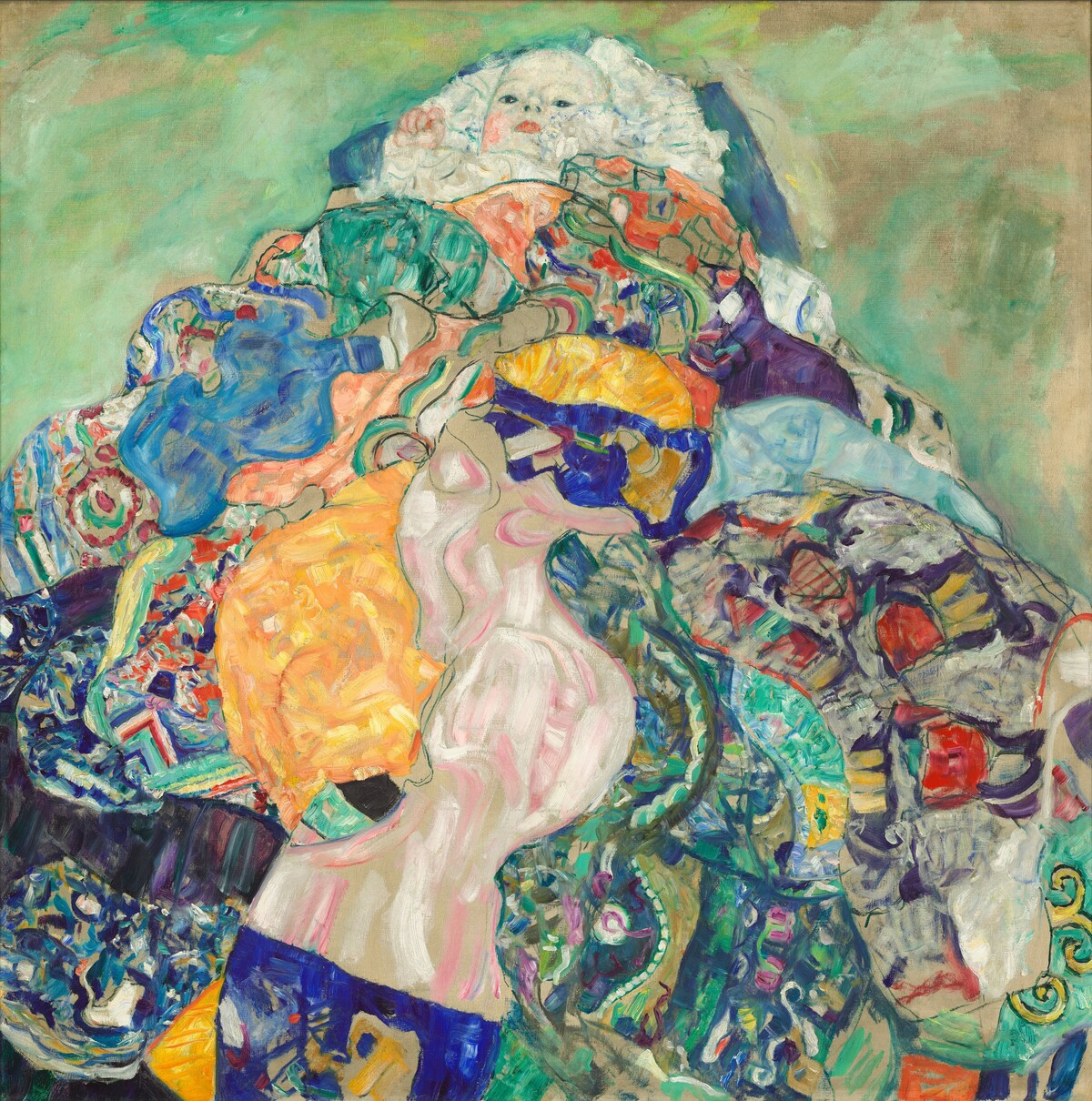
Gustav Klimt (1862-1918) was an Austrian painter known for his decorative, gilded portraits and allegorical paintings that make him the most accomplished painter of the Vienna Secession. Baby (Cradle) from 1917-18 is one of Klimt's last paintings, left unfinished at his death in February 1918, depicting a baby in a cradle surrounded by the colorful, patterned decoration that distinguishes his late work. The 1917-18 date places this at the very end of Klimt's career, when he was producing the freely painted, colorful works that show a departure from the gilded manner of his earlier portraits toward a more painterly, atmospheric approach.
Cultural Impact
Baby (Cradle) is important in Klimt's late oeuvre because it shows the freely painted, colorful manner that he was developing at the end of his career—a departure from the gilded, decorative manner of his earlier portraits. The painting was left unfinished at Klimt's death in February 1918, making it one of the last works of the Vienna Secession's greatest painter, and the unfinished state reveals Klimt's working process in a way that his finished paintings do not.
Why It Matters
Baby (Cradle) is Klimt's last unfinished painting: a baby in a cradle surrounded by colorful pattern, left incomplete at his death in February 1918. The 1917-18 painting shows the freely painted, atmospheric manner that Klimt was developing at the end of his career—a departure from the gilded decoration of his earlier portraits toward a more painterly approach.