Provenance
Purchased from the family of the artist by (Sam Salz, New York); sold April 1959 to Mr. Paul Mellon, Upperville, VA; gift 1995 to NGA.
Accession Number
1995.47.14
Medium
oil on cardboard
Dimensions
overall: 19.7 x 25.3 cm (7 3/4 x 9 15/16 in.) | framed: 34 x 39.7 x 4.4 cm (13 3/8 x 15 5/8 x 1 3/4 in.)
Classification
Painting
Credit Line
Collection of Mr. and Mrs. Paul Mellon
Tags
Painting Impressionist & Modern (1851–1900) Oil Painting Board French
Background & Context
Background Story
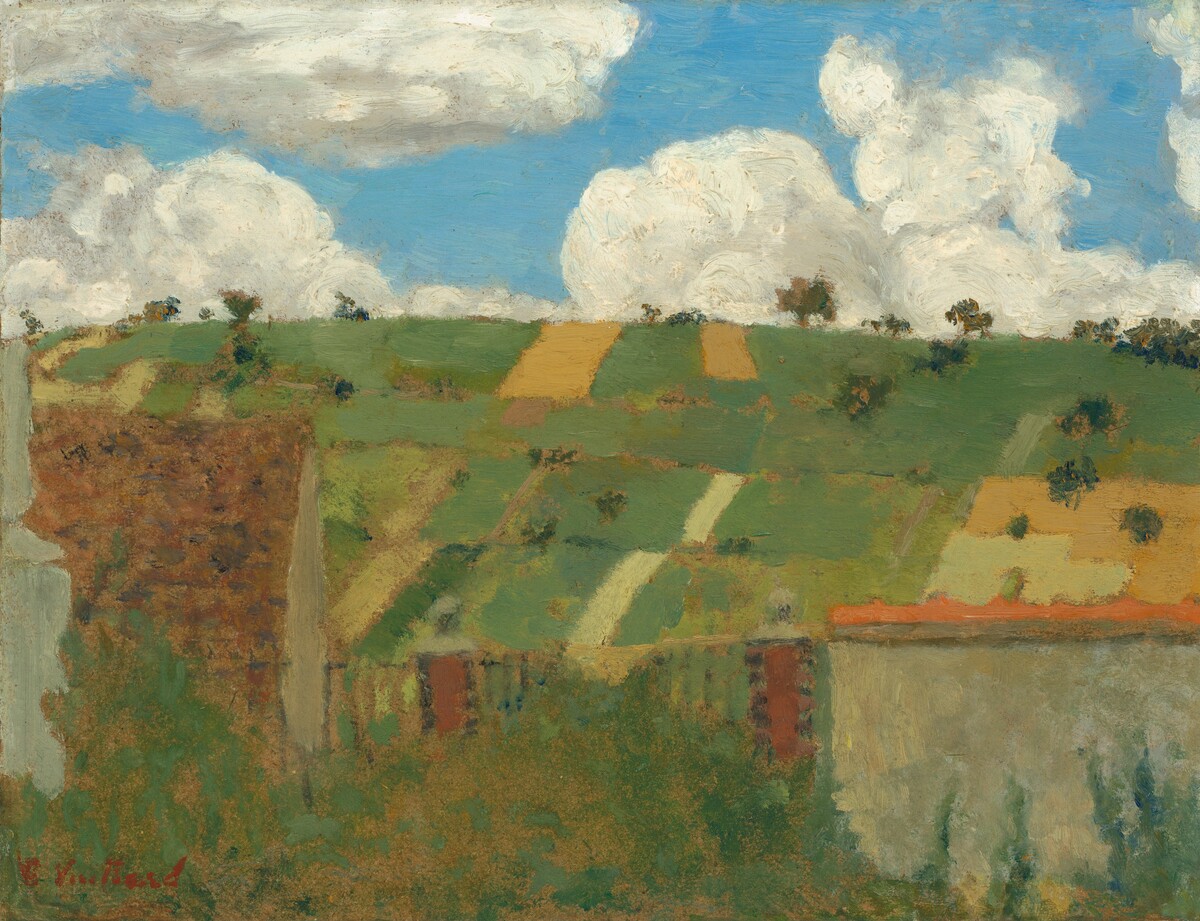
Landscape of the Ile-de-France (c. 1894) represents Vuillard's early engagement with landscape painting—a subject he approached with the same decorative sensitivity he brought to interior scenes. The Ile-de-France, the region surrounding Paris, provided the agricultural and suburban landscape that had inspired the Impressionists. Vuillard's 1894 treatment, painted during the height of his Nabi period, transforms this familiar landscape through decorative simplification: forms are flattened, colors are intensified, and the landscape's natural complexity is reduced to a patterned surface. The year 1894 was significant for the Nabi movement: the group had exhibited together for several years, and their decorative approach—drawing on Japanese prints, Gauguin's Synthetism, and the Symbolist interest in the spiritual dimension of visual experience—was reaching its fullest expression. Vuillard's landscape, with its pattern-intensive treatment, demonstrates how the Nabi approach could serve outdoor as well as indoor subjects. The Ile-de-France landscape, rendered with Vuillard's characteristic attention to pattern and surface, becomes a decorative composition that refers to the visible world without duplicating it—suggesting that the artist's task is to transform rather than record visual experience.
Cultural Impact
Vuillard's Nabi landscapes influenced how the Ile-de-France was represented in post-Impressionist art, offering decorative alternatives to Impressionist treatments of the same scenery. The paintings influenced later French painters who similarly sought to combine landscape observation with decorative treatment. The 1894 landscape influenced how the Nabi movement's outdoor work was understood, connecting its interior subjects to the broader landscape tradition.
Why It Matters
This painting matters because it demonstrates that the Nabi approach was not limited to interior subjects—Vuillard's decorative method could serve the open landscape as effectively as the enclosed room, arguing that artistic significance lies in the quality of seeing rather than in the nature of what is seen.
![Program Design for the Théâtre Libre [recto]](https://api.nga.gov/iiif/f8458b78-b7bf-4bb1-aa54-069a9696efaa/full/400,/0/default.jpg)