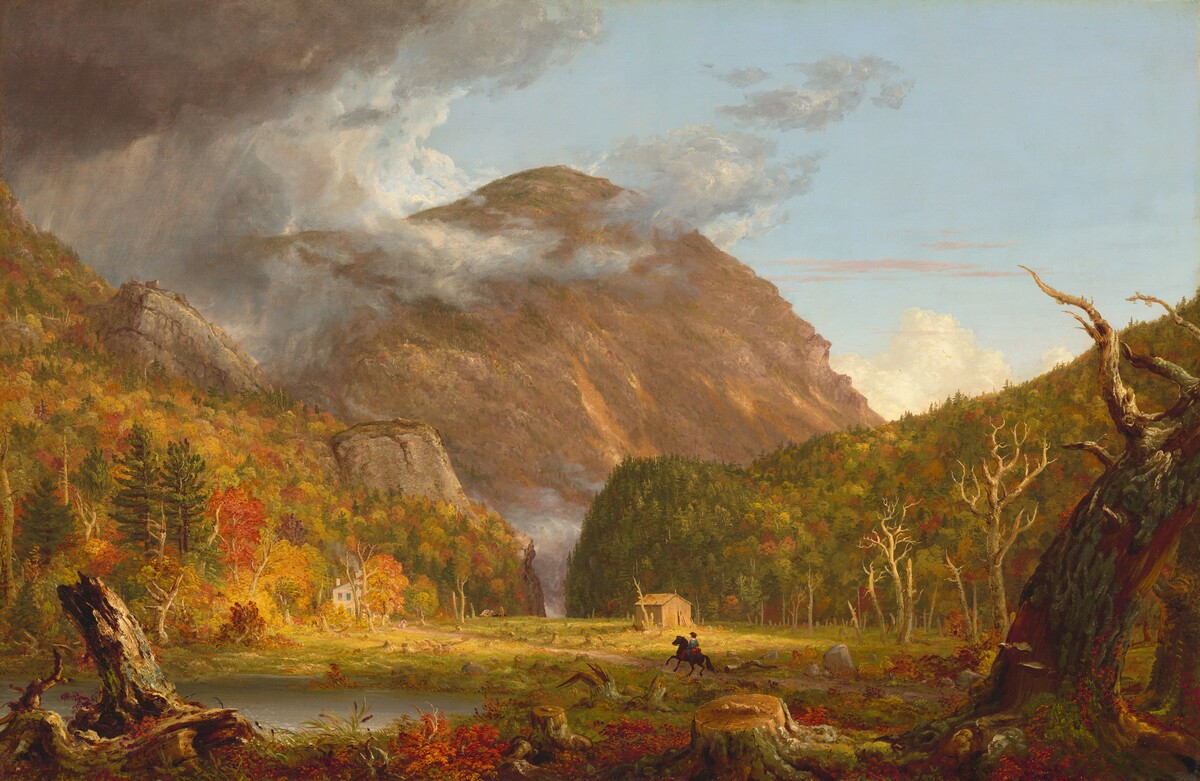
Provenance
Commissioned 1839 by Rufus L. Lord [1782-1869], New York.[1] Jonathan Sturges [1802-1874], New York, and Fairfield, Connecticut;[2] his son, Henry C. Sturges [d. 1924], Fairfield, Connecticut; his wife, Mrs. Henry C. Sturges, Fairfield, Connecticut; LeRoy Ireland, Philadelphia, probably early 1930s, but certainly by 1944;[3] purchased June 1944 by (Vose Galleries, Boston);[4] sold 5 April 1945 to Sanitary Scale Company, Belvidere, Illinois;[5] acquired 1966 by (Kennedy Galleries, New York); purchased 25 May 1967 by NGA.
[1] Lord commissioned the painting from Cole in 1839; see Theodore E. Stebbins, Jr., "Thomas Cole at Crawford's Notch," _National Gallery of Art Report and Studies in the History of Art_ 2 (1968): 138.
[2] Although there is no documentation, the Sturges family believed that Jonathan Sturges acquired the painting either directly from Rufus Lord or from his estate (letter of 10 November 1967 from Dudley Parker, in NGA curatorial files). Howard Merritt concurs in his letter of 29 October 1967 (in NGA curatorial files).
[3] The date Mrs. Sturges sold the painting and to whom are unknown to the Sturgeses. Parker's letter of 10 November 1967 (in NGA curatorial files), states that it was sold "in the depth of the great depression." In a letter of 2 June 1967 (in NGA curatorial files) Robert C. Vose, Jr., states that Vose Galleries purchased the painting from LeRoy Ireland, who "got it from the collection of Mr. H. C. Sturges of Fairfield, Connecticut."
[4] According to Vose (letter of 2 June 1967 in NGA curatorial files), the painting was sold to the Sanitary Scale Company while on view in the _Hudson River School_ exhibition at the AIC.
[5] Letter of 13 June 1973 from John V. Farwell III (in NGA curatorial files).
A View of the Mountain Pass Called the Notch of the White Mountains (Crawford Notch)
1839
Accession Number
1967.8.1
Medium
oil on canvas
Dimensions
overall: 102 x 155.8 cm (40 3/16 x 61 5/16 in.) | framed: 135.9 x 189.6 x 14 cm (53 1/2 x 74 5/8 x 5 1/2 in.)
Classification
Painting
Credit Line
Andrew W. Mellon Fund
Background & Context
Background Story
Self-Portrait with Thorn Necklace and Hummingbird, painted in 1940, is one of Frida Kahlo's most celebrated works. She depicts herself against lush foliage, wearing a necklace of thorns drawing blood from her neck, with a dead hummingbird suspended from the necklace and a black cat and monkey on either shoulder.
Kahlo painted this during one of the most turbulent periods of her life. Recently divorced from Diego Rivera and reconciled, her physical suffering from a spinal injury had intensified. The thorn necklace, a Christian symbol of Christ's passion, transforms personal suffering into sacred martyrdom.
The iconography draws from Christian and Aztec traditions. The hummingbird, traditionally a symbol of luck in Mexican folklore, hangs dead - reversing love's promise. The black cat (witchcraft) and monkey (Rivera's pet) create a dreamlike narrative whose meaning remains private. Kahlo's unflinching depiction of suffering combined with her synthesis of Mexican folk art and European Surrealism created a unique visual language of pain.
Cultural Impact
Kahlo's self-portraits created a new paradigm for female artistic self-representation: the body as site of both suffering and resistance. Her synthesis of personal narrative, Mexican folk tradition, and Surrealist symbolism influenced every subsequent artist who used autobiography for social and political commentary.
Why It Matters
This painting captures Kahlo's central paradox: suffering transformed into art, pain transfigured into beauty. The thorn necklace draws blood, but Kahlo's expression remains serene - the composure of a woman who has learned that suffering is something one does rather than something that happens.