Provenance
Sir Dudley Carleton, 1st viscount Dorchester [1573-1632], English Ambassador to The Hague, who acquired the painting in 1618 from the artist in an exchange for antique sculpture; presented to Charles I, King of England [1600-1649], between c. 1625 and 1632, where it hung in the Bear Gallery at Whitehall;[1] James Hamilton-Douglas, 1st duke of Hamilton [1606-1649], Hamilton Palace, Scotland, by 1643; by descent in his family to William Alexander Louis Stephen Hamilton-Douglas, 12th duke of Hamilton [1845-1895], Hamilton Palace; (first Hamilton Palace sale, Christie, Manson & Woods, London, 19 June 1882, no. 80); purchased by Duncan for Christopher Beckett Denison; (his sale, Christie, Manson & Woods, London, 13 June 1885, no. 925); purchased by Jamieson for the 12th duke of Hamilton; by inheritance to his kinsman, Alfred Douglas Hamilton-Douglas, 13th duke of Hamilton [1862-1940], Hamilton Palace; (second Hamilton Palace sale, Christie, Manson & Woods, London, 6-7 November 1919, 1st day, no. 57); purchased by Kearley for Weetman Dickinson Pearson, 1st viscount Cowdray [1856-1927], Cowdray Park, Midhurst, Sussex; by inheritance to his son, Weetman Harold Miller Pearson, 2nd viscount Cowdray [1882-1933], Cowdray Park; by inheritance to his son, Weetman John Churchill Pearson, 3rd viscount Cowdray [1910-1995], Cowdray Park; (sale, Bonhams, London, 1 August 1963, no. 25, listed as by Jordaens and De Vos by Bonhams' cataloguer, Mr. Lawson); withdrawn and sold by private treaty before the auction to (Julius H. Weitzner [1896-1986], New York); (M. Knoedler & Co., New York); sold 13 December 1965 to NGA.
[1] See Oliver Millar, _The Tudor, Stuart and Early Georgian Pictures in the Collection of Her Majesty the Queen_, London, 1963: 16. According to the Van der Doort inventory of circa 1639 (Oliver Millar, ed., _Abraham van der Doort's Catalogue of the Collections of Charles I_ [The Walpole Society 37], Glasgow, 1960:, 4), the picture was given "by the deceased Lord Dorchester" (Sir Dudley Carleton died on 5 February 1632). The painting is not mentioned in an inventory made of Prince Charles' paintings collection around 1623/1624 (see Claude Phillips, _The Picture Gallery of Charles I_, London, 1896: 24).
Accession Number
1965.13.1
Medium
oil on canvas
Dimensions
overall: 224.2 x 330.5 cm (88 1/4 x 130 1/8 in.) | framed: 267.97 × 374.65 × 15.24 cm (105 1/2 × 147 1/2 × 6 in.) | framed weight: 113.399 kg (250 lb.)
Classification
Painting
Credit Line
Ailsa Mellon Bruce Fund
Tags
Painting Baroque (1600–1750) Oil Painting Canvas Flemish
Background & Context
Background Story
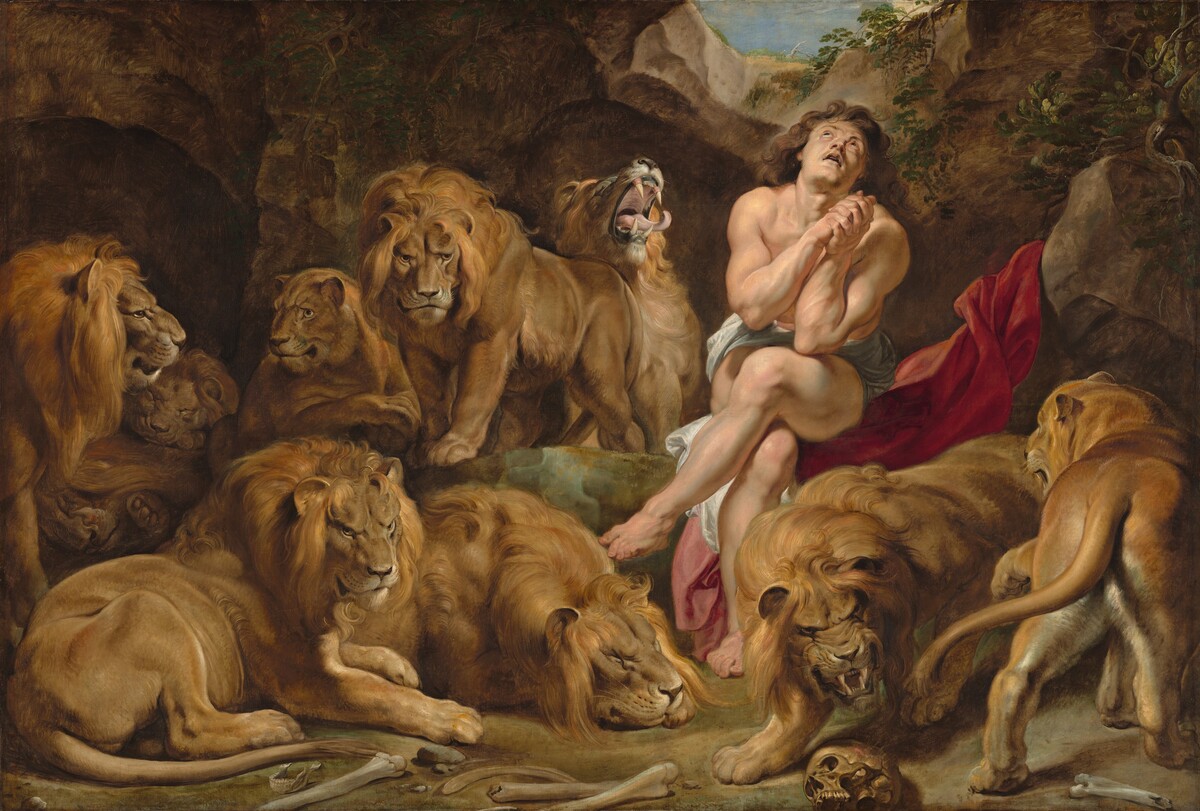
Daniel in the Lions' Den is one of Rubens' most dramatic Old Testament subjects, depicting the moment when the prophet Daniel, thrown into a den of lions for refusing to worship the Persian king's idols, is protected by an angel while the lions circle around him. The lions are the real protagonists of the painting—Rubens studied them from life in the royal menagerie in Brussels, and their muscular bodies and fierce expressions are rendered with a physical accuracy that makes the danger to Daniel feel immediate and real. The dramatic chiaroscuro, with Daniel illuminated by divine light while the lions prowl in shadow, creates the theatrical contrast between divine protection and mortal danger that is the painting's spiritual core.
Cultural Impact
Rubens' Daniel in the Lions' Den is one of the most physically convincing depictions of lions in Western painting, made possible by his direct observation of live animals in the Brussels menagerie. This scientific accuracy was combined with Baroque theatricality to create a painting that satisfied both the naturalistic demands of the new science and the devotional demands of the Counter-Reformation Church. The painting demonstrates that Rubens' art was simultaneously empirical and spiritual—a combination that defined the Baroque at its best.
Why It Matters
Daniel in the Lions' Den is Rubens' Baroque drama at its most physically convincing: lions observed from life, a prophet illuminated by divine light, and a composition that makes the viewer feel the lions' breath and the angel's protection simultaneously. The painting proves that scientific observation and spiritual conviction can coexist in the same work of art.