Provenance
Possibly Pieter Claesz van Ruijven [1624-1674], Delft; possibly by inheritance to his wife, Maria de Knuijt [d. 1681]; possibly by inheritance to her daughter, Magdalena van Ruijven [1655-1682], Delft; possibly by inheritance to her husband, Jacobus Abrahamsz. Dissius [1653-1695], Delft;[1] (his sale, Amsterdam, 16 May 1696, no. 35).[2] J. van Buren, The Hague; (his sale, Bernardus Scheurleer, The Hague, 7-12 November 1808, 6th day [12 Nov.], no. 22 of the paintings). Dr. Cornelis Jan Luchtmans [1777-1860], Rotterdam; (his sale, by Mierop, Muys van Leen, and Lamme, Rotterdam, 20 and 22 April 1816, 1st day, no. 90); J. Kamermans, Rotterdam; (his sale, by A. Lamme, Rotterdam, 3 October 1825, no. 70); Lelie.[3] Hendrik Reydon; (his sale, by J. de Vries, A. Brondgeest, E.M. Engelberts, and C.F. Roos, Amsterdam, 5-6 April 1827, no. 26). François-Xavier, comte de Robiano [1778-1836], Brussels; (his estate sale, Hotel du Défunt, Brussels, 1 May 1837 and days following, no. 436); purchased by Héris for François-Xavier's son. Ludovic, comte de Robiano [1807-1887], Brussels; by inheritance to Ludovic's heirs, possibly his daughter and only child, Jeanne [1835-1900] and her husband, Gustave, baron de Senzeilles de Soumagne [1824-1906], until 1906;[4] (J. & A. LeRoy, Brussels); purchased 1907 by J. Pierpont Morgan [1837-1913], New York; by inheritance to his son, J. P. Morgan, Jr. [1867-1943], New York; consigned 1935-1939 to, and purchased 1940 by (M. Knoedler & Co., New York); sold 1940 to Sir Harry Oakes [1874-1943], Nassau, Bahamas; by gift or inheritance to his wife, Lady Eunice Myrtle McIntyre Oakes [c. 1894-1981], Nassau, Bahamas; consigned 1946 to (M. Knoedler & Co., New York);[5] sold 1946 to Horace Havemeyer [1886-1956], New York; by inheritance to his sons, Harry Waldron Havemeyer [b. 1929], New York, and Horace Havemeyer, Jr. [1914-1990], New York;[6] gift 1962 to NGA.
[1] The 1683 inventory of goods accruing to Jacob Dissius after the death of his wife Magdalena van Ruyven lists twenty paintings by Vermeer. For the complete transactions between her husband Jacob Dissius and his father Abraham Dissius following her death, see John Michael Montias, _Vermeer and His Milieu: A Web of Social History_, Princeton, 1989: 246-257, 359-361, docs. 417, 420.
[2] For this sale see Michael Montias, _Vermeer and His Milieu: A Web of Social History_, Princeton, 1989: 363-364, doc. 439.
[3] This name is recorded in an annotated copy of the sale catalogue in the NGA Library.
[4] This is suggested by the Getty Provenance Index© Databases, Public Collections, record 17464.
[5] The Knoedler’s consignment numbers were CA 1503 (from Morgan) and CA 2758 (from Lady Oakes), per the Getty Provenance Index© Databases, Public Collections, record 17464.
[6] Harry W. Havemeyer (correspondence 12 August 2010) indicated that Vermeer’s painting hung over the fireplace in the library of their residence at 720 Park Avenue, but emphasized that the fireplace, therefore, was never used. He wrote that his father probably had first admired the painting at the Hudson-Fulton exhibition in 1909, and was pleased to be able to acquire it from Knoedler’s when it was offered to him in 1946. Harry and Horace Havemeyer decided to donate the painting to the National Gallery of Art because of their father’s admiration for the Gallery and its director John Walker.
Accession Number
1962.10.1
Medium
oil on canvas
Dimensions
overall: 45 x 39.9 cm (17 11/16 x 15 11/16 in.) | framed: 68.3 x 62.2 x 7 cm (26 7/8 x 24 1/2 x 2 3/4 in.)
Classification
Painting
Credit Line
Gift of Harry Waldron Havemeyer and Horace Havemeyer, Jr., in memory of their father, Horace Havemeyer
Tags
Painting Baroque (1600–1750) Oil Painting Canvas Dutch
Background & Context
Background Story
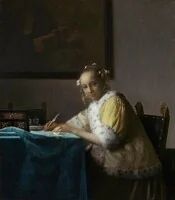
Johannes Vermeer painted A Lady Writing around 1665, at the height of his career and of Dutch Golden Age painting. It depicts a young woman seated at a table, caught in the act of writing a letter. She looks up from her task, meeting the viewer's gaze with an expression that balances concentration and self-awareness - as though aware of being observed in a private moment.
The painting is a masterclass in Vermeer's signature approach: the precise rendering of light. A single shaft of daylight enters from an unseen window upper left, illuminating the woman's face, the pearls at her ears and wrist, and the brass studs of the chair behind her. Each surface receives light differently - the luminous skin, the soft fur trim, the metallic reflections - creating a hierarchy of material presences that unfolds as the eye moves across the canvas.
Letter-writing was a recurring subject in Dutch genre painting, often carrying erotic overtones - a woman writing was assumed to be composing a love letter. Vermeer's treatment is characteristically ambiguous: the woman's expression is composed, even serene, but the presence of a string of pearls and the unseen window create an atmosphere of suspended narrative.
Cultural Impact
Vermeer's intimate interior scenes created a template for the depiction of private consciousness in Western art. His ability to suggest an entire inner world through the play of light on a single face influenced painters from Chardin to Hopper to contemporary photorealists.
Why It Matters
This painting demonstrates Vermeer's unique ability to make everyday actions luminous. The simple act of writing a letter becomes, under Vermeer's brush, an event of contemplative significance - a moment when interior life and exterior light coincide to create a portrait of consciousness itself.