Provenance
Purchased 1807, almost certainly from Turner's gallery, by Thomas Lister Parker [1779-1858], Brownsholme Hall, Yorkshire; (sale, 1808, bought in).[1] (sale, Christie, Manson & Woods, London, 9 March 1811, no. 29, bought in). John Newington Hughes [-1848], Winchester, after 1826; (sale, Christie, Manson & Woods, London, 14-15 April 1848, 2nd day, no. 147); (Thomas Rought); sold 3 May 1848 to Joseph Gillott, Birmingham; (sale, Christie, Manson & Woods, London, 19-20, 26-27 April 1872, 4th day, no. 306); (Thos. Agnew & Sons, London); sold 1872 to Richard Hemming [died c. 1892], Bentley Manor, Bromsgrove, and London; by inheritance to his wife; sold 1892 to (Thos. Agnew & Sons, London); sold 1893 to (Wallis & Son, London); purchased 10 March 1894 through John G. Johnson by Peter A.B. Widener, Elkins Park, Pennsylvania; inheritance from Estate of Peter A.B. Widener by gift through power of appointment of Joseph E. Widener, Elkins Park; gift 1942 to NGA.
[1] David Brown, "Turner, Callcott and Thomas Lister Parker: New Light on Turners' `Junction of the Thames and the Medway' in Washington," _Burlington Magazine_, 117 (1975), 721.
Accession Number
1942.9.87
Medium
oil on canvas
Dimensions
overall: 108.8 x 143.7 cm (42 13/16 x 56 9/16 in.) | framed: 148 x 180.3 cm (58 1/4 x 71 in.)
Classification
Painting
Credit Line
Widener Collection
Tags
Painting Neoclassical & Romantic (1751–1850) Oil Painting Canvas British
Background & Context
Background Story
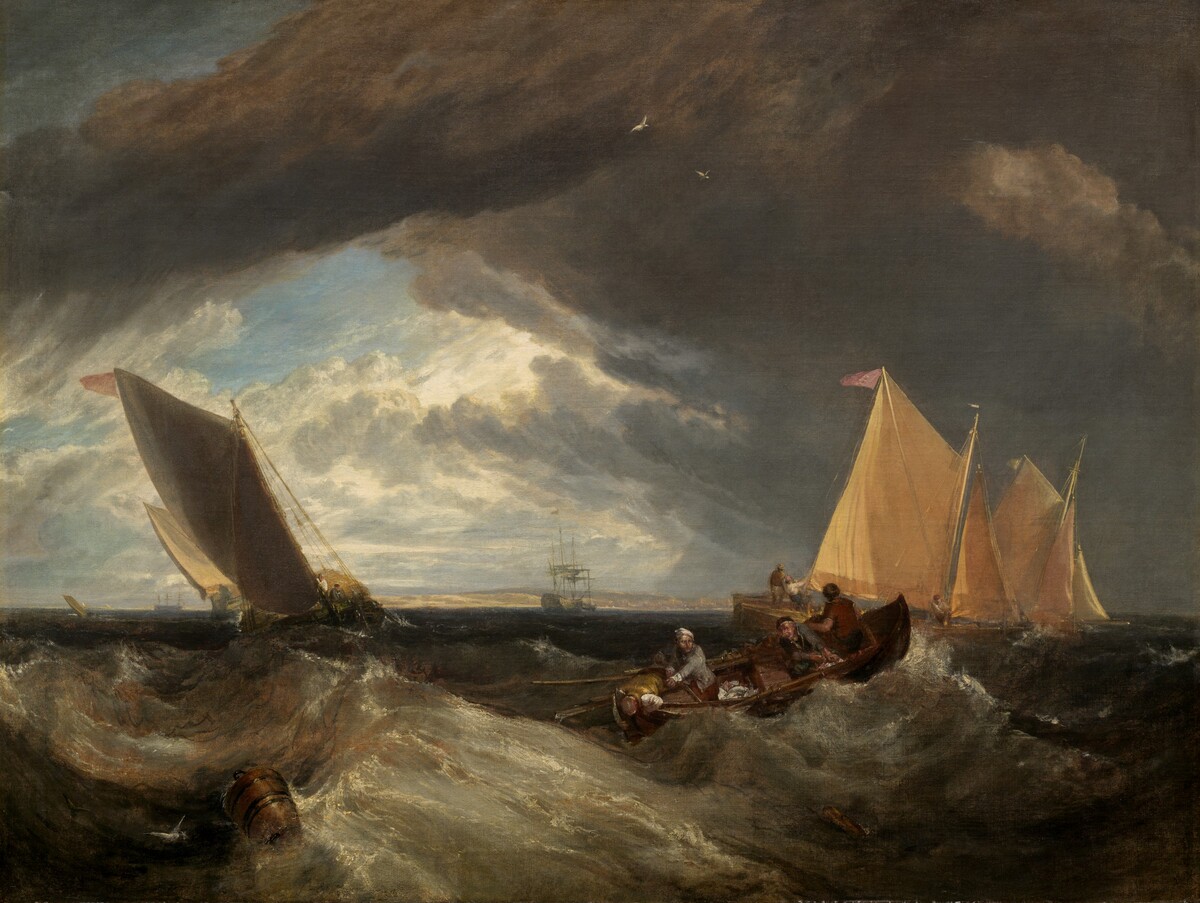
Painted when Turner was in his early thirties, this view of the Thames meeting the Medway near Sheerness is a confident statement about British maritime power and the sublime scale of nature. The wide estuary stretches to a hazy horizon where river meets sea, and the tiny sailing vessels emphasize the vastness of the scene. Turner knew this stretch of water intimately — he had traveled it repeatedly on his way to and from the continent.
Cultural Impact
The painting represents Turner in transition: still painting topographical views for patrons, but already infusing them with the sense of Nature as an overwhelming force. The low horizon, the weight of the sky, the luminous water — all mark this as the work of an artist transforming landscape from property survey into spiritual experience.
Why It Matters
This is the Thames as Turner saw it — not a river but a threshold between land and sea, between the known and the sublime. It anticipates his later, more radical treatment of British waterways.