Provenance
Painted for Henry McConnel [1801-1871], The Polygon, Ardwick, Manchester; sold 1849 to John Naylor [1813-1889], Leighton Hall, Liverpool;[1] passed to his wife, Georgiana Naylor, née Edwards [1818-1909]; purchased 1910 through (Dyer and Sons) by (Thos. Agnew & Sons, London); re-entered April 1910 in Agnew's stock in joint ownership with (Arthur J. Sulley & Co., London); purchased 13 June 1910 from (Arthur J. Sulley & Co., London) by Peter A.B. Widener, Elkins Park, Pennsylvania; inheritance from estate of Peter A. B. Widener by gift through power of appointment of Joseph E. Widener, Elkins Park.
[1] This work was painted as a companion to NGA 1942.9.85 (_Venice: The Dogana and San Giorgio Maggiore_), exhibited the previous year at the Royal Academy of Arts, London, and also owned by McConnel. He was obliged to sell the pictures at a time of business adversity, but regretted selling his Turners to John Naylor, and in 1861 tried, unsuccessfully, to buy at least one of them back. Letter from McConnel to John Naylor, 28 May 1861 (quoted in Martin Butlin and Evelyn Joll, _The Paintings of J.M.W. Turner_, 2 vols., rev. ed., New Haven: 1984: I:205).
Accession Number
1942.9.86
Medium
oil on canvas
Dimensions
overall: 92.3 x 122.8 cm (36 5/16 x 48 3/8 in.) | framed: 127.6 x 158.1 x 14 cm (50 1/4 x 62 1/4 x 5 1/2 in.)
Classification
Painting
Credit Line
Widener Collection
Tags
Painting Neoclassical & Romantic (1751–1850) Oil Painting Canvas British
Background & Context
Background Story
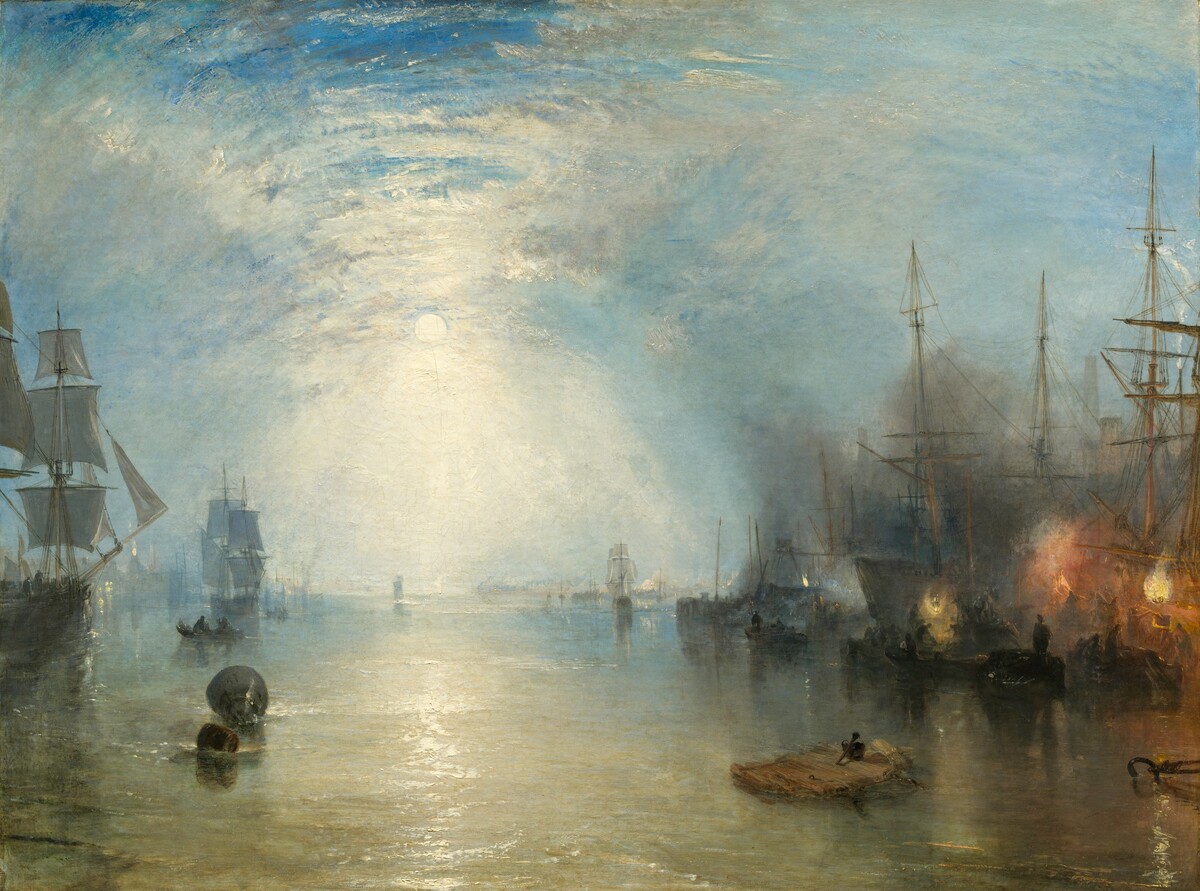
Keelmen Heaving in Coals by Moonlight, painted in 1835, depicts the industrial port of Newcastle at night, where keelmen work by the light of the moon and the glow of their own fires. The painting combines Turner lifelong interests in the sea, in light, and in industrial technology in a composition of extraordinary atmospheric complexity.
The painting was commissioned by the 3rd Earl of Lonsdale, a major landowner in the coal-mining district. Its subject - the coal trade that fueled the Industrial Revolution - was one that Turner addressed repeatedly, recognizing in the industrial landscape a new kind of sublime comparable to the natural sublime of mountains and storms.
The painting most innovative feature is its treatment of moonlight and firelight as complementary sources of illumination. The moon bathes the river and the distant ships in silvery light, while the keelmen fires illuminate the foreground with human warmth. The two light sources create a visual tension between the cosmic and the human, the permanent and the transient.
This combination of the industrial and the sublime was Turner most original contribution to landscape painting. Where earlier painters had excluded industry from the landscape, Turner recognized in the industrial scene a new form of the sublime: the power of human labor, comparable in its way to the power of nature itself.
Cultural Impact
Turner industrial paintings established the industrial landscape as a legitimate subject for the most ambitious art and influenced the entire subsequent tradition of industrial painting. His vision of the coal trade as a subject for the sublime expanded the range of landscape painting beyond the pastoral and the natural.
Why It Matters
Keelmen Heaving in Coals captures Turner most prophetic insight: that the industrial landscape is as sublime as any natural scene. The moonlit river, the glowing coal, and the working men constitute a new kind of landscape - one in which human labor and natural beauty coexist.