Provenance
Painted for Henry McConnel [1801-1871], The Polygon, Ardwick, Manchester; sold 1849 to John Naylor, Leighton Hall, Liverpool;[1] passed to his wife; purchased 1910 through (Dyer and Sons) by (Thos. Agnew & Sons, Ltd., London); re-entered April 1910 in Agnew's stock in joint ownership with (Arthur J. Sulley & Co., London); purchased 13 June 1910 from (Arthur J. Sulley & Co., London) by Peter A.B. Widener, Elkins Park, Pennsylvania; inheritance from estate of Peter A.B. Widener by gift through power of appointment of Joseph E. Widener, Elkins Park.
[1] McConnel, acclaimed as "the pioneer of art collecting in Lancashire," subsequently commissioned a contrasting companion picture of an industrial scene at a seaport in the north of England (NGA 1942.9.86, _Keelmen Heaving in Coals by Moonlight_). In 1861 he tried, unsuccessfully, to buy back from John Naylor one or other of these canvasses, which he had sold to him in 1849. McConnel to John Naylor, 28 May 1861 (quoted in Martin Butlin and Evelyn Joll, _The Paintings of J.M.W. Turner_, 2 vols., rev. ed., New Haven: 1984: I:205).
Accession Number
1942.9.85
Medium
oil on canvas
Dimensions
overall: 91.5 × 122 cm (36 × 48 1/16 in.) | framed: 126.37 × 156.21 × 15.88 cm (49 3/4 × 61 1/2 × 6 1/4 in.)
Classification
Painting
Credit Line
Widener Collection
Tags
Painting Neoclassical & Romantic (1751–1850) Oil Painting Canvas British
Background & Context
Background Story
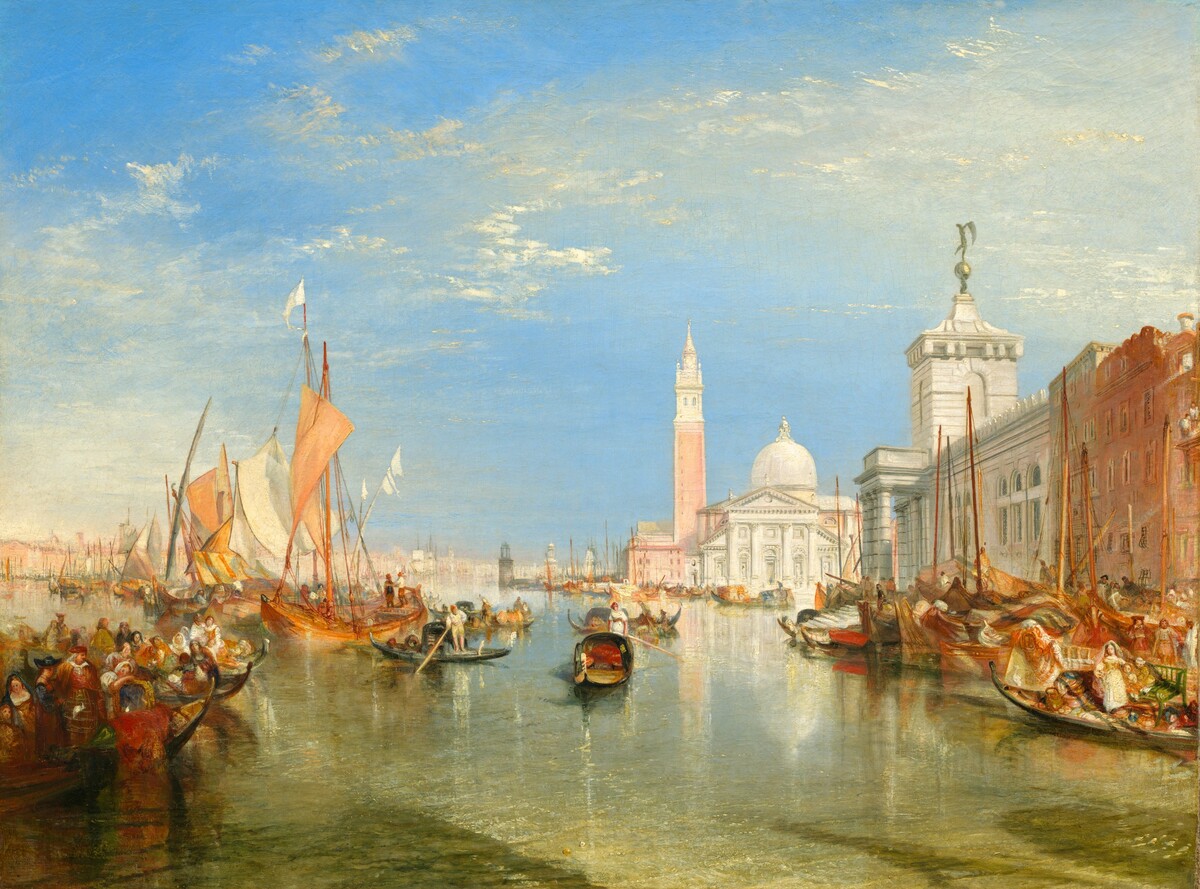
Turner visited Venice three times (1819, 1833, 1840), and each trip deepened his obsession with the city's liquid light. This 1834 view of the Dogana (customs house) and Palladio's church of San Giorgio Maggiore across the Giudecca Canal captures Venice at its most ethereal. The buildings emerge from haze like a vision — solid architecture dematerializing into atmosphere. Turner had just returned from his second Venetian trip when he painted this, and the freshness of his encounter is palpable.
Cultural Impact
Venice gave Turner the license he needed. The city's unique conditions — water reflecting sky, light dissolving solid form, humidity softening every edge — mirrored his own artistic inclinations. In Venice, Turner found a real-world equivalent to his radical vision of painting, where the boundaries between water, air, stone, and light simply cease to matter.
Why It Matters
Turner's Venetian paintings are among the most influential in Western art. Monet studied them obsessively in the 1870s, and the atmospheric dissolution here points directly toward Impressionism. This painting is Venice as dream, not as documentary.