Provenance
Harriet, viscountess Hampden [née Burton, 1751-1829], London;[1] (her estate sale, Christie & Manson, London, 19 April 1834 [originally 18 April], no. 83); Fuller. John A. Beaver, Green Heys, Lancashire; (his sale, T. Winstanley and Sons [of Liverpool], Manchester, 15-16 and 18 April 1840, no. 87, bought in); (his sale, Christie & Manson, London, 20 June 1840, no. 102, bought in). Probably William Parker [died 1856], Skirwith Abbey, Cumberland; by inheritance to Edward Wilson Parker [1853-1932], Skirwith Abbey;[2] (sale, Christie, Manson & Woods, London, 2 July 1909, no. 99); (F. Kleinberger & Co., Paris); sold to Fritz von Gans [1833-1920], Frankfurt-am-Main, by 1915.[3] (Bachstitz, The Hague), by 1921;[4] inheritance from Estate of Peter A.B. Widener by gift through power of appointment of Joseph E. Widener, Elkins Park, Pennsylvania, after purchase 1922 by funds of the estate; gift 1942 to NGA.
[1] It is possible that the painting was originally in the collection of the viscountess' father-in-law, Robert Hampden Trevor (1706-1783), 1st viscount Hampden, who was British minister at The Hague. He was succeeded by his elder son, Thomas, 2nd viscount (1746-1824), and then by the viscountess' husband, John, 3rd viscount (1748-1824).
[2] William Parker was one of four nephews who were left large fortunes by their uncle, Robert Parker, of Manchester. An invoice to William Parker from the Manchester framemaker Joseph Zanetti, dated 20 October 1841, mentions the “cleaning and repairing [of a] large fluted frame for picture by Rembrandt.” Correspondence between Christie’s and Edward Parker’s solicitors just prior to the July 1909 sale indicates that Parker had inherited the paintings. (Records of the Parker family of Skirwith Abbey, Warwick Hall, and Newbiggin Hall; Cumbria Record Office, Carlisle; WD PKR, box 2, bundle 14, document 213; WD PKR, box 4, bundle 18, documents 4-6, 8, 11-12; copies in NGA curatorial files.)
[3] Cornelis Hofstede de Groot, _Beschreibendes und kritisches Verzeichnis der Werke der hervorragendsten holländischen Maler des XVII. Jahrhunderts_, 10 vols., Esslingen, 1907-1928: 6(1915):81-82, no. 133.
[4] The Bachstitz Gallery, preface by G. Gronau, 3 vols., Berlin, 1921: 1:5, pl. 31.
Accession Number
1942.9.61
Medium
oil on canvas
Dimensions
overall: 142 x 110.9 cm (55 7/8 x 43 11/16 in.) | framed: 181 x 147.3 cm (71 1/4 x 58 in.)
Classification
Painting
Credit Line
Widener Collection
Tags
Painting Baroque (1600–1750) Oil Painting Canvas Dutch
Background & Context
Background Story
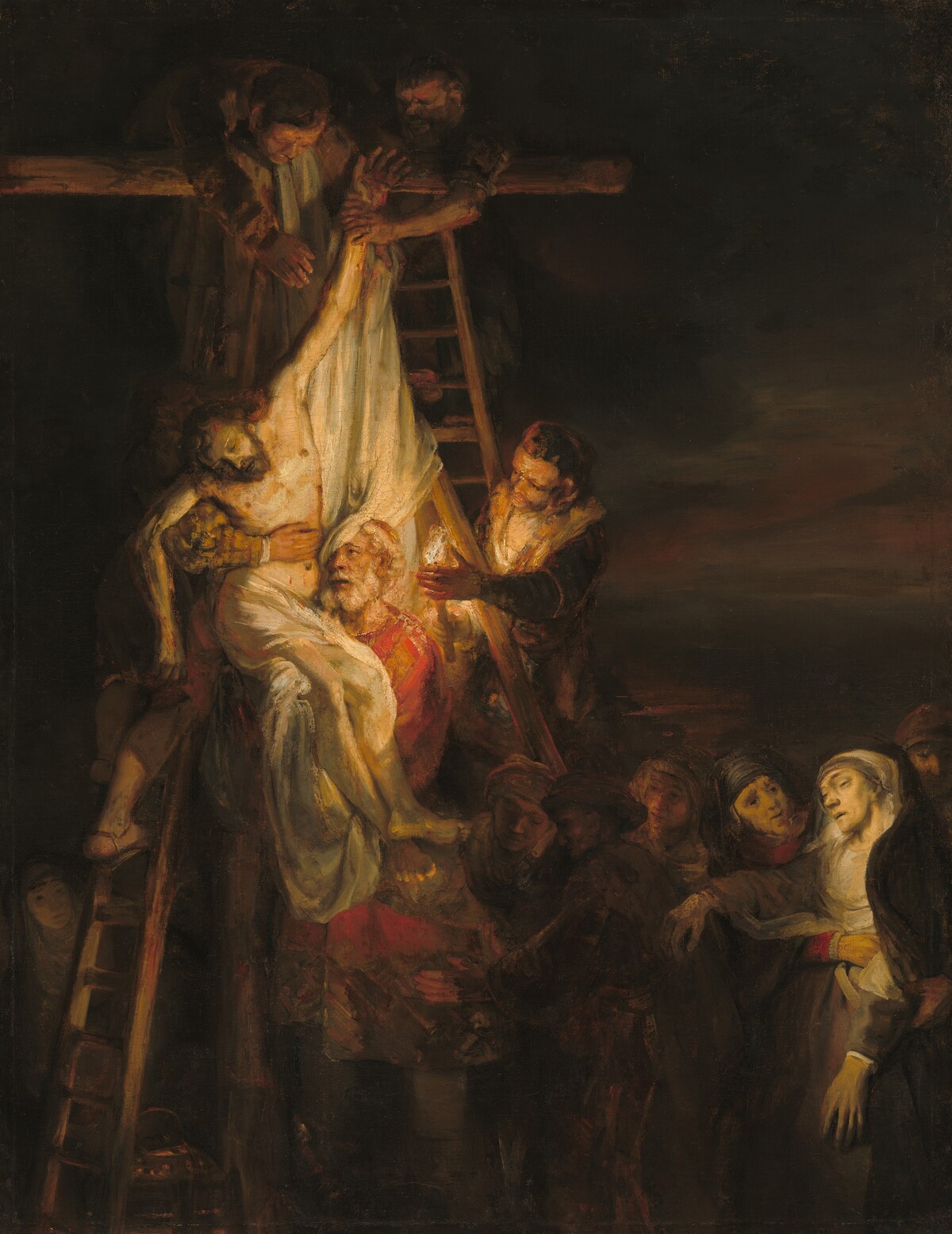
The Descent from the Cross (c. 1633-1634) depicts the moment when Christ's body is lowered from the cross after the crucifixion—one of the most emotionally charged scenes in the Passion narrative. Rembrandt's treatment of this subject demonstrates his ability to render physical and emotional suffering with a directness that distinguished his religious work from the more theatrical treatments that the Counter-Reformation tradition favored. The 1633-34 date places this during Rembrandt's early Amsterdam period, when he was painting the religious subjects that established his reputation as a dramatic narrator of biblical stories. The descent from the cross, with its combination of physical weight—the body being carefully lowered—and emotional grief—the disciples and mourners who receive it—provided Rembrandt with a subject that combined the dramatic chiaroscuro he was developing with the emotional depth that his religious work consistently pursued. His treatment of Christ's body demonstrates his mastery of figure drawing: the dead weight of the body, the careful handling of the disciples who lower it, and the grief of the mourners who receive it are all rendered with the physical accuracy that gives the scene its emotional power. The painting also reflects the Protestant theological emphasis on the humanness of Christ's suffering: the body's weight, the wounds' reality, and the mourners' grief are all more prominent than any divine glory, connecting Christ's suffering to human experience rather than theological abstraction.
Cultural Impact
Rembrandt's Descent from the Cross influenced how the Passion's physical and emotional reality was represented in art, connecting Christ's suffering to human experience rather than divine spectacle. The painting influenced later religious artists who similarly sought to render the Passion's physical reality rather than its miraculous dimension. The Descent influenced how death and grief were represented in Western art, establishing approaches to physical weight and emotional depth that influenced painting for centuries.
Why It Matters
This painting matters because it renders the Passion's physical reality with the directness that distinguishes Rembrandt's religious work from more theatrical treatments—Christ's dead body is a physical weight that must be carefully lowered, and the mourners' grief is a human emotion that requires no theological interpretation. The painting argues that the Passion's significance lies in its physical and emotional reality rather than in its miraculous dimension.