Provenance
Johan van Schuylenburg, The Hague; (his sale, The Hague, 20 September 1735, no. 31); Backer. Pierre-Louis Éveillard de Livois [1736-1790], Angers;[1] (his estate sale, by Sentout, Angers, unknown date in 1791, no. 65); Gamba;[2] (his sale, by Paillet and Geoffroy, Paris, 17-18 December 1811, 1st day, no. 26, bought in); purchased soon after this sale by Ferdinando Marescalchi [1754-1816], Bologna.[3] Sir George Hayter [1792-1871], London, by 1841;[4] (his sale, Christie & Manson, London, 3 May 1845, no. 82, as _Portrait of Cornelius Von Schrevellier [Schrevellius Translater(sic) of Homer_); (Nieuwenhuys).[5] James-Alexandre, comte de Pourtalès-Gorgier [1776-1855], Paris; (his sale, at his residence, Paris, 27 March-4 April 1865 [this lot 31 March], no. 182); purchased by (Otto Mündler, Paris) for Ivor Bertie Guest, 1st baron Wimborne [1835-1914], Canford Manor, Dorsetshire.[6] (Arthur J. Sulley & Co., London); Peter A.B. Widener, Lynnewood Hall, Elkins Park, Pennsylvania, by 1912; inheritance from Estate of Peter A.B. Widener by gift through power of appointment of Joseph E. Widener, Elkins Park, Pennsylvania; gift 1942 to NGA.
[1] Burton Fredericksen brought to the Gallery’s attention details of the provenance from Livois through Marescalchi; see his 14 February 1991 letter to Suzannah Fabing, in NGA curatorial files. Further details have been found in the The Getty Provenance Index© Databases.
[2] This was possibly Bartolomeo Gamba (1776-1841), bibliographer, publisher, and librarian of the Biblioteca Nazionale Marciana in Venice.
[3] An 1813 inventory of Marescalchi's collection includes the painting: “Una mezza figura in grande rappresentante una Persona in meditazione o studiosa, di grande maniera, comprata alla vendita di Monsieur Gamba negozio di Parigi, come dal suo Catalogo. Quadro grande in piedi” (Monica Proni, “Per la ricostruzione della quadreria del Conte Ferdinando Marescalchi (1753-1816),” _Antologia di Belle Arti_, nos. 33/34 [1988]: 39). It is also included in later inventories of the Marescalchi collection made in 1817 and 1824 (Monica Preti Hamard, _Ferdinando Marescalchi (1754-1816): Un collezionista italiano nella Parigi napoleonica_, 2 vols., Bologna, 2005: 1:384, fig. 48; 2:131-132).
[4] Hayter lent the painting an exhibition in 1841.
[5] The dealer’s name is written below lot 82 in a copy of the sale catalogue annotated by Lord Northwick, now at Yale University (copy in NGA curatorial files).
[6] _A Catalogue of the Pictures at Canford Manor in the Possession of Lord Wimborne_, Edinburgh, 1888: 63-64, no. 154. The entry on the painting, page 63, prints an extract from a letter of 31 March 1865 to Lord Wimborne from Otto Mündler in which Mündler wrote that he had purchased "the Rembrandt 185, representing St. Paul." However, either Mündler recorded the wrong lot number or the catalogue transcribed the number from the letter inaccurately, as on p. 64 the catalogue lists the Rembrandt under "copy of the auctioneer's note," as sale catalogue number 182.
Accession Number
1942.9.59
Medium
oil on canvas
Dimensions
overall: 131.5 x 104.4 cm (51 3/4 x 41 1/8 in.) | framed: 177.8 x 150.5 x 13.3 cm (70 x 59 1/4 x 5 1/4 in.)
Classification
Painting
Credit Line
Widener Collection
Tags
Painting Baroque (1600–1750) Oil Painting Canvas
Background & Context
Background Story
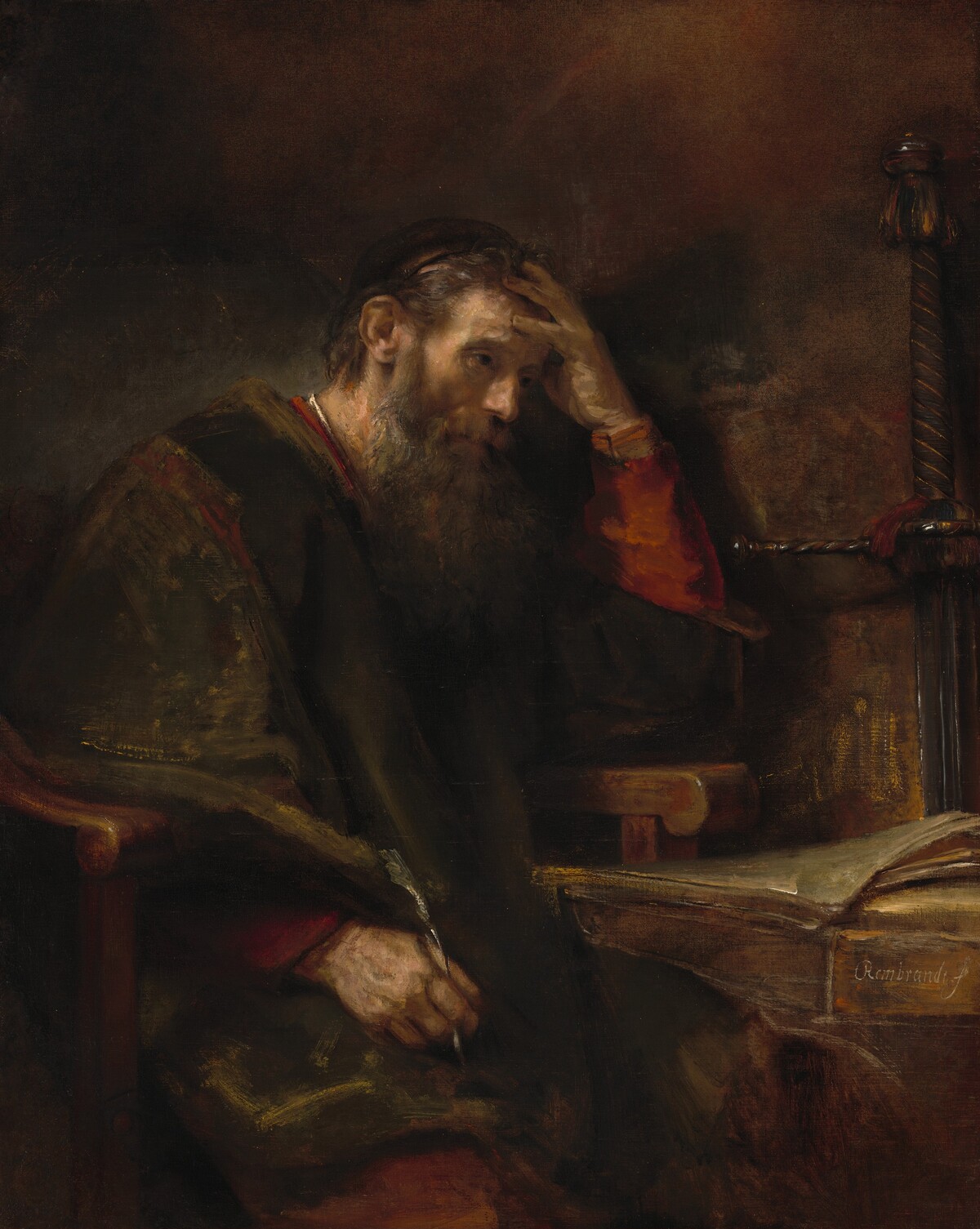
Rembrandt van Rijn (1606-1669) painted The Apostle Paul around 1657, depicting the apostle in the deeply introspective, psychologically penetrating manner that distinguishes Rembrandt's late religious paintings. The painting shows Paul seated at his writing desk, deep in thought, with the sword that symbolizes his martyrdom visible behind him. The c. 1657 date places this in Rembrandt's late period, when he was producing the deeply introspective religious paintings that are his most spiritually profound works. The '(and Workshop?)' attribution indicates that workshop assistance may have been involved, though the psychological depth and chiaroscuro are characteristically Rembrandt's own.
Cultural Impact
The Apostle Paul is important in Rembrandt's late oeuvre because it demonstrates the deeply introspective, psychologically penetrating manner that distinguishes his late religious paintings from his earlier, more narrative approach. The c. 1657 painting shows Rembrandt treating the apostle not as a narrative figure but as a psychological subject—a man deep in thought at his writing desk with his martyrdom visible behind him—creating a type of religious painting that is simultaneously devotional and deeply introspective.
Why It Matters
The Apostle Paul is Rembrandt's late introspection: the apostle seated at his writing desk deep in thought, with his martyrdom sword behind him, in the psychologically penetrating manner that distinguishes his late religious paintings. The c. 1657 painting treats the apostle not as narrative figure but as psychological subject, creating religious painting at its most introspective.