Provenance
William Wethered [d. 1863], King's Lynn, Norfolk, and by 1849, London. Benjamin Godfrey Windus [1790-1867],[1] Tottenham, after 1847;[2] (sale, Christie, Manson & Woods, London, 20 June 1853, no. 5); (Ernest Gambart, Paris, Brussels, and London). Charles Birch, Edgbaston and London; (sale, Messrs. Foster, London, 28 February 1856, no. 57); bought by Wallis. Joseph Gillott, Edgbaston, by 1860. (Ernest Gambart, Paris, Brussels, and London); purchased 1863 by (Thos. Agnew & Sons, London); sold 1863 to James Fallows, who exchanged it later that year for pictures by Alfred Elmore and P.F. Poole with (Thos. Agnew & Sons, London); sold to (J. Smith, London).[3] Bought 1870 from the executors of Smith's estate by (Thos. Agnew & Sons, London); sold 1871 to W. Moir; passed to Mrs. Emma Moir; sold 1899 to (Thos. Agnew & Sons, London); purchased the same year by Sir Charles Clow Tennant, 1st bt. [1823-1906], The Glen, near Innerleithen, Peeblesshire, Scotland; by descent to his grandson, Christopher Grey Tennant, 2nd baron Glenconner [1899-1983], The Glen;[4] sold July 1923 to (Charles Carstairs for M. Knoedler & Co., London and New York); purchased November 1923 by Andrew W. Mellon, Pittsburgh and Washington, D.C.; deeded 28 December 1934 to The A.W. Mellon Educational and Charitable Trust, Pittsburgh; gift 1937 to NGA.
[1] Martin Butlin and Evelyn Joll, _The Paintings of J.M.W. Turner_, 2 vols., 2nd rev. ed., (New Haven and London, [1977] 1984), I: no. 412, begin their provenance with Windus.
[2] The picture is not mentioned by Thomas Tudor, who visited Windus on 21 June 1847, as being among the latter's collection of Turners at that time (Butlin and Joll, as per note 1 above, I: 259).
[3] This is probably John Mountjoy Smith (1805-1869), who took over the firm when his father, John Smith (1781-by 1855), the picture dealer of 137 New Bond Street, retired in 1837. The information was kindly provided by Julia Armstrong-Totten; see her e-mail, 1 March 2011, in NGA curatorial files. (In the 1992 NGA catalogue of its British paintings, the elder Smith was incorrectly suggested as possibly being this Smith.) For more about the Smith firm, see Charles Sebag-Montefiore, with Julia I. Armstrong-Totten, _A Dynasty of Dealers: John Smith and Successors, 1801-1924: A Study of the Art Market in Nineteenth-Century London_, Arundel and London, 2013.
[4] NGA curatorial files.
Accession Number
1937.1.110
Medium
oil on canvas
Dimensions
overall: 62 x 94 cm (24 7/16 x 37 in.) | framed: 88 x 118.4 x 12.4 cm (34 5/8 x 46 5/8 x 4 7/8 in.)
Classification
Painting
Credit Line
Andrew W. Mellon Collection
Tags
Painting Neoclassical & Romantic (1751–1850) Oil Painting Canvas British
Background & Context
Background Story
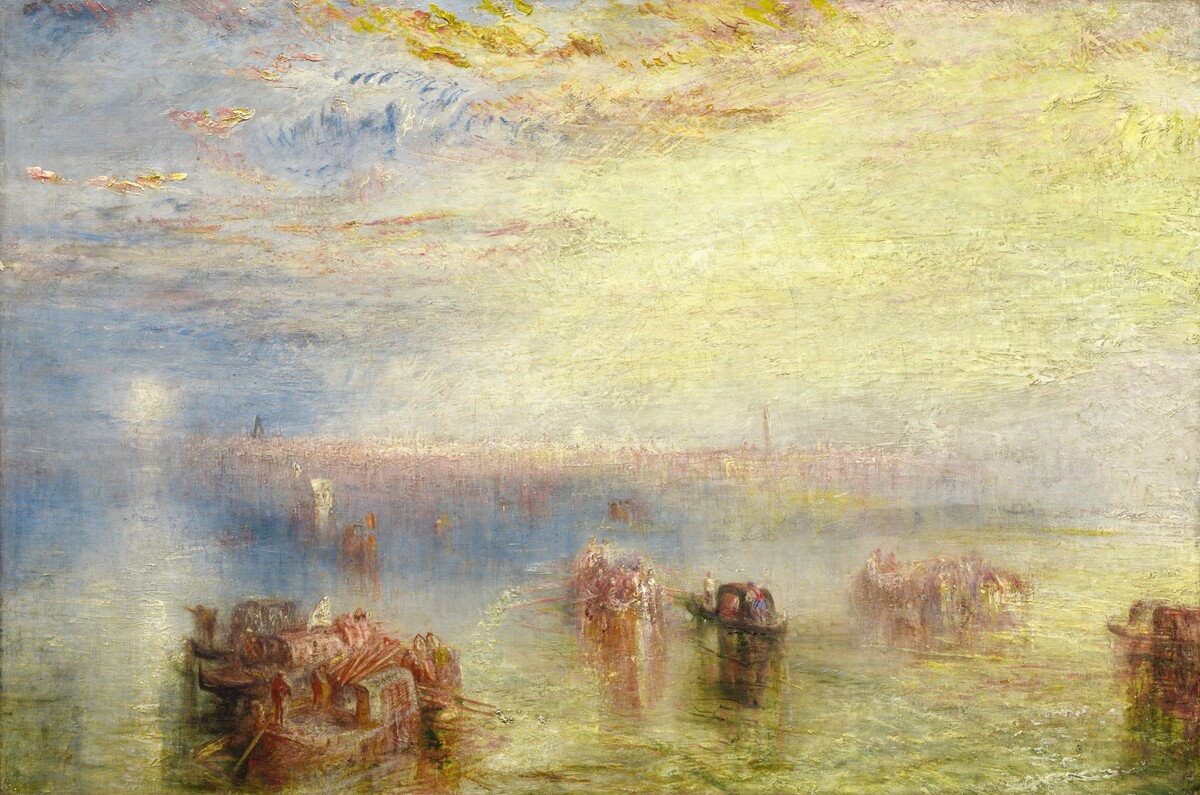
Approach to Venice, painted in 1844, is one of Turner most luminous Venetian views and a painting that demonstrates the dissolution of form that characterized his late style. The city of Venice, seen from the water, is a shimmer of light and color - its architecture barely distinguishable from the sky and sea that surround it.
Turner visited Venice three times, and each visit produced paintings of increasing atmospheric radicalism. The Approach to Venice, painted after his final visit in 1840, represents the culmination of his Venetian project: the point where Venice becomes a vision of pure light.
The painting most radical feature is its treatment of the horizon, where the sea and the sky merge into a single field of luminous color. The Venetian buildings dissolve into this radiance, their forms suggested by the thinnest washes of pale pigment. The boat in the foreground provides the only solid anchor in a composition that has abandoned solidity itself.
The painting was controversial when exhibited. Critics accused Turner of abandoning drawing for color, of substituting atmosphere for architecture. This criticism was precisely the point: the painting is about light, and Venice is merely the pretext for its investigation.
Cultural Impact
Turner late Venetian views established the most radical landscape painting of the 19th century and influenced the entire tradition of painting Venice, from Whistler and Monet to the present. Their influence on the development of abstract painting was acknowledged by Rothko and the Abstract Expressionists.
Why It Matters
Approach to Venice captures Turner ultimate vision: Venice not as a city of stone but as a condition of light. The buildings, the sea, and the sky are all made of the same luminous substance, and light itself is the only permanent thing in a world of transient forms.