Provenance
Painted for William Moffatt [c. 1754/1755-1831], "The Limes," Mortlake. with William Bernard Cooke, the engraver, c. 1831-1838. Harriott, by 1838; (sale, Christie, Manson & Woods, London, 23 June 1838, no. 111); bought by Allnutt.[1] The Reverend Edward Thomas Daniell [1804-1842]; (sale, Christie, Manson & Woods, London, 17 March 1843, no. 160); M.E. Creswick; sold 1851 to (Thos. Agnew & Sons, London); purchased 1851 by Samuel Ashton;[2] by descent to Elizabeth Gair Ashton [Mrs. Hyde Ashton], Cheshire;[3] by descent to Captain Ashton; sold 1920 jointly to (Thos. Agnew & Sons, London) and (Arthur J. Sulley & Co., London); sold 1920 to (M. Knoedler & Co., London and New York); sold 1 December 1920 to Andrew W. Mellon, Pittsburgh and Washington, D.C.; deeded 28 December 1934 to The A.W. Mellon Educational and Charitable Trust, Pittsburgh; gift 1937 to NGA.
[1] This is probably John Allnutt (1773-1863), a friend and patron of numerous artists, including Turner, John Constable, and Thomas Lawrence.
[2] Ashton lent the painting in 1857 to the exhibition in Manchester, _Art Treasures of the United Kingdom_, _Paintings by Modern Masters_, no. 256.
[3] She lent it to the exhibition, _Pictures and Drawings by J.M.W. Turner, R.A., and a Selection of Pictures by some of his Contemporaries_, Corporation of London Art Gallery, Guildhall, 1899, no. 23.
Accession Number
1937.1.109
Medium
oil on canvas
Dimensions
overall: 92.1 x 122.2 cm (36 1/4 x 48 1/8 in.) | framed: 111.1 x 143.2 x 9.5 cm (43 3/4 x 56 3/8 x 3 3/4 in.)
Classification
Painting
Credit Line
Andrew W. Mellon Collection
Tags
Painting Neoclassical & Romantic (1751–1850) Oil Painting Canvas British
Background & Context
Background Story
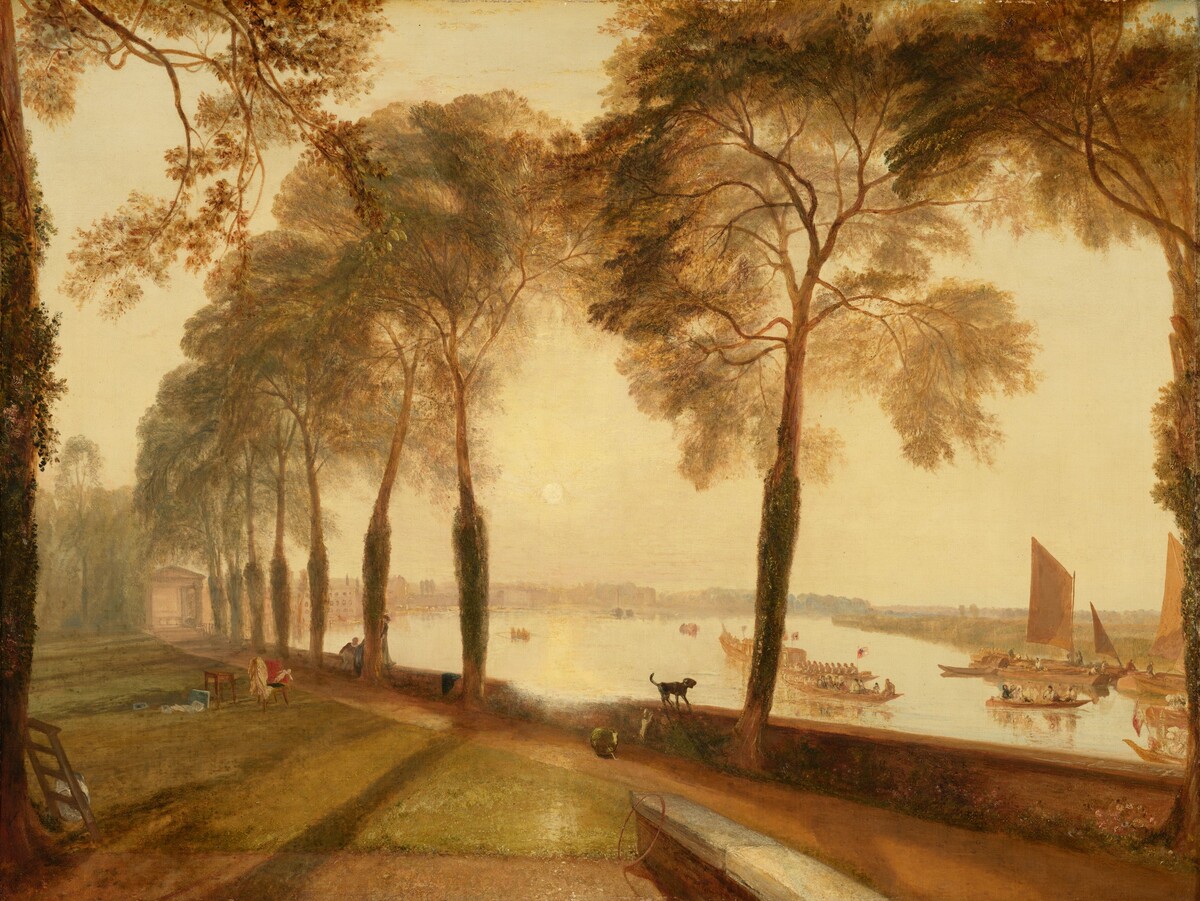
Mortlake Terrace, painted in 1827, depicts the terrace of a house on the Thames at Mortlake, looking across the river toward the trees and fields of the opposite bank. The painting belongs to Turner middle period, when his art achieved a balance between topographic precision and atmospheric freedom.
The painting was commissioned by William Moffatt, the owner of the house, as a pair with a view from the opposite direction. Turner handled the commission with a thoroughness that produced one of his most satisfying domestic landscapes.
The painting most Turner-like feature is its treatment of the river. The Thames, reflecting the sky and the trees of the opposite bank, becomes a surface of such luminous complexity that it rivals the sky above. Turner was the first landscape painter to treat water as a subject worthy of the same attention traditionally reserved for the sky.
The two dogs playing on the terrace remind the viewer that this is a domestic scene. Turner ability to combine the intimate and the panoramic, the domestic and the sublime, in a single composition is one of his most distinctive gifts.
Cultural Impact
Turner domestic landscapes demonstrated that the English country house and its river setting could sustain the most ambitious landscape painting. Their combination of topographic precision and atmospheric beauty influenced the development of the English landscape tradition.
Why It Matters
Mortlake Terrace captures Turner at his most balanced: a painter who can satisfy a patron and himself in the same work, producing a painting that is both a record of a specific place and a study in the luminous beauty of the Thames at dusk.