Provenance
Gerard Hoet, Jr. [d.1760], The Hague; (his sale, by Arnoldus Franken, The Hague, 25-26 August 1760, no. 44).[1] Johann Ernst Gotzkowsky [1710-1775], Berlin; acquired in 1763 by Catherine II, empress of Russia [1729-1796], Saint Petersburg; Imperial Hermitage Gallery, Saint Petersburg; sold January 1931, as a painting by Rembrandt, through (Matthiesen Gallery, Berlin, P. & D. Colnaghi & Co., London, and M. Knoedler & Co., New York) to Andrew W. Mellon, Pittsburgh and Washington; deeded 1 May 1937 to The A.W. Mellon Educational and Charitable Trust, Pittsburgh;[2] gift 1937 to NGA.
[1] Gerard Hoet, _Catalogus of Naamlyst van Schilderijen..._, 2 vols., The Hague, 1752, supplement by Pieter Terwesten, 1770, reprint ed. Soest, 1976, 3: 225, no. 44. The painting, which was described as a "kapitaal en uitmuntend stuk," sold for 100 florins.
[2] The Mellon purchase date and the date deeded to the Mellon Trust are according to Mellon collection records in NGA curatorial files and David Finley's notebook (donated to the National Gallery of Art in 1977, now in the Gallery Archives).
In 2012 The Getty Research Institute, Los Angeles, acquired the M. Knoedler & Co. records (accession number 2012.M.54), and in 2013 processed portions of the archive were first made publicly available. An entry from a January 1931 Knoedler sales book confirms the sale to Mellon (on-line illustration of the sales book page, in Karen Meyer-Roux, "Treasures from the Vault: Knoedler, Mellon, and an Unlikely Sale," _The Getty Iris_ [http://blogs.getty.edu/iris/author/kmeyerroux/], 30 July 2013).
Accession Number
1937.1.79
Medium
oil on canvas transferred to canvas
Dimensions
overall: 105.7 x 97.8 cm (41 5/8 x 38 1/2 in.) | framed: 130.8 x 123.2 cm (51 1/2 x 48 1/2 in.)
Classification
Painting
Credit Line
Andrew W. Mellon Collection
Tags
Painting Baroque (1600–1750) Oil Painting Canvas Dutch
Background & Context
Background Story
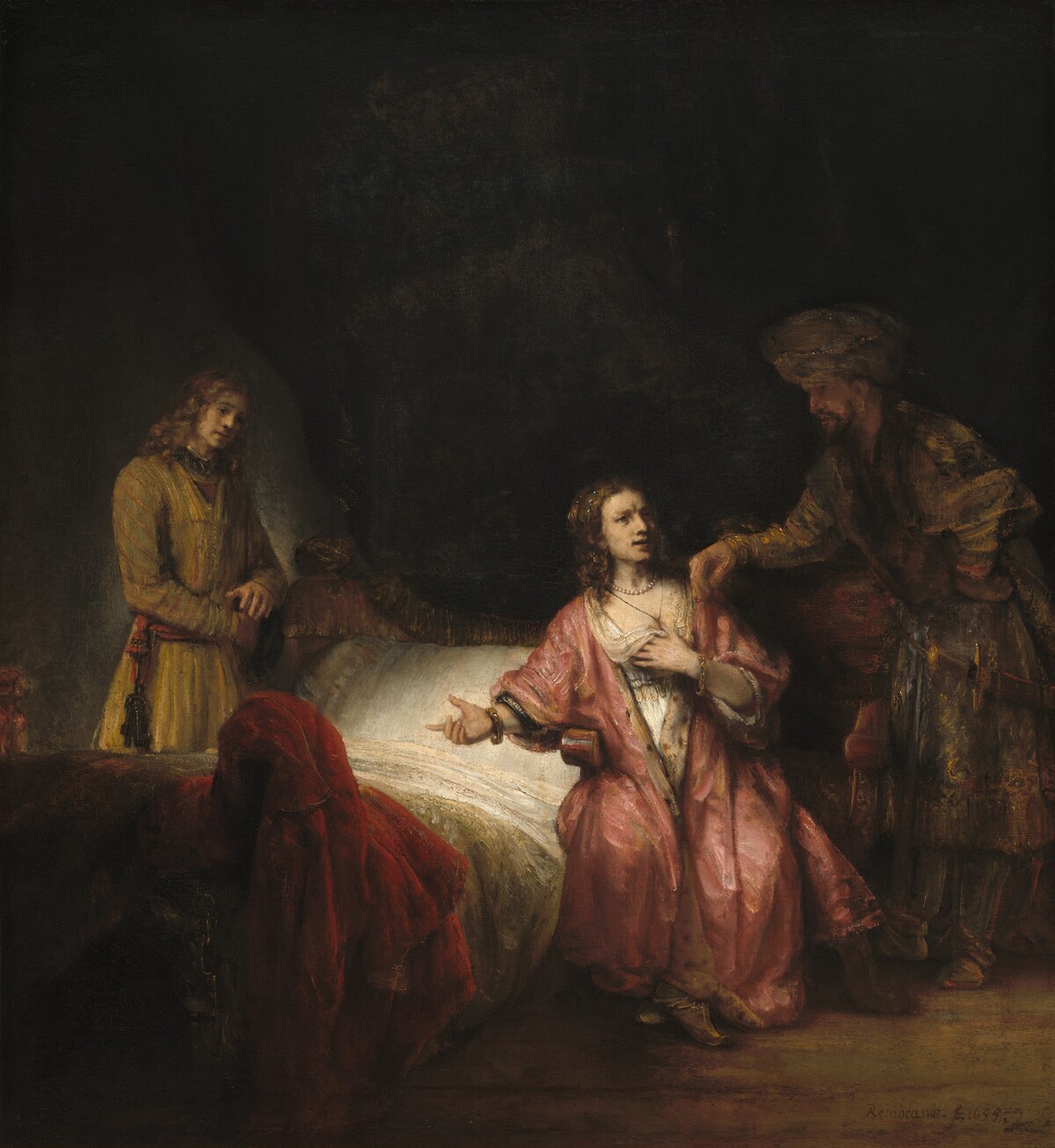
Joseph Accused by Potiphar's Wife (c. 1634-1635) depicts the biblical story from Genesis in which Joseph, sold into slavery in Egypt, is falsely accused of seduction by Potiphar's wife after he rejects her advances. The story—.woman whose desire is rejected and who then uses her power to destroy the man who refused her—was one of the most dramatic narratives in the Old Testament, and Rembrandt's treatment of it demonstrates his ability to render the psychological complexity of biblical stories with a contemporary relevance that made them speak to his Dutch audience. The 1634-35 date places this during Rembrandt's early Amsterdam period, when he was establishing the dramatic narrative method that would produce his most celebrated biblical paintings. His treatment of the accusation scene likely focuses on the confrontation between Joseph's innocence and Potiphar's wife's false accusation—the moment when the truth becomes a lie and the lie becomes the truth, with Potiphar's social power determining which version prevails. The painting's dramatic content—the false accusation, the innocent man's powerlessness, and the woman's manipulation of patriarchal authority—carried obvious contemporary implications for a Dutch audience that understood the relationship between power and truth in their own commercial and political culture.
Cultural Impact
Rembrandt's Joseph paintings influenced how the relationship between power and truth was represented in biblical art, connecting the Old Testament narrative to contemporary Dutch experience. The paintings influenced later artists who similarly found contemporary relevance in biblical stories. Joseph Accused by Potiphar's Wife influenced how the power dynamics of sexual accusation were represented in visual art, connecting the biblical story to contemporary experience.
Why It Matters
This painting matters because it renders one of the Old Testament's most psychologically complex narratives—the false accusation that turns truth into lies and innocence into guilt—with the dramatic intensity that Rembrandt brought to all his biblical subjects. The painting's contemporary relevance—.power that determines which version of truth prevails—argued that the biblical story was not a distant narrative but a continuing human experience.