Provenance
Cornelis Sebille Roos [1754-1820], Amsterdam; (his sale, R.W.P. de Vries, Amsterdam, 28 August 1820, no. 51); Isaac van Eyck.[1] (sale, Paris); purchased by a Mr. Mason; purchased by Baron Lionel de Rothschild [1808-1879], Gunnersbury Park, Greater London, by 1842; by inheritance to his son, Nathan Mayer Rothschild, 1st baron Rothschild [1840-1915]; by exchange with or sale to his brother, Baron Alfred Charles de Rothschild [1842-1918], London and Halton House, near Wendover, Buckinghamshire;[2] bequeathed to his illegitimate daughter, Almina Victoria, Countess of Carnarvon [c. 1877-1969, later Mrs. Ian Onslow Dennistoun], London; sold 1924 to (Duveen Brothers, Inc., London, New York, and Paris);[3] sold November 1924 to Andrew W. Mellon, Pittsburgh and Washington, D.C.; deeded 28 December 1934 to The A.W. Mellon Educational and Charitable Trust, Pittsburgh; gift 1937 to NGA.
[1] John Smith, _A Catalogue Raisonné of the Works of the Most Eminent Dutch, Flemish and French Painters_, 9 vols. London, 1829-1842: 9(1842):573, no. 30.
[2] The Rothschild provenance information was kindly provided by Michael Hall, curator to Edmund de Rothschild; see his "Rothschild Picture Provenances" from 1999 and his letter of 27 February 2002, in NGA curatorial files, in which he cites documents in The Rothschild Archive, London.
[3] Duveen Brothers Records, accession number 960015, Research Library, Getty Research Institute, Los Angeles: reel 292, box 437, folders 4 and 5, and reel 293, box 438, folders 1 and 2; copies in NGA curatorial files.
Accession Number
1937.1.56
Medium
oil on canvas
Dimensions
overall: 69.5 x 60 cm (27 3/8 x 23 5/8 in.) | framed: 92.7 x 83.8 x 12.1 cm (36 1/2 x 33 x 4 3/4 in.)
Classification
Painting
Credit Line
Andrew W. Mellon Collection
Tags
Painting Baroque (1600–1750) Oil Painting Canvas Dutch
Background & Context
Background Story
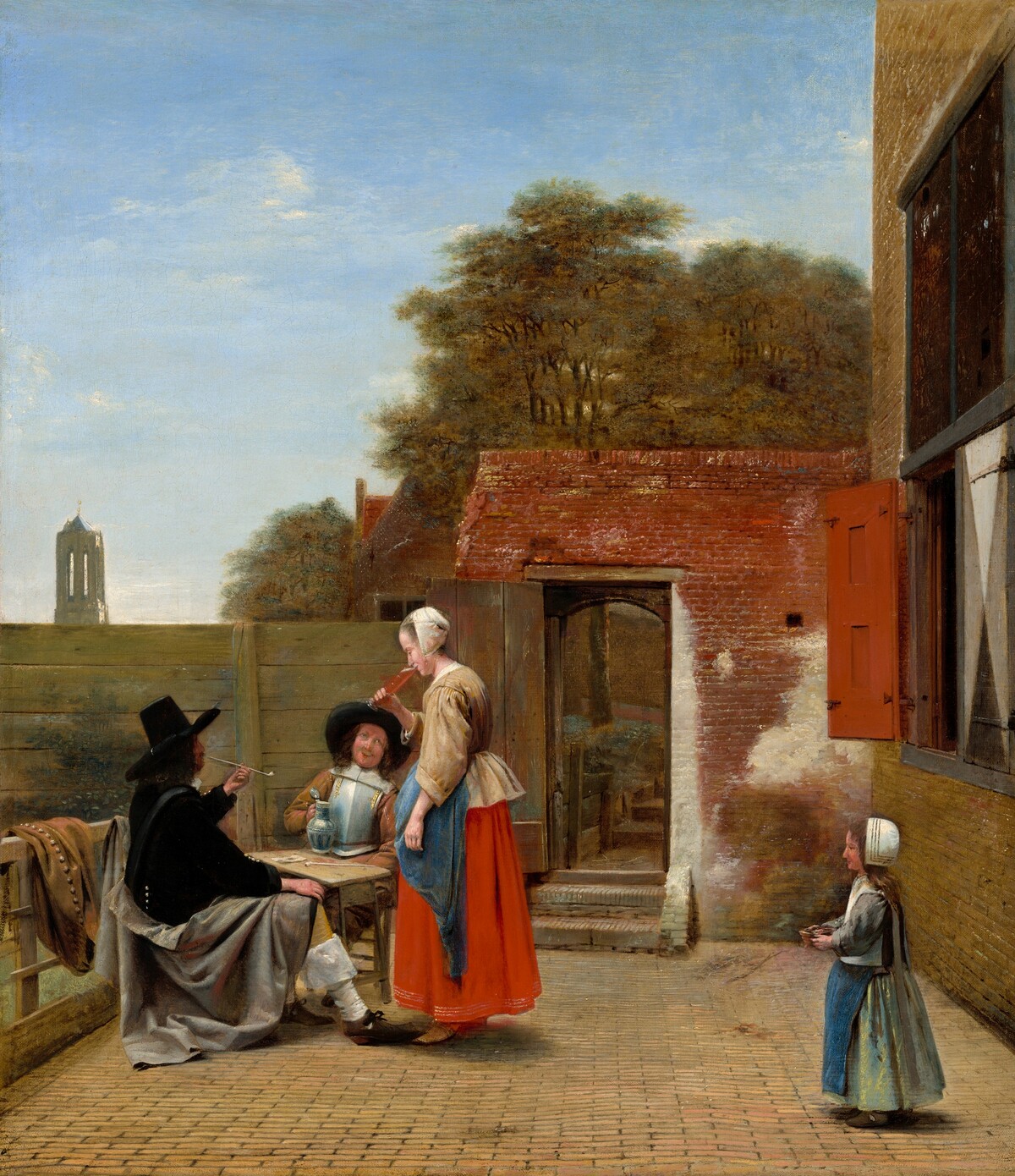
A Dutch Courtyard is one of de Hooch's most celebrated compositions, depicting a group of figures in an outdoor courtyard that opens to a view of the city beyond. The brick courtyard, the figures engaged in conversation and leisure, and the distant cityscape are organized according to de Hooch's characteristic perspectival principles, with every architectural element—walls, doorways, windows—contributing to the construction of a believable and complex spatial environment. The warm light that fills the courtyard is the same golden tone that illuminates all of de Hooch's best work, creating a mood of domestic tranquility that is as convincing as the perspective is precise.
Cultural Impact
A Dutch Courtyard is one of the canonical works of the Dutch Golden Age, demonstrating the genre painter's ability to transform everyday life into art through the combined effects of perspective, light, and composition. The painting is simultaneously a topographic record (the courtyard is a real place), a genre scene (the figures are engaged in real activities), and a work of art (the composition is as carefully constructed as any history painting).
Why It Matters
A Dutch Courtyard is de Hooch at his most balanced and most Dutch: figures in a courtyard, light and perspective constructing a believable space, and a mood of domestic tranquility that makes everyday life feel like civil virtue. The golden light that fills the courtyard is the light of a society that valued domestic order above all else.