Provenance
Possibly Paolo Giovio, appointed to the Bishopric of Nocera by Clement VII in 1528; possibly from him to Chiesa di Monte Oliveto, Nocera de'Pagani; sold 1686 to Gasparo de Haro y Guzman, Conde-Duque de Olivares, Marqués del Carpio and Viceroy of Naples [d. 1687]; by inheritance to his daughter, Catalina Méndez de Haro y Guzmán, later Duquesa de Alba; by inheritance to the Duques de Alba; by inheritance to María del Pilar Teresa Cayetana de Silva y Alvarez de Toledo, Duquesa de Alba [d. 1802], Sanlúcar, near Seville;[1] sold by her heirs to Count Edmund de Bourke, Danish Ambassador to Spain; sold 1820 to William G. Coesvelt, London;[2] sold 1836 to (M. Labensky) for Czar Nicholas I of Russia [1796-1855], Saint Petersburg; Imperial Hermitage Gallery, Saint Petersburg;[3] purchased April 1931 through (Matthiesen Gallery, Berlin; P. & D. Colnaghi & Co., London; and M. Knoedler & Co., New York) by Andrew W. Mellon, Pittsburgh and Washington, D.C.; deeded 5 June 1931 to The A.W. Mellon Educational and Charitable Trust, Pittsburgh;[4] gift 1937 to NGA.
[1] See A. Barcia, _Catalogo de la collecion de pinturas del Excmo. Sr. Duque de Berwick y de Alba_, 1911: 260.
[2] Recorded in Mrs. Anna Jameson, _Collection of Pictures of W. G. Coesvelt, Esq._, London, 1836: VII, 24.
[3] According to E. Bruiningk and A. Somoff, _Ermitage Imperial, Catalogue de la galerie des tableaux_, Saint Petersburg, 1891: 1:137.
[4] Mellon/Mellon Trust purchase date and/or date deeded to Mellon Trust is according to Mellon collection files in NGA curatorial records and David Finley's notebook (donated to the National Gallery of Art in 1977, now in the Gallery Archives).
Accession Number
1937.1.24
Medium
oil on panel transferred to canvas
Dimensions
overall (diameter): 94.5 cm (37 3/16 in.) | framed (diameter x depth): 140.34 × 15.88 cm (55 1/4 × 6 1/4 in.)
Classification
Painting
Credit Line
Andrew W. Mellon Collection
Background & Context
Background Story
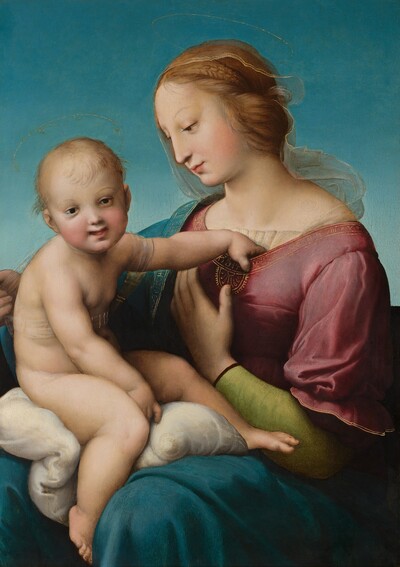
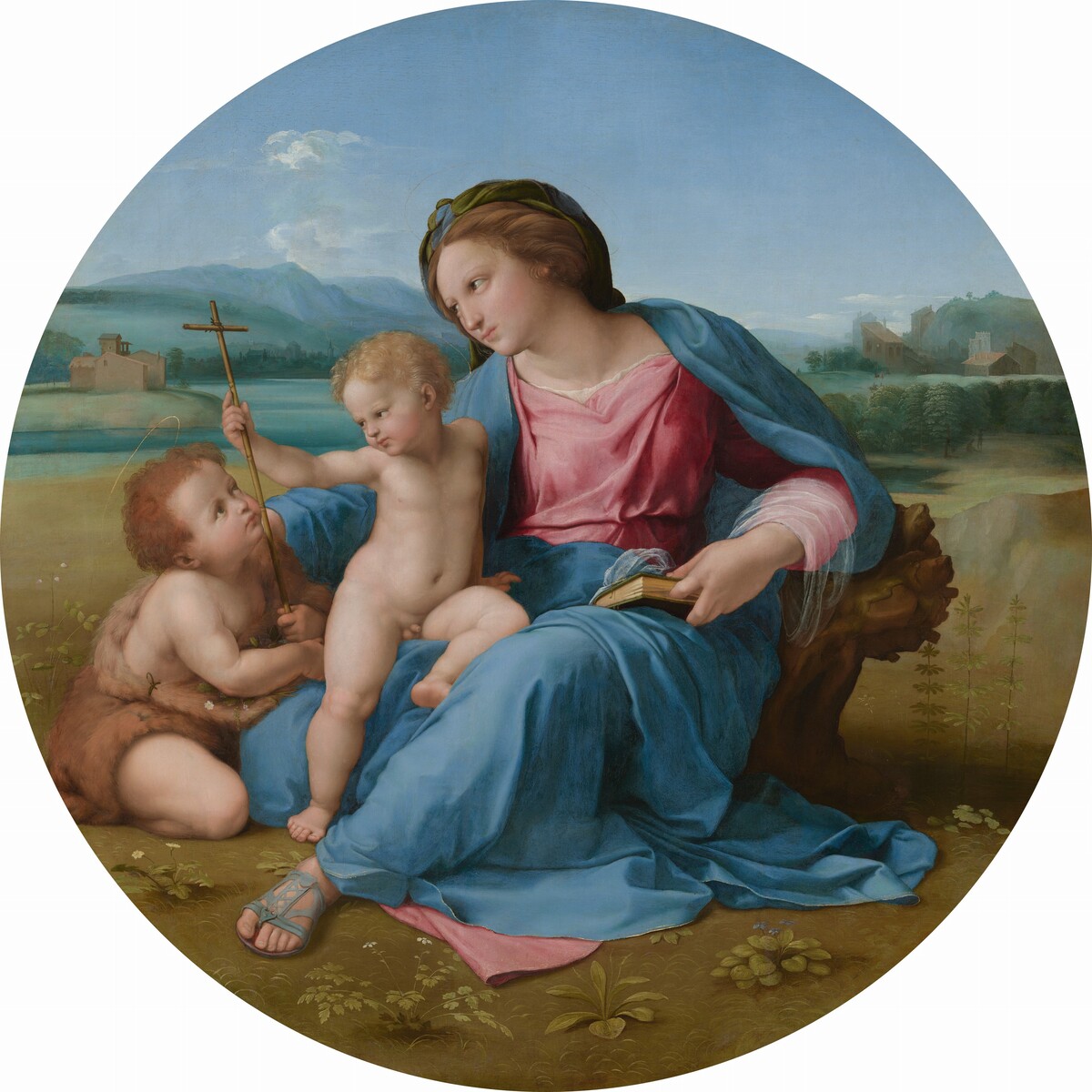
Raphael (1483-1520) painted The Alba Madonna around 1510, depicting the Virgin Mary, the Christ Child, and the young John the Baptist in a circular composition (tondo) that is one of the most accomplished examples of the form in Renaissance painting. The three figures are arranged in a pyramidal composition within the circle, with the Virgin seated on the ground (a sedes terrena rather than a sedes caelestis) in a landscape that recedes to a distant view of Rome. The Alba Madonna is named after the Spanish aristocratic family that owned it for centuries, and its journey from Rome to Spain to Russia to Washington makes it one of the most traveled paintings in the history of art.
Cultural Impact
The Alba Madonna is one of the most important paintings in the history of Western art because it represents the culmination of Raphael's synthesis of Florentine design and Roman grandeur. The circular composition, the pyramidal arrangement of the three figures, and the landscape setting are all perfected in this painting, which represents Raphael's mature style at its most accomplished. The painting's influence on subsequent Madonnas was enormous—Raphael's arrangement of the Virgin and Child in a landscape became the standard formula for Renaissance and Baroque Madonna compositions.
Why It Matters
The Alba Madonna is Raphael's tondo at its most perfect: the Virgin, Christ Child, and young John the Baptist arranged in a pyramidal composition within the circle, with the landscape receding to Rome. The c. 1510 painting represents the synthesis of Florentine design and Roman grandeur that defines Raphael's mature style and established the formula for Renaissance Madonna compositions.