Provenance
Said to have been acquired from a private collection in Rome by the engraver Peralli.[1] Dominique Vivant Denon [1747-1825], Paris;[2] sold 1808 to Czar Alexander I of Russia, [1777-1825], Saint Petersburg; Imperial Hermitage Gallery, Saint Petersburg;[3] purchased January 1931 through (Matthiesen Gallery, Berlin; P. & D. Colnaghi & Co., London and New York; and M. Knoedler & Co., New York and London) by Andrew W. Mellon, Pittsburgh and Washington, D.C.;[4] deeded 5 June 1931 to The A.W. Mellon Educational and Charitable Trust, Pittsburgh;[5] gift 1937 to NGA.
[1] Information given by E. Brüningk and Andrei Somov, _Ermitage Impérial. Catalogue de la Galerie des Tableaux. Les Écoles d'Italie et d'Espagne_, 3rd ed., Saint Petersburg, 1891: 73: "d'après le témoignage du baron Vivant Denon." No reference to an engraver named Peralli could be found in any of the generally used art dictionaries. It is know, however, that Botticelli's small panel _St. Augustine in His Study_ (no. 1473 in the Uffizi in Florence), was acquired in 1779 through Piero Pieralli (see John Fleming, "The Hugfords in Florence," _The Connoisseur_ 136 [1955]: 206). On Denon see the following note.
[2] Actually Brüningk and Somov 1891: 73 say only that the painting was acquired "par l'entremise" ("through the intermediation") of Denon. It is quite possible, however, that Denon--who, apart from being the creator of the Musée Napoleon, also had a very large private collection of paintings, art objects, and antiquities of his own (see Jean Chatelain, _Dominique Vivant Denon et le Louvre de Napoleon_, Paris, 1973: 260)--was already in possession of _The Adoration of the Magi_ when in 1808 he was entrusted with augmenting the Russian Imperial collections (see Vladimir Levinson-Lessing, _Istoria kartinskoi galerei Ermitaga, 1764-1917_, Leningrad, 1985: 138).
[3] The list of abbreviations for Brüiningk and Somov (1891: xxxv) and Andrei Ivanovich Somov (_Ermitage Impérial. Catalogue de la Galerie des Tableaux. Les Écoles d'Italie et d'Espagne_, 2nd ed., Saint Petersburg, 1899 [3rd ed., 1909]: xxxiv) states that the sign "A," included in the entry relative to the NGA painting, means it was acquired by Czar Paul I (1754-1801). Yet this identification is obviously an error, since besides the fact that Paul I was notoriously un-interested in art collecting, the very date of the acquisition of _The Adoration of the Magi_ for the Hermitage, seven years after the death of Paul I, proves that the painting entered the Imperial collection by request of his successor.
[4] See note 5. According to John Walker, _Self-Portrait with Donors_, Washington, D.C., 1974: 116, Matthiessen announced to his associates on 9 February 1931 that he had succeeded in buying _The Adoration of the Magi_. Art periodicals had begun to divulge the information by October 1931 ("Hermitage Art Reported Sold to A.W. Mellon," _Art News_ 30 [17 October 1931]: 3, 13, which quotes an article that appeared earlier that month in _The New York Herald Tribune_; see also "Editorial: Breaking up the Hermitage," _The Burlington Magazine_ 63, no. 365 [August 1933]: 53, but the acquisition was officially announced only in 1935 ("Mellon Holdings are Announced by Knoedler & Co.," _Art News_ 33, no. 21 [23 February 1935]: 3-5; "Rundschau. Amerika," _Pantheon_ [April 1935]: 150).
[5] The Mellon purchase date and the date deeded to the Mellon Trust are according to Mellon collection records in NGA curatorial files and David Finley's notebook (donated to the National Gallery of Art in 1977, now in the Gallery Archives).
In 2012 The Getty Research Institute, Los Angeles, acquired the M. Knoedler & Co. records (accession number 2012.M.54), and in 2013 processed portions of the archive were first made publicly available. An entry from a January 1931 Knoedler sales book confirms the sale to Mellon (on-line illustration of the sales book page, in Karen Meyer-Roux, "Treasures from the Vault: Knoedler, Mellon, and an Unlikely Sale," _The Getty Iris_ [http://blogs.getty.edu/iris/author/kmeyerroux/], 30 July 2013).
Accession Number
1937.1.22
Medium
tempera and oil on poplar panel
Dimensions
painted surface: 68 x 102 cm (26 3/4 x 40 3/16 in.) | overall size: 70 x 104.2 cm (27 9/16 x 41 in.) | framed: 98.4 x 132.1 x 8.3 cm (38 3/4 x 52 x 3 1/4 in.)
Classification
Painting
Credit Line
Andrew W. Mellon Collection
Tags
Painting Renaissance (1400–1599) Oil Painting Tempera Panel Painting Italian
Background & Context
Background Story
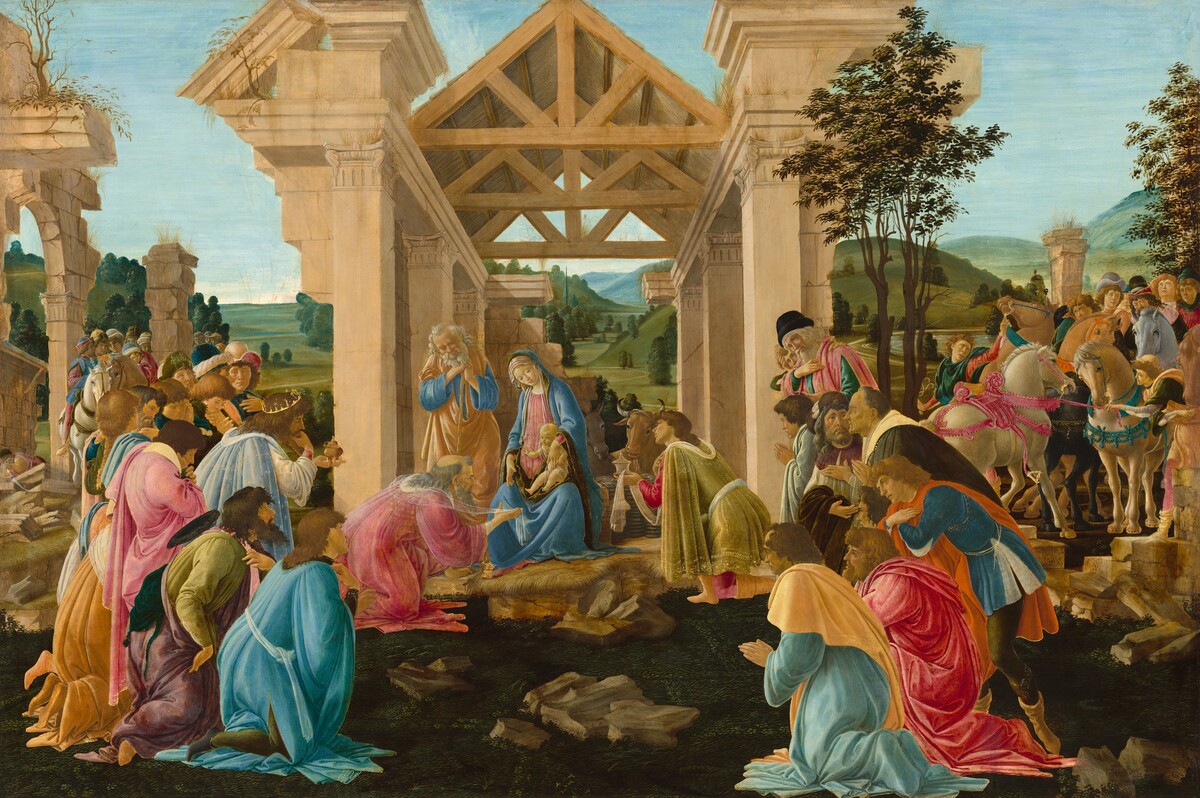
Sandro Botticelli (1445-1510) was a Florentine painter known for his mythological subjects (The Birth of Venus, Primavera) and religious paintings that combine the graceful line and poetic mood of the Florentine tradition. The Adoration of the Magi from c. 1478-82 is one of Botticelli's most accomplished early religious paintings, depicting the biblical episode in which the three Magi come to worship the newborn Christ in the graceful, linear manner that distinguishes Botticelli's work from the more sculptural painting of his Florentine contemporaries. The painting is notable for including portrait heads of the Medici family among the adoring figures, reflecting the close relationship between Botticelli and his Medici patrons.
Cultural Impact
The Adoration of the Magi is important in Botticelli's early development because it demonstrates the graceful line and poetic mood that he was developing in the late 1470s, before the mythological subjects of the 1480s that would make him the most poetic painter of the Florentine Renaissance. The Medici portraits in the adoring figures show the close relationship between Botticelli and his patrons, and the painting is one of the key documents of Botticelli's development from the sculptural manner of his early work to the graceful, poetic manner of his mature paintings.
Why It Matters
The Adoration of the Magi is Botticelli's graceful Florentine Renaissance at its most accomplished: the biblical episode rendered with the linear grace and poetic mood that distinguish his work from the more sculptural Florentine tradition. The c. 1478-82 painting includes Medici portraits and shows the development of the graceful manner that would produce The Birth of Venus.