Provenance
The sitter [1762-1834], Casa Pontejos and Palacio Miraflores, Madrid; her third husband, Joaquín Pérez Vizcaíno y Moles [1790-1840], Palacio Miraflores, Madrid;[1] his son-in-law, Don Manuel de Pando y Fernández, Marqués de Miraflores, Palacio Miraflores, by 1867;[2] Don Manuel's granddaughter, Genoveva de Sanmiego y Pando, Marquesa Viuda [widow] de Martorell and Marquesa de Miraflores y de Pontejos, Palacio Miraflores, by 1900;[3] her son, Don Manuel Alvarez de Toledo, Marqués de Miraflores y de Pontejos, Palacio Miraflores, by 1900;[4] sold July 1931 through Mrs. Walter H. [Anna] Schoellkopf, Madrid, and (M. Knoedler & Co., New York and Paris) to Andrew W. Mellon, Pittsburgh and Washington, D.C.; deeded December 1934 to The A. W. Mellon Educational and Charitable Trust, Pittsburgh; gift 1937 to NGA.
[1] Walter Cook, "Spanish Paintings in the National Gallery of Art II: Portraits by Goya," _Gazette des Beaux-Arts_ 28 (1945): 152 n 2. On Vizcaíno's life and career and on his inheritance of his wife's estate, see Eduardo C. Puga, "El Marqués de Pontejos," _La ilustración española y americana_ 39 (8 May 1895): 286-287.
[2] Charles Yriate, _Goya: sa biographie et le catalogue de l'oeuvre_, Paris, 1867: 139. Basic biographical information about the members of the house of Pontejos is given by Alberto and Arturo García Carrafa, _Diccionario heráldico y genealógico de apellidos españoles y americanos_, vol. 71, Madrid, 1956: 137-140; and by Juan Moreno de Guerra y Alonso, _Guía de la grandeza_ Madrid, 1917: 228-229.
[3] _Obras de Goya_, exh. cat., Ministerio de Instruccion Pública y Bellas Artes, Madrid, 1910: 32, no. 92. The painting was also recorded in her possession by S. L. Benusan, "A Note upon the Paintings of Francisco José Goya," _The Studio_ 24 (1901): 156; Albert F. Calvert, _Goya: an Account of his Life and Works_, London, 1908: 193, no. 215; Paul Lafond, _Goya_, Paris, 1910: 6; Hugh Stokes, _Francisco Goya_, London, 1914: 338, no. 251; Aureliano de Beruete y Moret, _Goya, pintor de retratos_, Madrid, 1915: 39; Valerian von Loga, _Francisco de Goya_, Munich, 1923: 200, no. 307; _Colección de cuatrocientos y nueve reproducciones de cuadros, dibujos, y aquafuertes de Don Francisco de Goya precididas de un epistolario del gran pintor y noticias biograficas por Don Francisco Zapatar (1860)_, Madrid, 1924: no. 58.
[4] _Pinturas de... Goya_, exh. cat., 1928: 23, no. 18.6. Lively accounts of the negotiations involved in this sale are given by David Edward Finley, _A Standard of Excellence_, Washington, 1973: 21-22; and John Walker, _Self-Portrait with Donors_ , Boston, 1974: 125.
Accession Number
1937.1.85
Medium
oil on canvas
Dimensions
overall: 210.3 x 127 cm (82 13/16 x 50 in.) | framed: 231.8 x 146.4 cm (91 1/4 x 57 5/8 in.)
Classification
Painting
Credit Line
Andrew W. Mellon Collection
Tags
Painting Neoclassical & Romantic (1751–1850) Oil Painting Canvas Spanish
Background & Context
Background Story
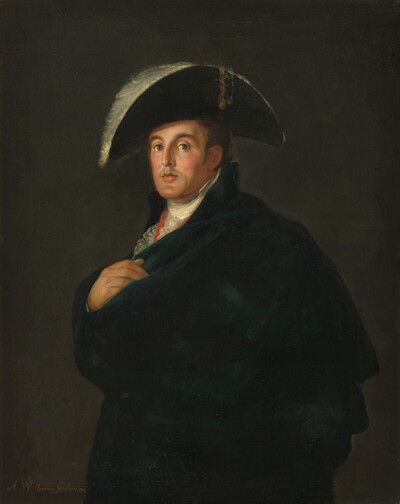
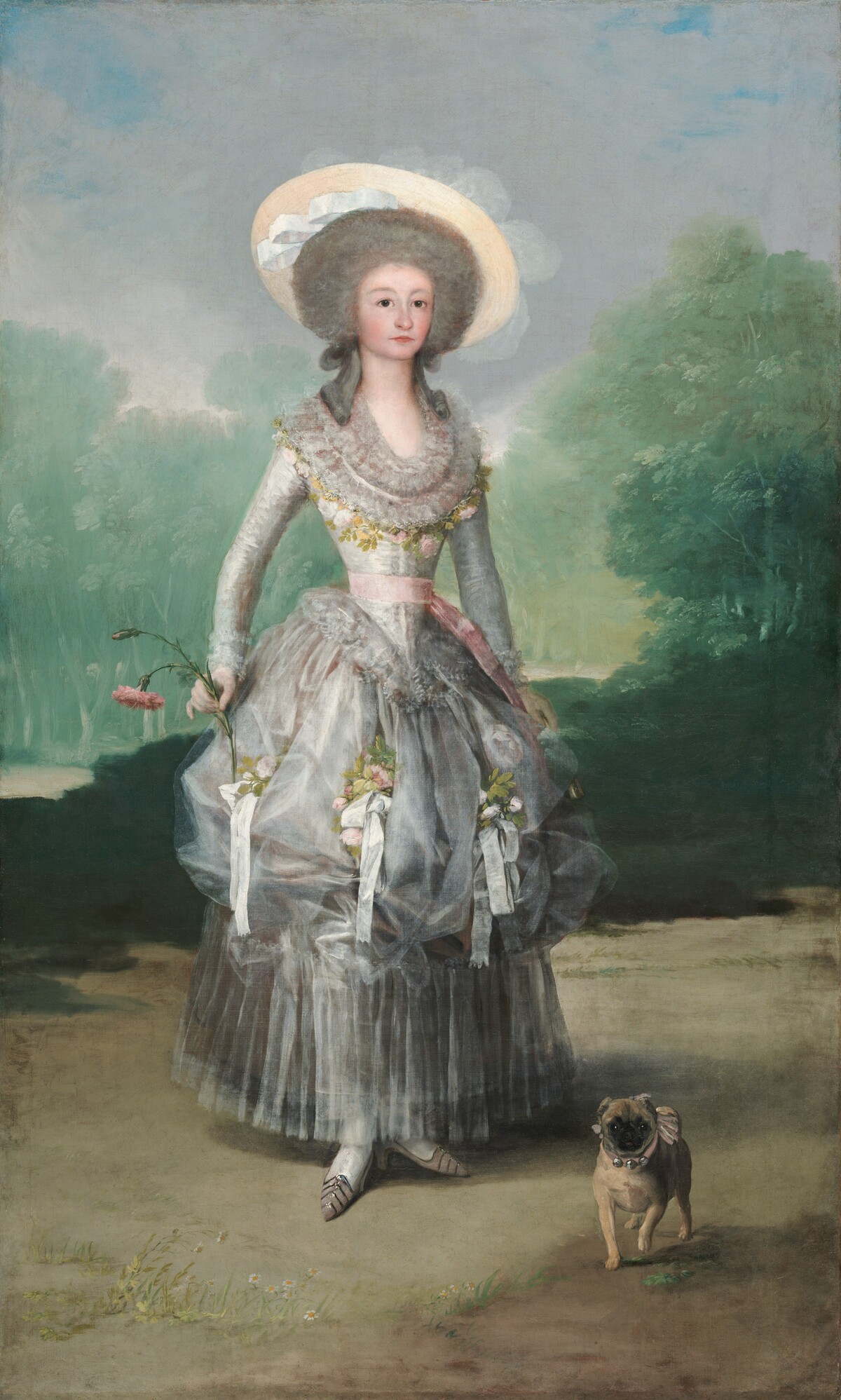
Francisco Goya painted this portrait of the Marquesa de Pontejos around 1786, early in his career as a court painter to the Spanish monarchy. It depicts a noblewoman of the Spanish aristocracy standing in a landscape, dressed in the elaborate costume of a maja - the distinctive Spanish fashion that combined peasant and aristocratic elements in a provocative display of national identity.
The marquesa's outfit is the painting's real subject: a fitted bodice with gold braiding, a mantilla of black lace, and a striking sash. Her tiny feet, pointedly visible beneath her skirt, were a conventional focus of Spanish erotic attention. She holds a fan - another attribute of the maja, signaling both modesty and flirtation. The landscape behind her is rendered in Goya's characteristically loose, atmospheric manner, contrasting with the precise detail of the costume.
This portrait belongs to Goya's early tapestry cartoon period, when he designed scenes of Spanish life for the Royal Tapestry Factory. These works required vivid color, narrative charm, and an intimate knowledge of Spanish customs. The Marquesa de Pontejos shares the tapestry designs' celebration of Spanish popular culture and its conviction that authentic national identity resided not in Frenchified aristocratic manners but in the bold, sensual world of the maja.
Cultural Impact
Goya's portraits of Spanish aristocrats in maja costume created an enduring image of Spanish identity - one that fused elegance and earthiness, aristocracy and populism. This visual synthesis influenced Manet's Spanish paintings, the imagery of flamenco culture, and the entire Romantic construction of Spain in the European imagination.
Why It Matters
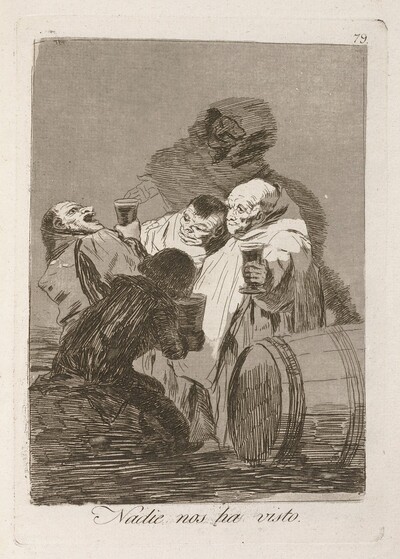
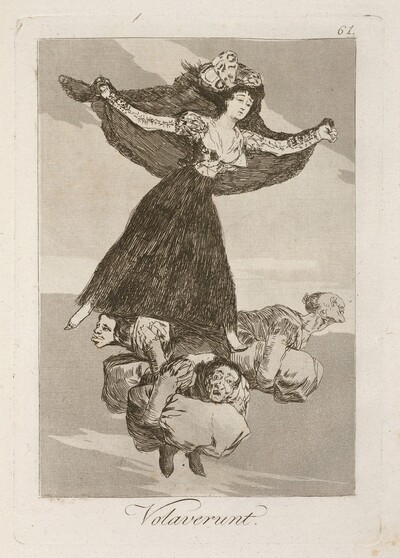
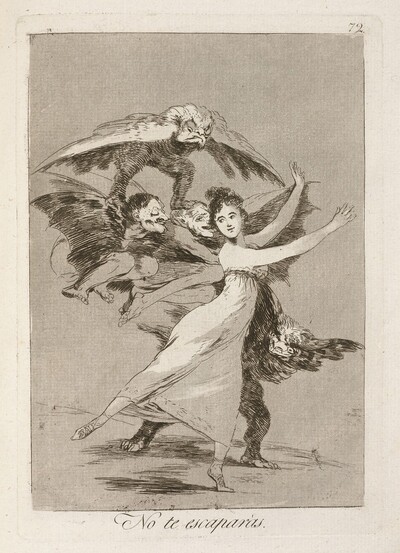
The painting captures Goya at the intersection of court portraiture and popular culture - a position from which he would launch his radical critique of Spanish society in the Caprichos and Disasters of War. It is simultaneously a beautiful portrait and a document of the social theater that Goya would eventually strip away.