Provenance
William Herbert, 3rd Earl of Pembroke [1580-1630], Wilton House, Wiltshire, by 1627; possibly his brother, Philip Herbert, 4th Earl of Pembroke [1584-1649/1650], Wilton House; given either by the 3rd Earl or the 4th Earl between 1628 and 1639 to Charles I, King of England [1600-1649];[1] (Charles I [Commonwealth] sale, Somerset House, London, 19 December 1651); purchased by Edward Bass.[2] Charles d'Escoubleau, Marquis de Sourdis [d. 1666], possibly acquired from Bass.[3] Laurent Le Tessier de Montarsy, by 1729; Pierre Crozat [1665-1740], Paris, by 1729;[4] by inheritance to his nephews, first to Louis-François Crozat, marquis du Châtel [1691-1750], Paris, and then [on Louis-François' death without a male heir] to Louis-Antoine Crozat, baron de Thiers [1700-1770];[5] the latter's heirs; purchased 1772, through Denis Diderot [1713-1784] as an intermediary, by Catherine II, empress of Russia [1729-1796], for the Imperial Hermitage Gallery, Saint Petersburg;[6] purchased March 1931 through (Matthiesen Gallery, Berlin; P. & D. Colnaghi & Co., London; and M. Knoedler & Co., New York) by Andrew W. Mellon, Pittsburgh and Washington, D.C.; deeded 30 March 1932 to The A.W. Mellon Educational and Charitable Trust, Pittsburgh;[7] gift 1937 to NGA.
[1] Recorded in Van der Doort, _A Catalogue and Description of King Charles the First's Capital Collection of Pictures, Limnings, Statues, etc_, from an Ashmolean manuscript (c. 1639), prepared for press by G. Vertue (printed by W. Bathoe), 1757: 4.
[2] According to O. Miller, "The Inventories and Valuations of the King's Goods, 1649-1651," _Journal of the Walpole Society_ 43 (1970-1972): 258.
[3] According to N. Le Clerc and J. Colomsat, _Cabinet des Singularitez D'Architecture, Peinture, Sculpture, et Graveure_, Paris, 1699: 66-67.
[4] Cited by F. R. Shapley, _Catalogue of the Italian Paintings_, 2 vols., Washington, 1979: 1:394, as documented in the _Recueil des Stampes...dans le Cabinet du Roi..._, Volume I, 1763: 13.
[5] Recorded in _Catalogue des Tableaux du Cabinet de M. Crozat, Baron de Thiers_, Paris, 1755: 34.
[6] See A. Somof, _Catalogue de la Galerie des Tableaux_, Saint Petersburg, 1899: 112-113.
[7] Mellon/Mellon trust purchase date and/or date deeded to to Mellon Trust is according to Mellon collection files in NGA curatorial records and David Finley's notebook (donated to the National Gallery of Art in 1977, now in Gallery Archives).
Accession Number
1937.1.26
Medium
oil on panel
Dimensions
overall: 28.5 x 21.5 cm (11 1/4 x 8 7/16 in.) | framed: 53.3 x 47.6 x 8.3 cm (21 x 18 3/4 x 3 1/4 in.)
Classification
Painting
Credit Line
Andrew W. Mellon Collection
Tags
Painting Renaissance (1400–1599) Oil Painting Panel Painting Italian
Background & Context
Background Story
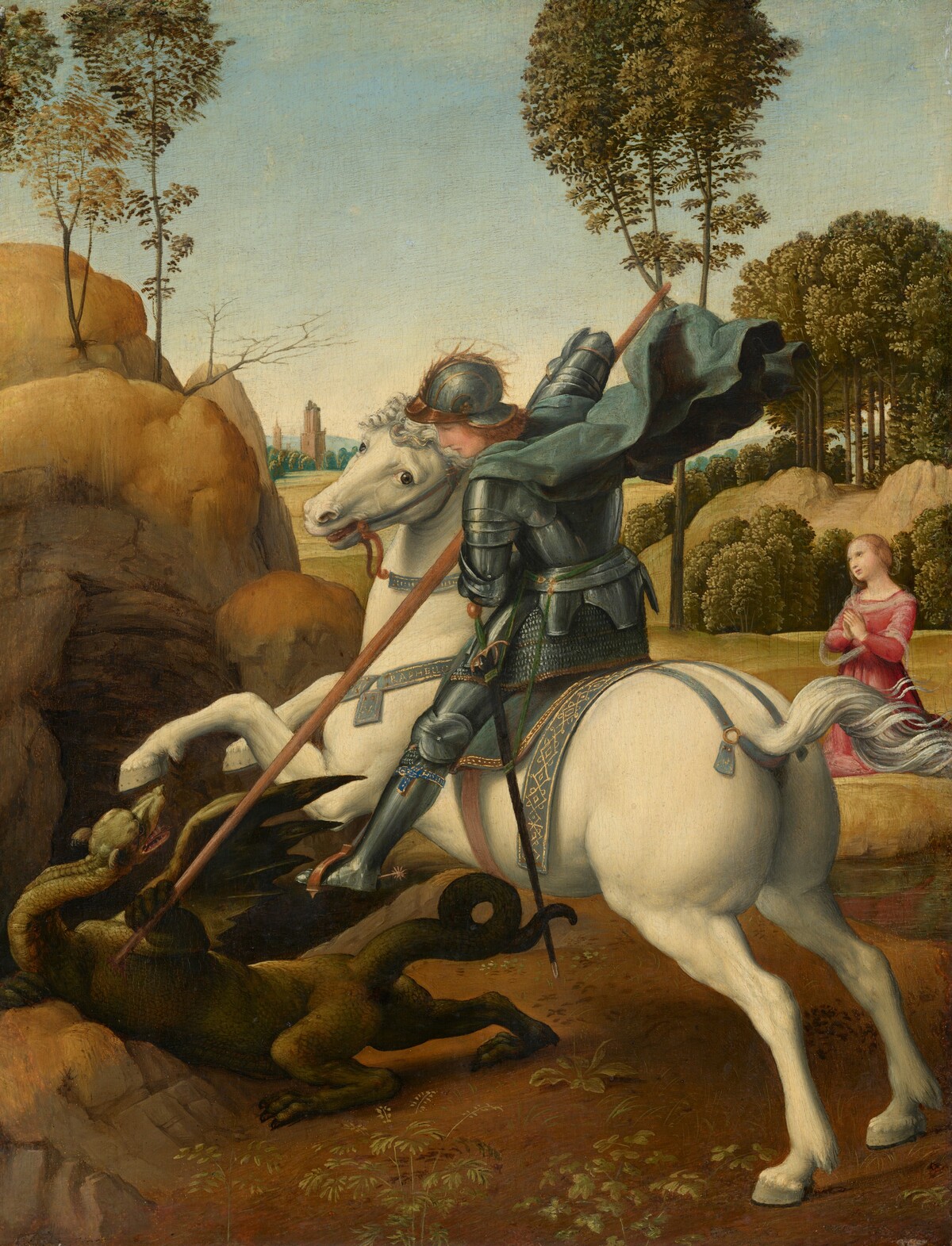
Raphael painted Saint George and the Dragon around 1506, during his transformative years in Florence. The painting depicts the legendary episode in which the Christian knight George saves a princess by slaying the dragon that has been terrorizing her city - a story that served as an allegory of faith overcoming evil throughout the Renaissance.
The composition is a model of High Renaissance balance and grace. Saint George, mounted on a rearing white horse, dominates the foreground, his red cloak streaming behind him as he drives his lance into the dragon's jaw. The princess, fleeing in the background, provides a secondary focal point that creates a dynamic diagonal movement across the canvas. The landscape - rolling hills, a distant walled city, a harbor with ships - demonstrates the influence of Leonardo da Vinci's atmospheric perspective.
This painting was likely commissioned by the Duke of Urbino as a diplomatic gift to King Henry VII of England, connecting the patron saint of England with the politics of the Italian courts. Raphael, only 23 at the time, was already a master of the narrative composition that would define his career.
Cultural Impact
Raphael's Saint George established the visual archetype of the knight-errant in Western art. His composition - horse and rider rearing against a dragon - was borrowed, adapted, and reinterpreted by artists from Rubens to Delacroix to the illustrators of modern fantasy. The image of Saint George and the Dragon remains one of the most widely recognized visual narratives in Western culture.
Why It Matters
This painting documents Raphael's emergence as the supreme narrative painter of the High Renaissance. At 23, he had already achieved the compositional mastery and emotional range that would make him the most influential painter in Western history.