Provenance
(Hammer Galleries, New York); sold 15 February 1965 to Ailsa Mellon Bruce [1901-1969]; bequest 1970 to NGA.
[1]Provenance according to invoice from Hammer Galleries to Ailsa Mellon Bruce dated 15 February 1965, a copy of which is in NGA curatorial records.
Accession Number
1970.17.126
Medium
oil on fiberboard
Dimensions
overall: 21.9 x 26.9 cm (8 5/8 x 10 9/16 in.) | framed: 35.2 x 39.7 x 6.7 cm (13 7/8 x 15 5/8 x 2 5/8 in.)
Classification
Painting
Credit Line
Ailsa Mellon Bruce Collection
Tags
Painting Contemporary (after 1950) Oil Painting Board British
Background & Context
Background Story
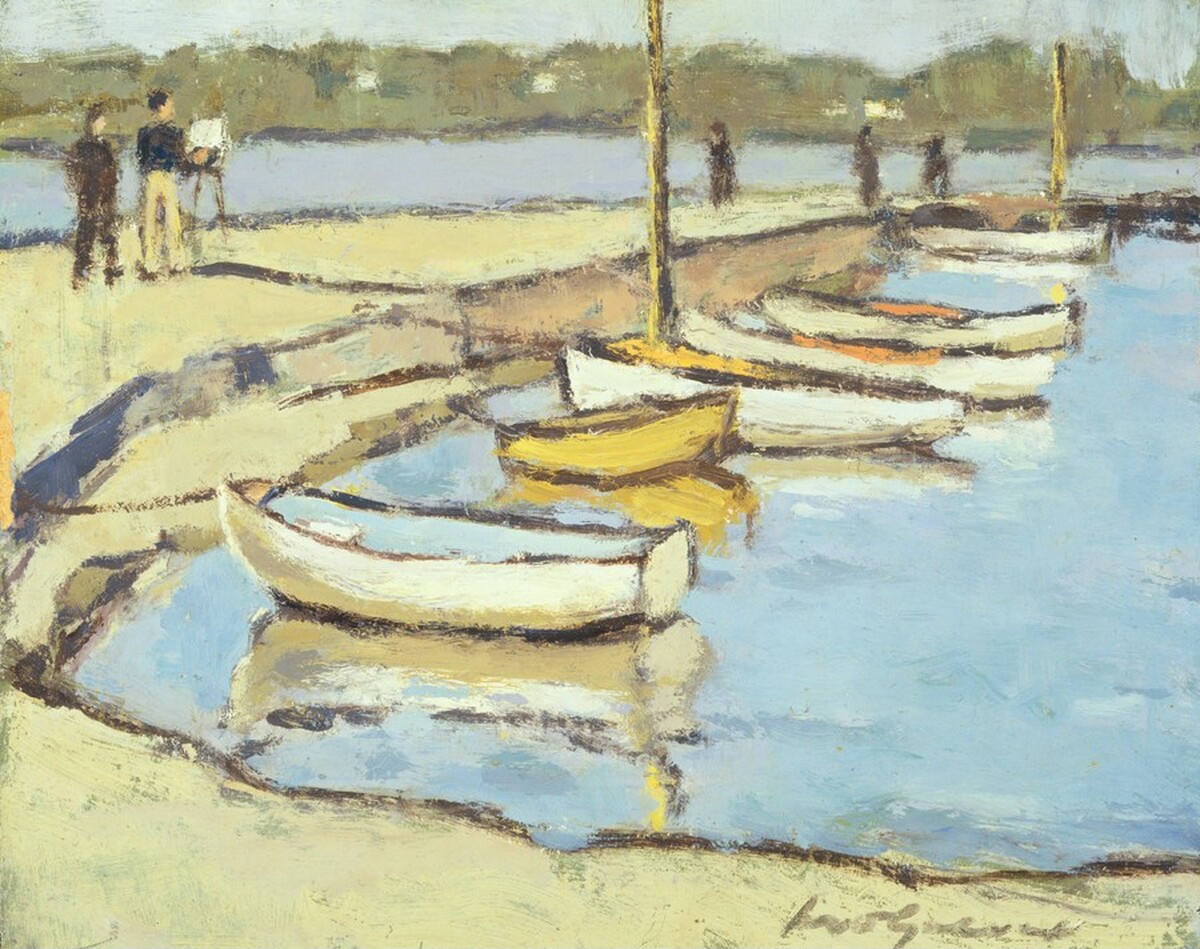
Captain Edward Molyneux (1891-1974) was an Irish-born fashion designer and painter who founded one of the most influential fashion houses of the 20th century while maintaining a parallel career as a painter. Artist on a Quay from 1962/64 depicts an artist working on a quay—a subject that combines Molyneux's interests in both fashion design and painting. The fiberboard support and the 1962-64 date suggest a work painted for personal pleasure rather than commission, and the subject of an artist at work on a quay reflects Molyneux's own practice of painting alongside his career in fashion design.
Cultural Impact
Molyneux's paintings are important in the history of 20th-century design because they demonstrate the creative range of one of the most influential fashion designers of the century. Artist on a Quay shows Molyneux applying the same compositional sense that made his fashion designs successful to the very different medium of painting, creating a record of the creative life of a designer who maintained his interest in painting throughout his career in fashion.
Why It Matters
Artist on a Quay is Molyneux the fashion designer as painter: an artist working on a quay, combining the compositional sense of a fashion designer with the personal practice of painting. The 1962/64 painting on fiberboard reflects the dual creative life of one of the 20th century's most influential fashion designers.