Provenance
Acquired 1930 from the artist by (Bernheim-Jeune, Paris). (Sam Salz, Inc., New York); sold 15 October 1964 to Ailsa Mellon Bruce [1901-1969], New York;[1] gift 1970 to NGA.
[1]Provenance according to the Ailsa Mellon Bruce notebook now in NGA archives, copy NGA curatorial records.
Accession Number
1970.17.9
Medium
oil on canvas
Dimensions
overall: 70.1 x 47.2 cm (27 5/8 x 18 9/16 in.) | framed: 99.4 x 76.5 x 10.2 cm (39 1/8 x 30 1/8 x 4 in.)
Classification
Painting
Credit Line
Ailsa Mellon Bruce Collection
Tags
Painting Early Modern (1901–1950) Oil Painting Canvas French
Background & Context
Background Story
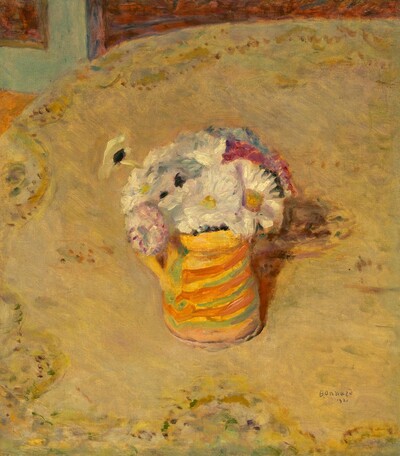
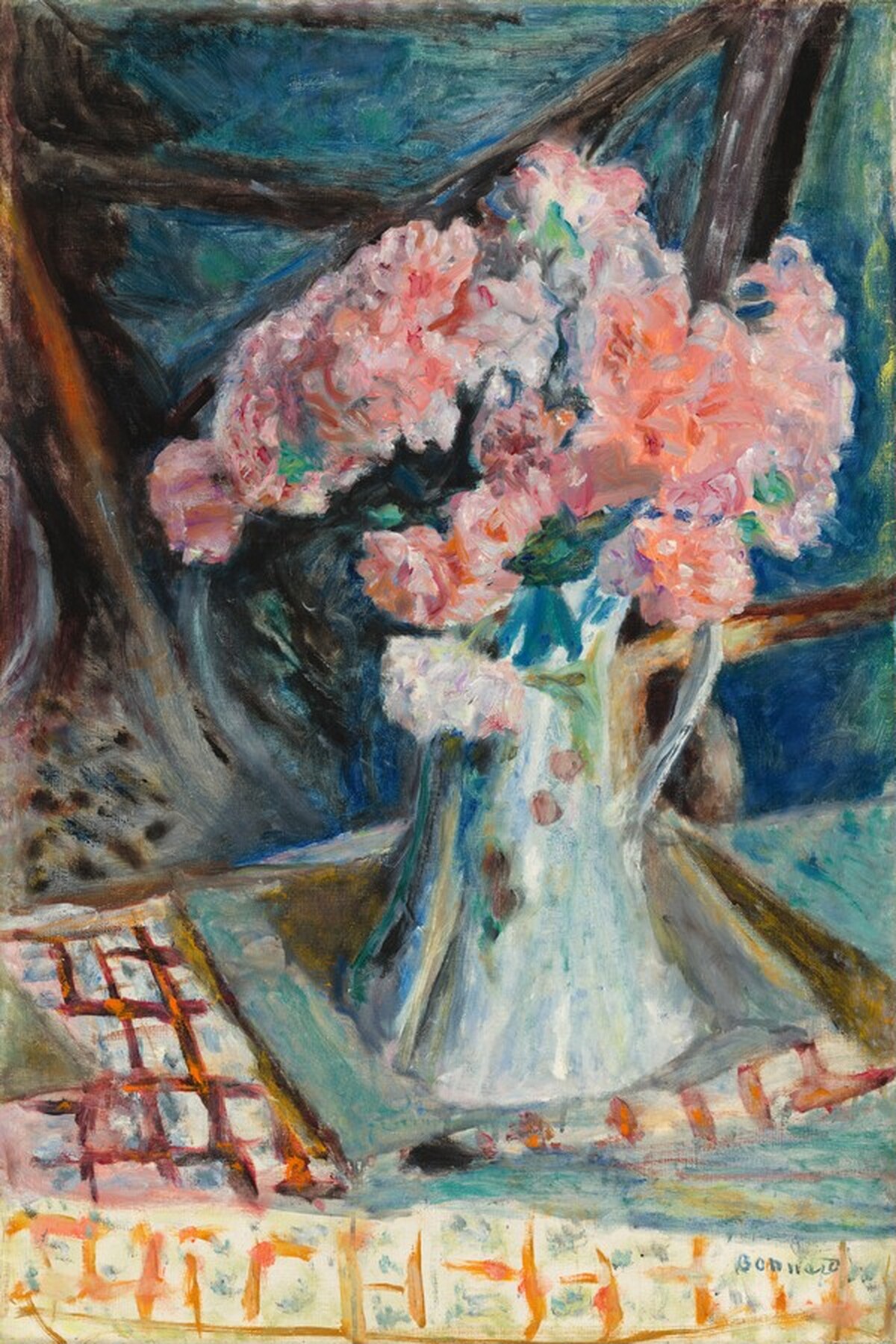
Bouquet of Flowers (c. 1926) represents Bonnard's lifelong engagement with flower subjects—the still-life tradition that provided him with some of his most vibrant chromatic explorations. By 1926, Bonnard had settled in Le Cannet in the south of France, where Mediterranean light and the garden he cultivated at Le Bosquet provided flower subjects of extraordinary chromatic richness. The bouquet, with its concentrated color within the domestic interior, allowed Bonnard to explore color interactions with an intensity that landscape subjects could not provide. The year 1926 places this during Bonnard's most chromatically adventurous period, when the Mediterranean's intense light was pushing his palette toward the warm oranges, yellows, and pinks that distinguished his late work. His treatment of the flowers departs from botanical accuracy: the bouquet is not a record of specific blooms but a chromatic composition where color itself is the primary subject. This approach—using the still-life tradition as a vehicle for chromatic exploration rather than for description—distinguishes Bonnard's flower paintings from the more conventional botanical still-life tradition and connects them to the modernist emphasis on the painting's surface rather than on its representational content. The painting also demonstrates Bonnard's characteristic method: working from memory rather than from direct observation, allowing the color experience to develop through the painting process rather than being constrained by the actual appearance of the flowers.
Cultural Impact
Bonnard's flower paintings influenced how the still-life tradition was updated for modernist art, using conventional subjects as vehicles for chromatic exploration. The paintings influenced later French painters who similarly found in flowers opportunities for color experimentation, from Matisse to the painters of the École de Paris. The bouquet subject influenced how the boundary between representation and abstraction was negotiated in modern art.
Why It Matters
This painting matters because it demonstrates how a conventional subject—the floral bouquet—could serve the most ambitious chromatic exploration when approached by a painter who understood that color, not description, was still-life painting's primary function. Bonnard's flowers argue for the primacy of color experience over botanical accuracy and for painting's ability to transform rather than merely record visual experience.