Provenance
The artist [1867-1947]; by inheritance to Bonnard-Terrasse family, Paris. (Wildenstein & Co., New York); sold 21 May 1969 to Ailsa Mellon Bruce [1901-1969], New York; gift 1970 to NGA.[1]
[1]Provenance according to invoice from Wildenstein dated 21 May 1969, in NGA curatorial records.
Accession Number
1970.17.8
Medium
oil on paper on canvas
Dimensions
overall: 49.5 x 64.7 cm (19 1/2 x 25 1/2 in.) | framed: 75.6 x 91.1 x 12.1 cm (29 3/4 x 35 7/8 x 4 3/4 in.)
Classification
Painting
Credit Line
Ailsa Mellon Bruce Collection
Tags
Painting Early Modern (1901–1950) Oil Painting Canvas French
Background & Context
Background Story
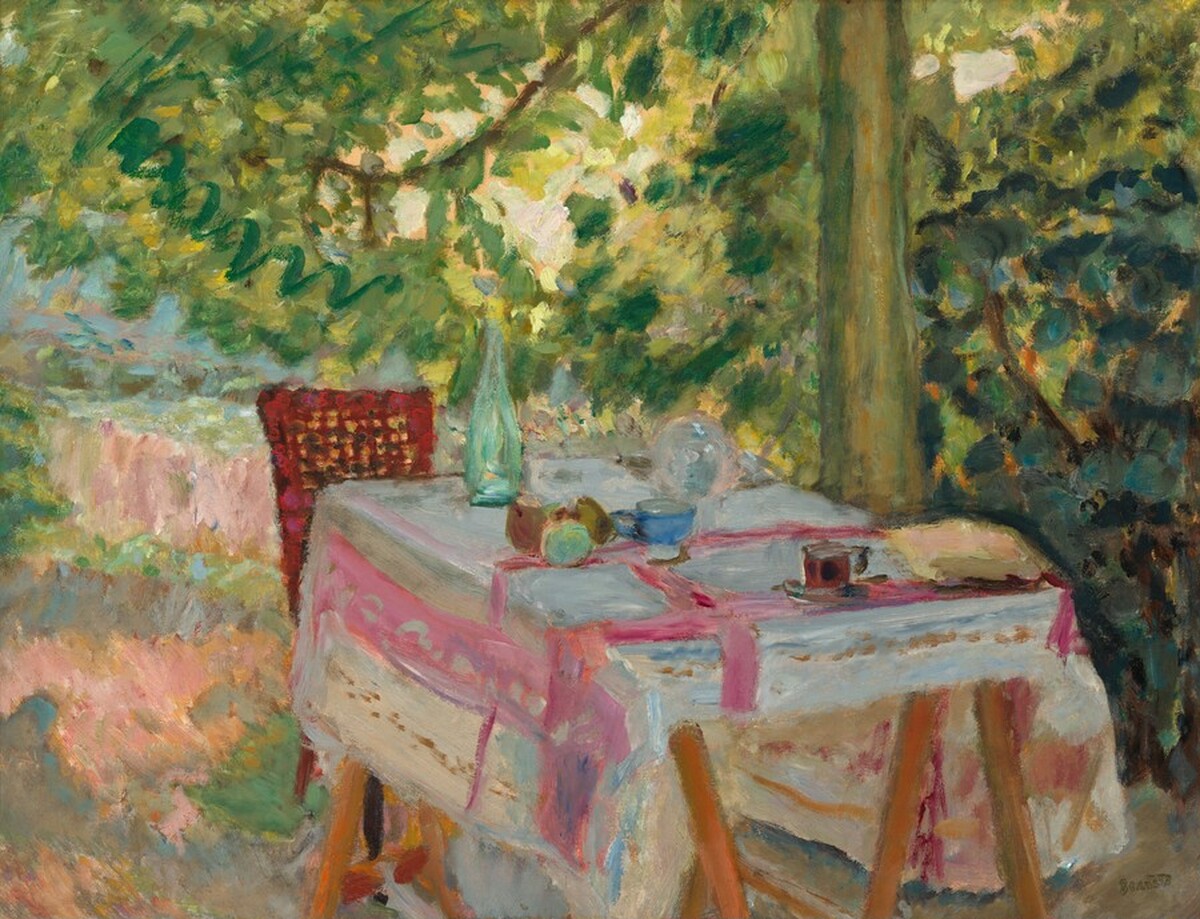
Table Set in a Garden (c. 1908) represents Bonnard's engagement with the domestic landscape—the garden as an extension of the interior world that was his primary subject. The table, set for a meal in the garden, combines the still-life tradition with the garden landscape, creating a subject where the domestic and the natural coexist. The year 1908 places this during Bonnard's most productive period, when he was dividing his time between Paris and the countryside and developing the decorative landscape style that would define his mature work. The garden table, with its tablecloth, dishes, and the specific quality of outdoor dining, represents the bourgeois domestic tradition that Bonnard chronicled with extraordinary sensitivity—the rituals of daily life that took place in the spaces where interior and exterior met. His treatment of the dappled garden light—filtering through foliage and falling on the white tablecloth—demonstrates his mastery of the chromatic effects that made his outdoor paintings so distinctive. The painting also reveals Bonnard's interest in the table as a compositional device: seen from above or from an unusual angle, the table creates a planar element that organizes the garden's spatial depth, connecting the foreground's domestic objects to the background's natural scenery.
Cultural Impact
Bonnard's garden-table paintings influenced how outdoor domestic life was represented in modern art, establishing the garden table as a significant artistic subject. The paintings influenced later French painters who similarly found subjects at the boundary between interior and exterior. The table-set-in-garden subject influenced how French bourgeois domestic culture was visually documented, connecting the rituals of daily life to the decorative landscape tradition.
Why It Matters
This painting matters because it captures the boundary between interior and exterior that was Bonnard's most characteristic setting—the garden table where domestic ritual and natural beauty meet, and where the Intimist tradition's attention to daily life combines with the landscape tradition's attention to natural atmosphere.