Provenance
The artist [1867-1947]; by inheritance to Bonnard-Terrasse family, Paris. (Wildenstein & Co., New York); sold 21 May 1969 to Ailsa Mellon Bruce [1901-1969], New York; gift 1970 to NGA.[1]
[1]Provenance according to invoice from Wildenstein dated 21 May 1969, in NGA curatorial records.
Accession Number
1970.17.7
Medium
oil on canvas
Dimensions
overall: 51 x 65 cm (20 1/16 x 25 9/16 in.) | framed: 77 x 90.5 x 9.5 cm (30 5/16 x 35 5/8 x 3 3/4 in.)
Classification
Painting
Credit Line
Ailsa Mellon Bruce Collection
Tags
Painting Early Modern (1901–1950) Oil Painting Canvas French
Background & Context
Background Story
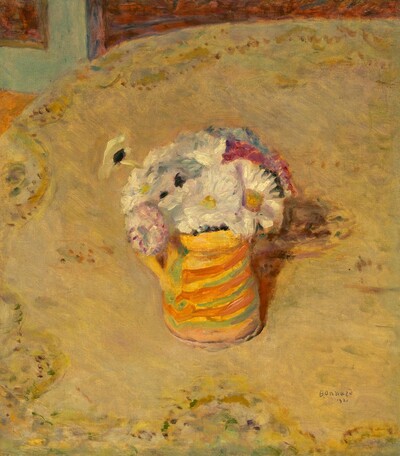
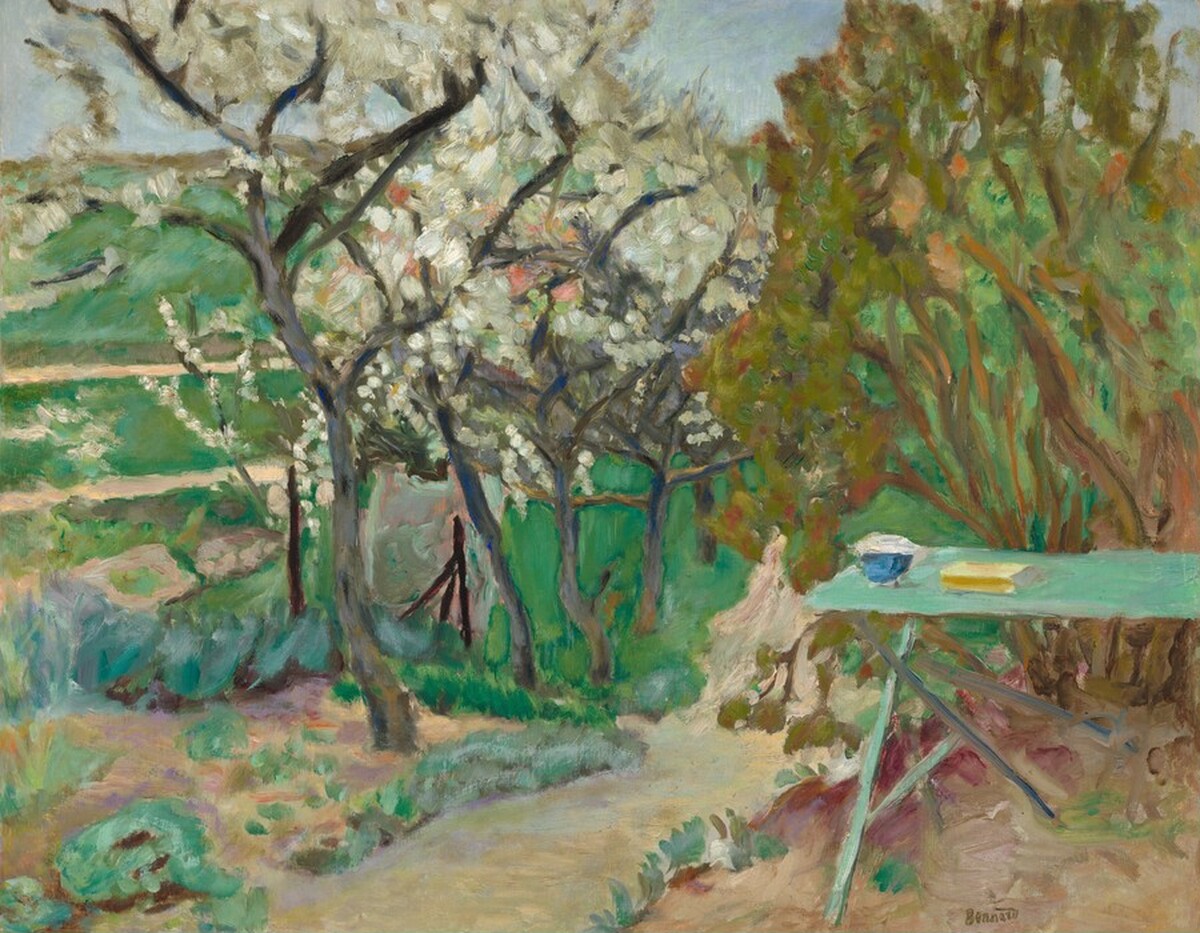
The Green Table, painted around 1910, depicts the artist's dining room viewed from above, the surface of the table - rendered in a characteristically intense green - dominating the composition like a landscape seen from a great height. Figures are glimpsed at the edges, their forms fragmenting into the patterned space of the room.
Pierre Bonnard was the most domestic of the great modern painters. His subjects were confined almost entirely to his own homes and gardens - the rooms he shared with his companion Marthe de Meligny, the tables at which they ate, the bathrooms in which she bathed. From these limited materials he created an art of extraordinary richness and formal daring.
The painting's radical composition - the extreme high viewpoint, the tipped-up perspective, the dissolution of figures into pattern - reflects Bonnard's engagement with Japanese prints, which he collected obsessively. Like the Japanese masters, Bonnard understood that domesticity could be a site of formal experimentation as demanding as any landscape or history painting. The green table, with its scattered dishes and napkins, becomes a field of chromatic energy in which the painting's real subject - the pleasure of perception itself - unfolds across the surface.
Cultural Impact
Bonnard's interior paintings demonstrated that the most radical formal innovations could emerge from the most ordinary subjects. His tipped-up perspectives, his dissolution of figure into ground, and his chromatic intensity influenced Matisse and established the domestic interior as a major site of modernist experiment.
Why It Matters
The Green Table captures Bonnard's central conviction: that intensity of looking can transform any subject - even a dining table after a meal - into a work of art. It is a painting about the pleasure of seeing, and an argument that perception, not subject matter, is the proper province of painting.