Provenance
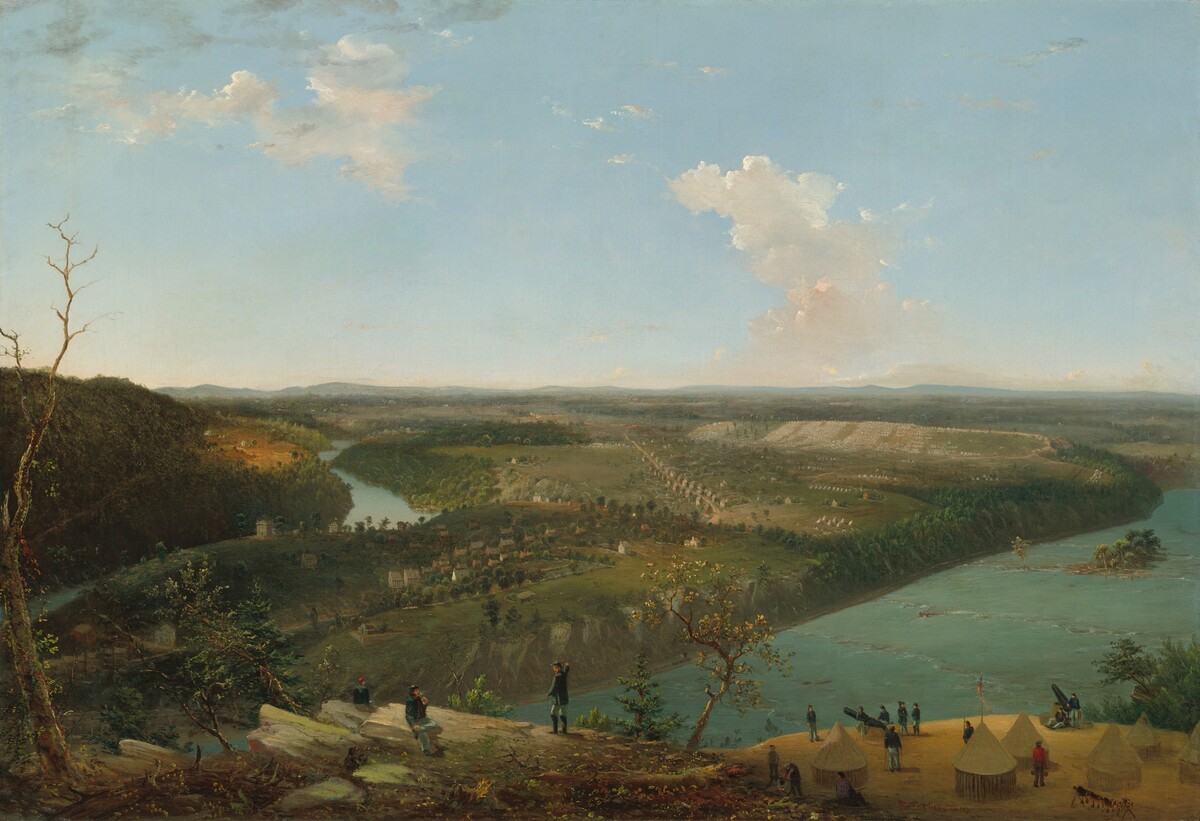
The artist; probably to his brother-in-law, Edward Stabler Plummer [b. 1825]; probably to his son, William B. Plummer [c. 1858-after 1930]; his daughter, and the artist's grandniece, Genevieve Plummer [1881-1969]; gift 1954 to the Corcoran Gallery of Art, Washington, as _Battle of Antietam_; acquired 2016 by the National Gallery of Art.
Accession Number
2016.22.12
Medium
oil on canvas
Dimensions
overall: 76.2 × 111.76 cm (30 × 44 in.) | framed: 94.62 × 129.86 × 11.11 cm (37 1/4 × 51 1/8 × 4 3/8 in.)
Classification
Painting
Credit Line
Corcoran Collection (Gift of Genevieve Plummer)
Tags
Painting Impressionist & Modern (1851–1900) Oil Painting Canvas American
Background & Context
Background Story
William MacLeod's Maryland Heights: Siege of Harpers Ferry, dated 1863, documents one of the most dramatic episodes of the American Civil War. The siege of Harpers Ferry in September 1862 resulted in the largest surrender of Union forces during the war, when Confederate General Stonewall Jackson's troops surrounded the garrison at the confluence of the Shenandoah and Potomac Rivers. Maryland Heights, the towering bluff across the Potomac from Harpers Ferry, served as a key strategic position whose capture by Confederate forces on September 13, 1862, made the Union position untenable. MacLeod, a landscape painter working in the mid-Atlantic region, captured the imposing terrain that played such a decisive role in the engagement. The painting shows the dramatic topography of the Heights rising above the river, with the landscape itself serving as both subject and historical witness. Harpers Ferry had long attracted artists for its spectacular scenery, as Thomas Jefferson had declared the view from the heights worth a voyage across the Atlantic, but MacLeod's painting transforms this picturesque landscape into a document of military significance. The year 1863, when this work was painted, saw continued fighting in the region, and the memory of the siege remained vivid. MacLeod's painting belongs to a tradition of landscape art in service of historical memory, where terrain itself becomes an actor in the narrative of events.
Cultural Impact
This painting preserves the visual landscape of a pivotal Civil War engagement and contributes to the tradition of American landscape painting that documents sites of national historical significance, joining works by artists who recognized that terrain shapes history.
Why It Matters
The work demonstrates how Civil War landscapes served as both historical documents and acts of national memory, preserving the terrain where decisive events unfolded.
![Saint Bernard and Saint Catherine of Alexandria with the Virgin of the Annunciation [right panel]](https://api.nga.gov/iiif/e6890364-4d99-4684-a62b-5060ee3c3446/full/400,/0/default.jpg)