Provenance
William A. Clark [1839-1925], New York; bequest 1926 to the Corcoran Gallery of Art, Washington; acquired 2014 by the National Gallery of Art.
Accession Number
2014.136.52
Medium
oil on canvas
Dimensions
overall: 101.6 × 130.81 cm (40 × 51 1/2 in.) | framed: 123.19 × 150.65 × 8.89 cm (48 1/2 × 59 5/16 × 3 1/2 in.)
Classification
Painting
Credit Line
Corcoran Collection (William A. Clark Collection)
Tags
Painting Neoclassical & Romantic (1751–1850) Oil Painting Canvas British
Background & Context
Background Story
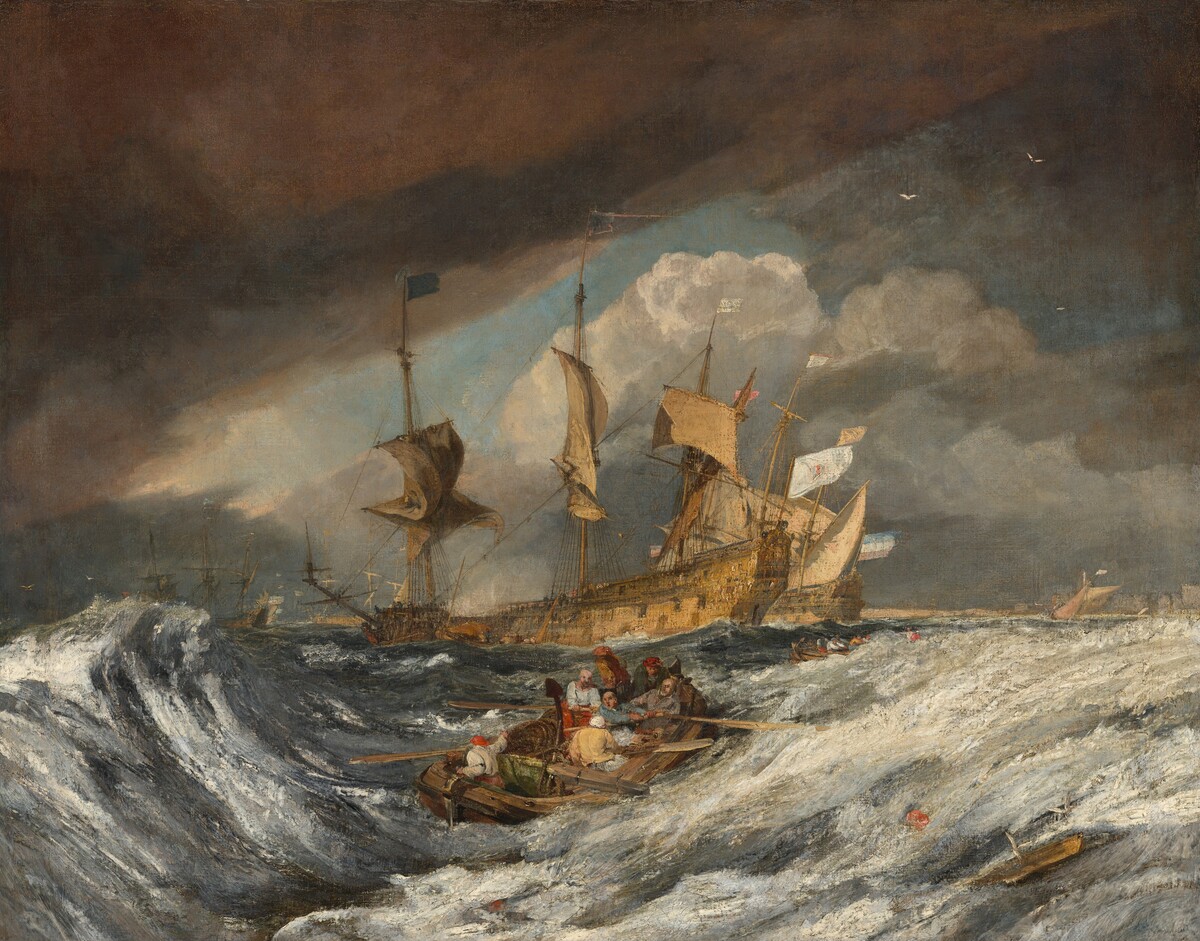
This early maritime scene reveals the young Turner deeply engaged with the tradition of Dutch marine painting while already asserting his own sensibility. The composition shows small boats struggling through heavy seas to carry anchors out to waiting warships — a routine naval operation rendered with extraordinary drama. Turner was about twenty-nine when he painted this, recently elected the youngest-ever Royal Academician, and clearly studying the Dutch Golden Age masters with whom he felt an affinity.
Cultural Impact
The painting bridges two worlds: the meticulous detail of 17th-century Dutch marine art (Willem van de Velde, Ludolf Bakhuizen) and the atmospheric dissolution that would become Turner's signature. The churning water, the lowering sky, and the desperate human activity against nature's indifference all point to themes Turner would develop for the next four decades.
Why It Matters
This work shows the roots of Turner's genius. His ability to find sublimity in the ordinary — a routine naval maneuver — would define his entire career, from 'The Fighting Temeraire' to his late, nearly abstract seascapes.