Provenance
Paul Mellon [1907-1999], Upperville, Virginia; bequest 1999 to NGA, with life interest to his wife, Rachel Lambert Mellon [1910-2014].
Accession Number
2014.18.36
Medium
oil on metal
Dimensions
overall: 25.4 × 35.24 cm (10 × 13 7/8 in.) | framed: 33.66 × 43.66 × 2.86 cm (13 1/4 × 17 3/16 × 1 1/8 in.)
Classification
Painting
Credit Line
Collection of Mr. and Mrs. Paul Mellon
Tags
Painting Neoclassical & Romantic (1751–1850) Oil Painting American
Background & Context
Background Story
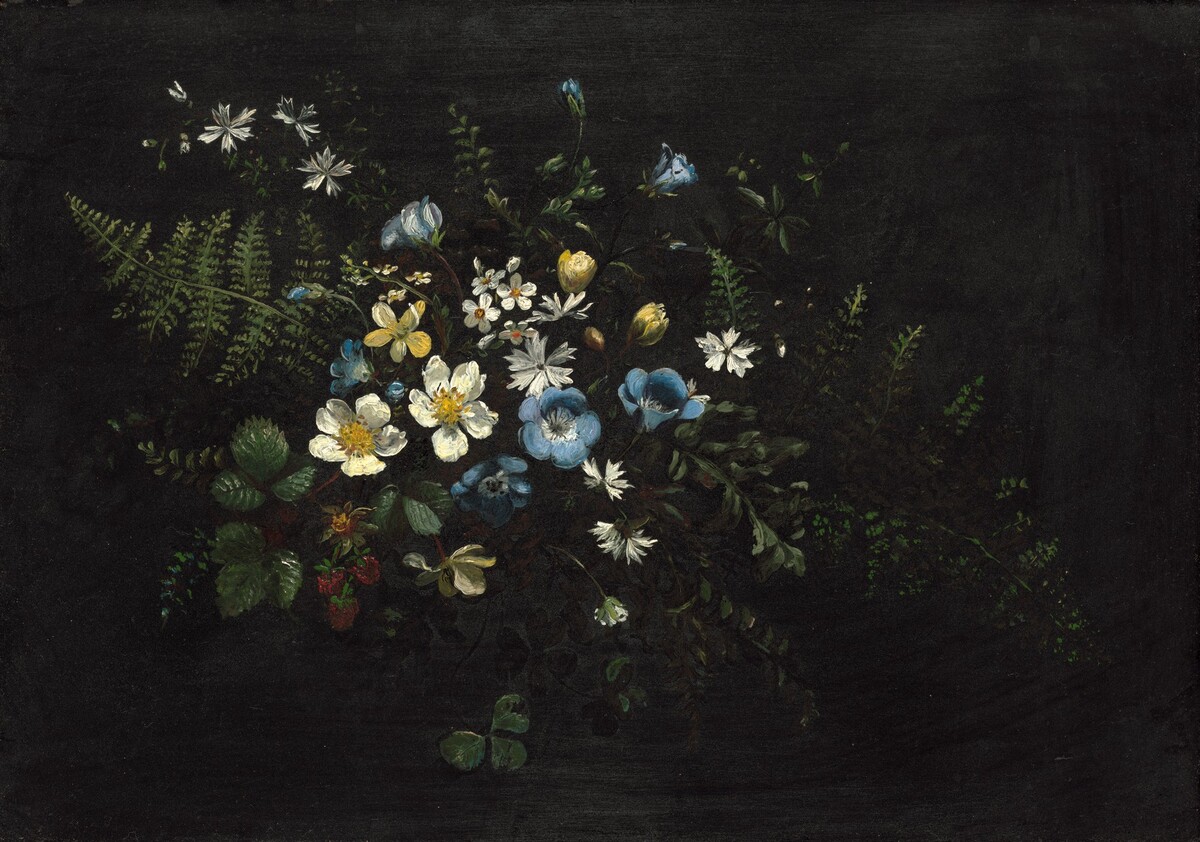
Titian Ramsay Peale's Spray of Flowers and Ferns is a delicate natural history study by one of America's most accomplished artist-naturalists of the 19th century. A member of the illustrious Peale family of artists and scientists, Titian Ramsay Peale (1799-1885) was the son of Charles Willson Peale and contributed significantly to American natural history through both his art and his scientific expeditions. This botanical rendering demonstrates Peale's characteristic precision and his deep understanding of plant morphology acquired through decades of field observation. The composition presents flowers and ferns arranged with an artist's eye for graceful line and natural rhythm, yet rendered with the exactitude required of scientific illustration. Peale participated in major scientific expeditions, including the Long Expedition to the Rocky Mountains and the United States Exploring Expedition under Charles Wilkes, experiences that honed his ability to capture specimens with both accuracy and aesthetic sensitivity. The date of this particular work is unknown, but Peale produced natural history illustrations throughout his long career, working in watercolor and pencil with a lightness of touch that distinguished his work from more mechanical scientific illustration. The ferns in the composition reflect the 19th-century fascination with pteridology, as fern collecting was a popular Victorian pursuit, while the flowers display Peale's mastery of color and form. His dual identity as artist and scientist places this work at the intersection of art and natural history, a space where beauty and knowledge converge.
Cultural Impact
Peale's natural history illustrations form an important part of America's scientific and artistic heritage, bridging the gap between fine art and scientific documentation during a formative period of American natural science.
Why It Matters
This work illuminates the Peale family's foundational role in American natural history and demonstrates how art served scientific knowledge in 19th-century America.

![Saint Bernard and Saint Catherine of Alexandria with the Virgin of the Annunciation [right panel]](https://api.nga.gov/iiif/e6890364-4d99-4684-a62b-5060ee3c3446/full/400,/0/default.jpg)