Provenance
Pieter Cornelis, baron van Leyden [1717-1788, known during his lifetime as the Heer van Leyden van Vlaardingen], Leiden;[1] by inheritance with the paintings in his collection to his son, Diederik van Leyden [1844-1810/1811], Leiden and Amsterdam;[2] sold, with the rest of his father's painting collection, to a consortium formed by L.B. Coclers, Alexander Joseph Paillet, and A. de Lespinasse de Langeac;[3] (sale, Paillet and Delaroche, Paris, 5-8 November 1804, no. 6);[4] purchased by Paillet for Herard. Alexander Baring [later 1st baron Ashburton, 1774-1848], Bath House, London, by 1821;[5] by inheritance to his son, William Bingham Baring, 2nd baron Ashburton [1799-1864], Bath House, London; by bequest 1864 to his wife, Louisa Caroline, Lady Ashburton [née Mackenzie, 1827-1903], Bath House, London; sold by her executor and son-in-law, William George Spencer Scott Compton, 5th marquess of Northampton [1851-1913], to a consortium of (Thos. Agnew & Sons, Charles Davis, Arthur J. Sully, and Asher Wertheimer, all in London); presumably retained by Wertheimer until (his sale, Christie, Manson & Woods, London, 18 June 1920, no. 6, as _A Woody Landscape_); (Permain, London).[6] Charles Hubert Archibald Butler [1901-1978], Shortgrove, Newport, Essex; (sale, Christie, Manson & Woods, London, 26 June 1964, no. 51);[7] (Alfred Brod Gallery, London), until at least December 1965.[8] (Hazlitt, Gooden and Fox, London), 1966-1967; sold to private collection; (sale, Christie, Manson & Woods, 7 July 2000, no. 17); purchased by NGA.
[1] The provenance is taken from the 7 July 2000 sale catalogue. About the Van Leyden collection, see the description of Sale F-80, by Benjamin Peronnet, in The Getty Provenance Index© Databases, accessed 17 February 2012, and J.W. Niemeijer,“Baron van Leyden, Founder of the Amsterdam Print Collection,” trans. Patricia Wardle, Apollo (June 1983): 461-468. As Niemeijer explains, in Van Leyden’s own day the title of baron was not actually used; when alive he was known as the Heer Van Leyden van Vlaardingen. He is given the title of baron in later publications, a title that was indeed his, as an ancestor was created a baron of the Holy Roman Empire in 1548.
[2] Niemeijer 1983, 468. While his son inherited the paintings, Van Leyden’s large and important print collection was bequeathed to his grandson, after whose death in 1789 it became the property of the young man’s mother. Sold in 1806 to Louis Napoleon, it was housed first in The Hague, then Paris, and was eventually returned in 1816 to Amsterdam, where it formed the nucleus of the print collection at the Rijksmuseum.
[3] The sale catalogue does not cite a source for this information.
[4] The sale was originally scheduled for 5 July 1804, and rescheduled for 10 September 1804 (the date printed on the sale catalogue), before finally taking place in November.
[5] Baring lent the painting to an 1821 exhibition at the British Institution.
[6] The 2000 sale catalogue indicates that the painting was “possibly purchased by Seligman” at the 1920 sale. However, the annotated copy of the 1920 sale catalogue available on microfiche in the Christie’s catalogues from the Knoedler Library gives the buyer as “Permain,” who might be the London dealer William Permain.
[7] The painting was erroneously described in the sale catalogue as having come from the collection of his grandfather, Charles Butler of Warren Wood, presumably having been confused with a landscape by Both lent by his grandfather to the British Institution in 1864 (no. 88).
[8] The painting was offered by the Alfred Brod Gallery to the National Gallery of Art in December 1965 (original letter of 13 December 1965 in NGA Photographic Archives, copy in NGA curatorial files).
Accession Number
2000.91.1
Medium
oil on canvas
Dimensions
overall: 138.5 x 172.7 cm (54 1/2 x 68 in.)
Classification
Painting
Credit Line
Patrons' Permanent Fund
Tags
Painting Baroque (1600–1750) Oil Painting Canvas Dutch
Background & Context
Background Story
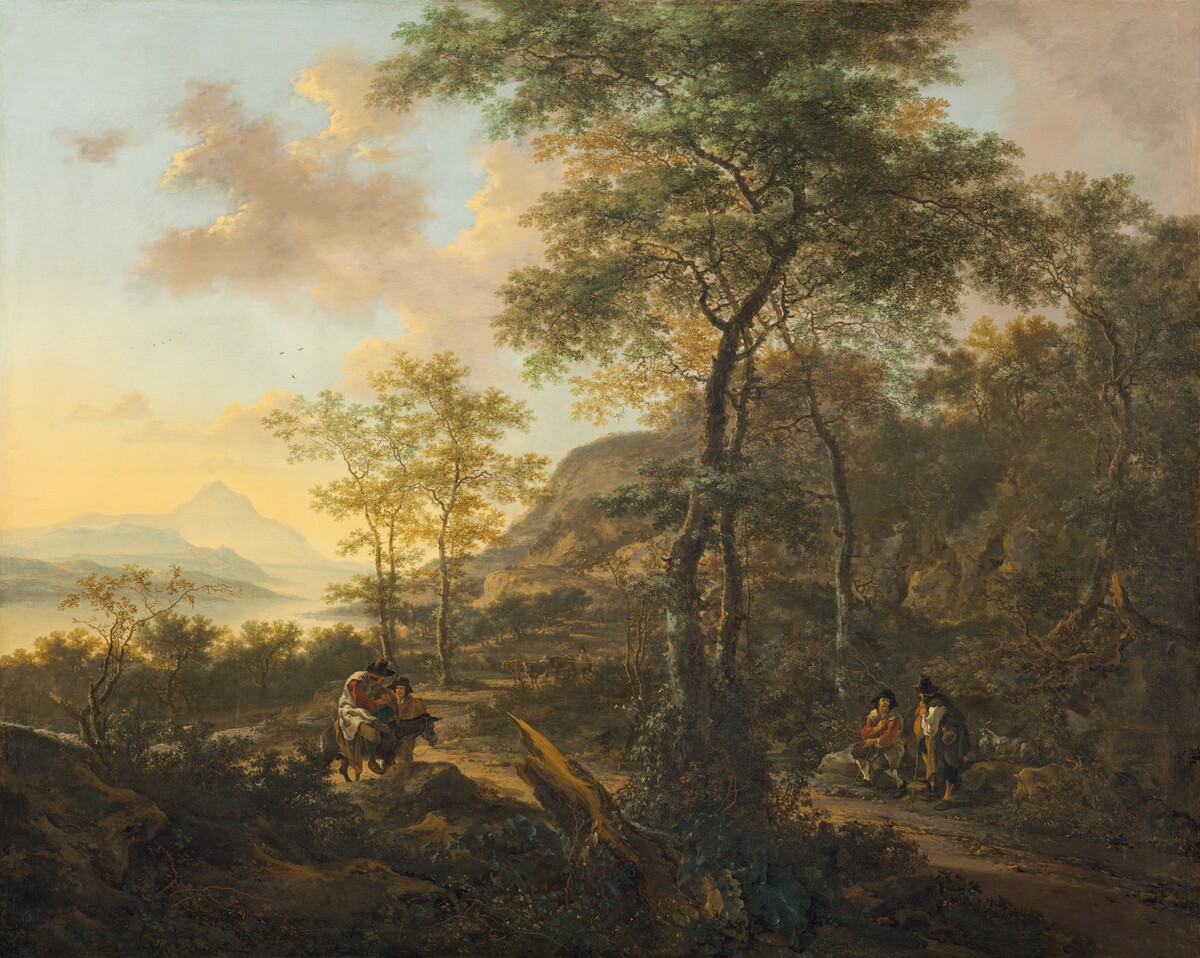
Jan Both (c. 1618-1652) was a Dutch Golden Age painter known for his Italianate landscapes that combine the warm golden light of the Italian south with the naturalistic detail of the Dutch landscape tradition. An Italianate Evening Landscape from c. 1650 depicts an evening landscape in the warm, golden light that distinguishes Both's best work from the more tonal manner of his Dutch contemporaries. The c. 1650 date places this in Both's most productive period, when he was producing the Italianate landscapes that established the warm, golden manner as the dominant mode of Dutch Italianate landscape painting.
Cultural Impact
An Italianate Evening Landscape is important in the history of Dutch landscape painting because it demonstrates the warm, golden manner that Both established as the dominant mode of Dutch Italianate landscape painting. Both's Italianate landscapes introduced the warm southern light that Dutch landscape painters had seen during their Italian travels, creating a type of landscape that combined the naturalistic detail of the Dutch tradition with the warm, golden light of the Italian south.
Why It Matters
An Italianate Evening Landscape is Both's warm golden Italianate manner: an evening landscape rendered in the warm, golden light that distinguishes his work from the more tonal manner of his Dutch contemporaries. The c. 1650 painting established the golden Italianate manner as a major mode of Dutch landscape painting.