Provenance
Sir Henry Thompson, 1st bt. [1820-1904].[1] George McCulloch [1848-1907], London, by 1903;[2] (his estate sale, Christie, Manson & Woods, London, 23, 29, and 30 May 1913, 1st day, no. 35); (Henry Wallis & Son, London); purchased 30 October 1916 by Henry Clay Frick [1849-1919], Pride’s Crossing, Eagle Rock, Massachusetts, and New York;[3] by inheritance to his daughter, Helen Clay Frick [1888-1984], Pride’s Crossing; gift 19 October 1959 to her nephew, Dr. Henry Clay Frick, II [1919-2007], Alpine, New Jersey;[4] (Noortman [Maastricht] BV, Maastricht); purchased 16 June 1999 by NGA.
[1] Statement about the painting by Wallis & Son, and letter, Wallis & Son to Henry Clay Frick, 4 October 1916; copies in NGA curatorial files from: The Frick Collection/Frick Art Reference Library Archives, The Frick Collection Records, Henry Clay Frick Art Collection Files, TFC.100.10, Series I: Purchases, 1881-1920, Subseries 2: Purchase Files, 1896-1919, box 4, folder 13. Thompson was a prominent physician, surgeon, and professor at the Royal College of Surgeons in London.
[2] McCulloch lent the painting to a 1903 exhibition in London. Born in Glasgow, he made his fortune as a mine owner in New South Wales before he settled in London. There McCulloch befriended John Singer Sargent and amassed an important collection of works by then living artists.
[3] Letter, 30 October 1916, Henry Clay Frick to Wallis & Son, London; handwritten Ledger Pages showing paintings acquired December 31, 1912 – April 14, 1917, page dated 1916, entry dated October 30; typed List of Paintings Acquired December 29, 1910-August 23, 1919; 1920 Inventory of One East 70th Street, paintings in the Gallery; receipts and letter, 14 and 15 November 1916, Wallis & Son, London, to Henry Clay Frick; copies in NGA curatorial files from: The Frick Collection/Frick Art Reference Library Archives: The Frick Collection Records, Henry Clay Frick Art Collection Files, TFC.100.10, Series I: Purchases, 1881-1920, Subseries 2: Purchase Files, 1896-1919, box 4, folder 3, and Subseries 3: Lists, 1910-1920, box 5, folders 12 and 15; and The Frick Family Papers, Henry Clay Frick Papers, HCFF.1.1, Series I: Art Files, Purchases, 1881-1921, undated, box 10, folder 27.
[4] Information sheet on the painting, titled “A Dutch Landscape” or “Windmill and Locks;” copy in NGA curatorial files from: The Frick Collection/Frick Art Reference Library Archives, Helen Clay Frick Artwork Files, no. 318-10b.
Accession Number
1999.56.1
Medium
oil on canvas
Dimensions
overall: 81 x 144 cm (31 7/8 x 56 11/16 in.) | framed: 110.5 x 176.5 x 11.4 cm (43 1/2 x 69 1/2 x 4 1/2 in.)
Classification
Painting
Credit Line
Patrons' Permanent Fund
Tags
Painting Impressionist & Modern (1851–1900) Oil Painting Canvas Dutch
Background & Context
Background Story
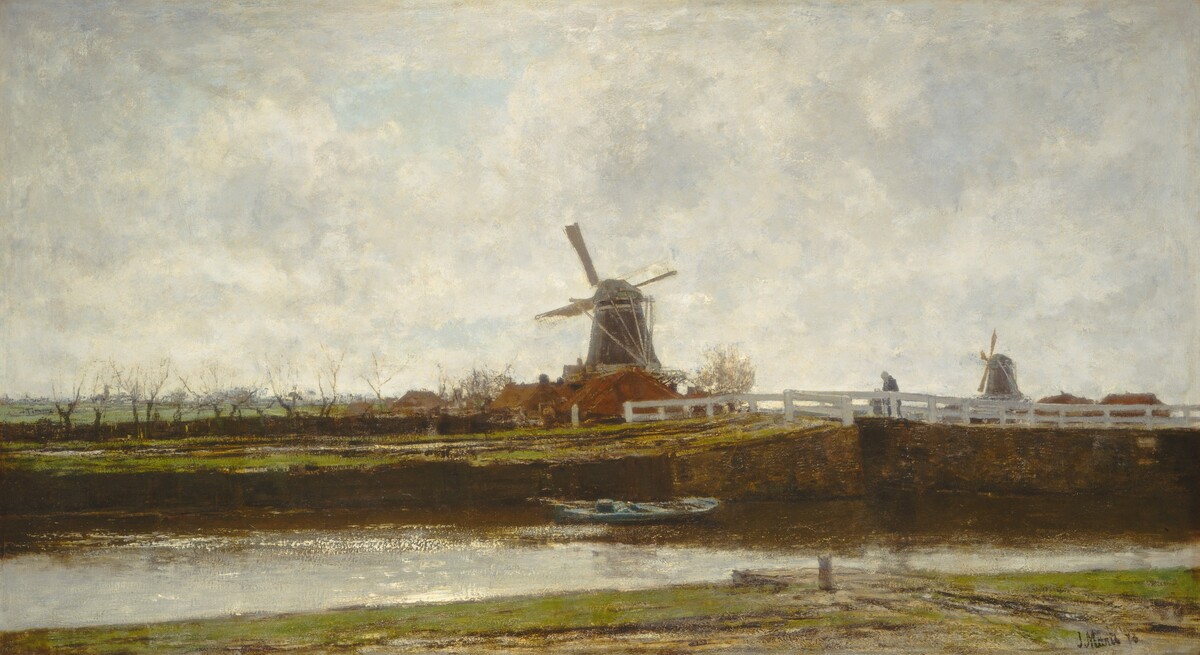
Jacob Maris (1837-1899) was a Dutch painter known as the most important member of the Maris family of painters and the leading figure of the Hague School, whose atmospheric landscapes and city views make him one of the most important Dutch painters of the late 19th century. View of the Mill and Bridge on the Noordwest Buitensingel in The Hague from 1873 depicts a Dutch city view in the atmospheric, tonal manner that distinguishes Maris's best work from the more colorful painting of his contemporaries. The 1873 date places this in Maris's most productive period, when he was producing the atmospheric, tonal city views that are his most accomplished works.
Cultural Impact
View of the Mill and Bridge is important in the history of Dutch painting because it demonstrates the atmospheric, tonal manner that Maris brought to Dutch city views as the leading figure of the Hague School. Maris's atmospheric city views—combining tonal harmony with the atmospheric effect of the Dutch landscape—represent the most accomplished tradition of Dutch landscape painting in the late 19th century, and the 1873 painting shows this tradition at its most atmospheric.
Why It Matters
View of the Mill and Bridge is Maris's atmospheric Hague School: a Dutch city view rendered in the tonal manner of the leading figure of the most important Dutch landscape tradition of the late 19th century. The 1873 painting shows the atmospheric, tonal city views that are Maris's most accomplished works.
![Saint Bernard and Saint Catherine of Alexandria with the Virgin of the Annunciation [right panel]](https://api.nga.gov/iiif/e6890364-4d99-4684-a62b-5060ee3c3446/full/400,/0/default.jpg)